


Views: 0 Author: Site Editor Publish Time: 2026-09-27 Origin: Site


Professional automotive environments face a persistent challenge with traditional linear lighting. Standard fluorescent or LED tubes create harsh, directional shadows across the workspace. These shadows obscure the lower third of vehicles and hide complex body panels. Technicians constantly struggle to see rocker panels, lower doors, and intricate bumper curves clearly. Relying on single-source overhead lighting forces operators to contort their bodies or depend heavily on handheld inspection lamps.
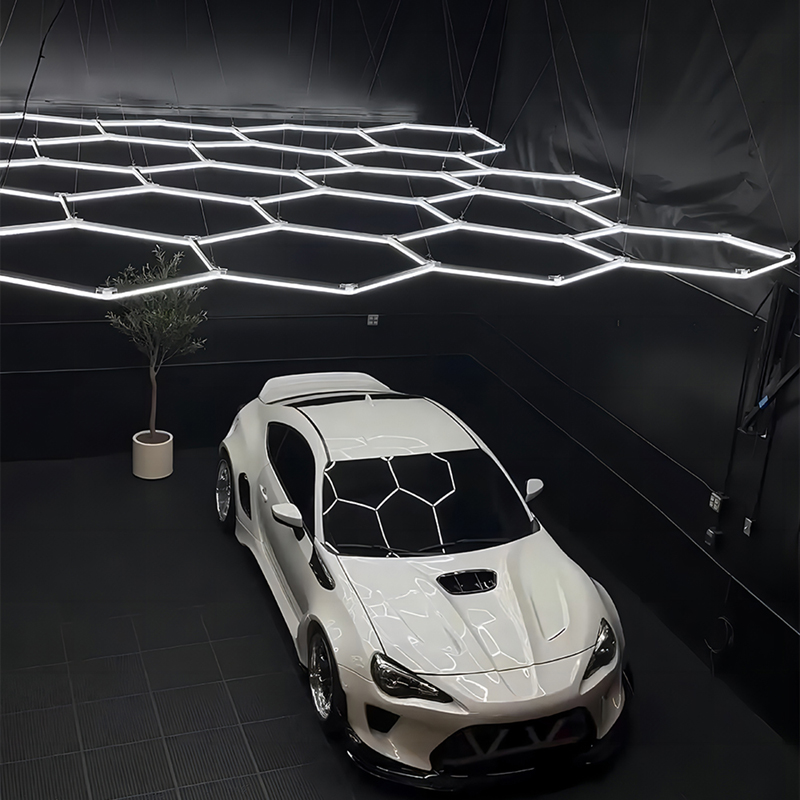
Unseen shadows lead directly to severe quality control issues. Detailers miss fine swirl marks during the compounding stage. Ceramic coatings level unevenly when operators cannot see flashing solvents in dark corners. Orange peel remains completely undetected until the vehicle rolls outside into natural sunlight. Upgrading to a hexagonal light grid offers a distinct geometric advantage. The honeycomb pattern shifts the environment from single-source linear fixtures to multi-directional illumination, wrapping the vehicle in continuous light.
Standard linear lights emit illumination on a single, downward plane. When a vehicle sits directly under a linear tube, the broad surface of the roof blocks the light path. This physical obstruction casts a hard shadow down the sides of the vehicle. Technicians working on fenders or doors must constantly battle these dark patches. Adding more linear tubes rarely solves the problem. It simply creates multiple overlapping shadows with harsh cutoff lines that confuse the eye during detailed polishing work.
A hexagonal structure operates on entirely different physical principles. It pushes light from 360 degrees through intersecting nodes. Every point on the vehicle receives light from multiple angles simultaneously. The honeycomb structure covers massive surface areas evenly. Light hits the vehicle from the front, back, and sides all at once. This multi-directional dispersion effectively neutralizes the dark patches inherent to standard linear setups. When you polish a widebody vehicle or a truck with aggressive fender flares, the intersecting beams ensure no panel blocks the light intended for the panel directly below it.
Vertical panels present the hardest challenge in automotive lighting. Rocker panels, lower doors, and quarter panels naturally angle away from overhead fixtures. The honeycomb pattern forces light beams to overlap continuously across the workspace. This overlapping effect acts as a massive diffuser. It softens harsh lines and pushes illumination deep into the lower half of the vehicle.
Technicians no longer need to rely solely on portable floor lamps to see the bottom edge of a door. The intersecting angles of the grid cast light inward toward the vehicle sides. Shadow elimination happens because the light source is wider than the object it illuminates. The geometric spread ensures that even aggressive vehicle curves do not create blind spots for the operator.
Common shadow zones eliminated by multi-directional grids include:
Automotive clear coats act as highly reflective mirrors. Technicians use these reflections to map the curvature of the vehicle visually. Continuous geometric reflections reveal surface irregularities instantly. A perfectly straight reflection line bends when it crosses a dent, high spot, or patch of orange peel. The hexagonal shape provides a uniform, repeating pattern that makes these distortions obvious to the naked eye.
Grid density dictates this process. The individual hexagons must be sized correctly relative to the vehicle. If the geometric pattern is too sparse, the continuous reflection breaks across the clear coat. Large gaps between light nodes create dead zones on the paint. A dense, tightly structured grid maintains a constant visual reference point. This allows operators to track their polishing progress seamlessly across complex aerodynamic shapes without losing the reflection line.
| Grid Density Level | Reflection Quality on Clear Coat | Defect Detection Capability |
|---|---|---|
| Low (Large gaps between nodes) | Broken, inconsistent lines | Poor. Misses small dents and high spots. |
| Medium (Standard commercial spacing) | Continuous lines on flat panels | Good. Identifies orange peel and leveling issues. |
| High (Tight honeycomb pattern) | Unbroken geometric mapping | Excellent. Highlights micro-curves and subtle warping. |
Basic brightness does not equal visual clarity. The Color Rendering Index (CRI) measures how accurately a light source reveals true colors compared to natural sunlight. A CRI rating of 90 or higher is absolutely non-negotiable for professional surface work. High CRI ensures that red paint looks truly red, rather than a washed-out orange. It allows technicians to see subtle color shifts, metallic flake pops, and pearl transitions.
Low CRI ratings actively hide paint defects. Poor color rendering washes out the contrast needed to spot micro-marring and fine holograms. Even with perfect shadow elimination, a low-CRI fixture renders the workspace useless for high-end paint correction. Upgrading to high-CRI hexagonal LED lights guarantees that the illuminated surface reflects reality accurately. You cannot correct a defect you cannot see, and color accuracy is the foundation of visibility.
Detailing bays require significant light volume. A standard benchmark targets 75 to 100 foot-candles at the vehicle surface. However, raw lumen output introduces a new problem: surface glare. Staring at highly reflective clear coats under intense LEDs causes severe eye fatigue. Operators cannot maintain focus during multi-hour polishing sessions if the light physically hurts their eyes.
Polycarbonate diffusers solve this glare issue. High-quality diffusers scatter the raw LED beam just enough to soften the harshness without sacrificing intensity. They create a smooth, milky reflection on the paint rather than a blinding pinpoint of light. Evaluating the diffuser material is just as important as checking the lumen specification on the box. Acrylic diffusers tend to yellow and crack over time, whereas polycarbonate maintains its optical clarity and impact resistance.
The physical build of the lighting frame dictates its lifespan. Commercial environments expose fixtures to dust, moisture, and constant vibration from heavy machinery. Cheap, snap-together plastic housings degrade rapidly. Plastic warps under the heat generated by high-output LEDs. This warping causes the grid to sag, ruining the perfect geometric reflection on the vehicle below.
Commercial-grade aluminum or reinforced polymer frames provide necessary rigidity. Aluminum acts as a natural heat sink. It pulls thermal energy away from the LED diodes, significantly extending their operational life. A rigid frame keeps the entire structure perfectly level. This structural integrity ensures the lighting pattern remains uniform year after year, regardless of temperature fluctuations in the shop.
Many operators consider building custom grids from raw LED strips to fit unique spaces. This DIY approach carries significant operational risks. Custom setups often suffer from inconsistent node spacing. Even a half-inch variance in the grid pattern creates a noticeable break in the paint reflection. DIY wiring also introduces potential fire hazards if not managed perfectly by a licensed professional.
Pre-built commercial kits eliminate these variables. Off-the-shelf systems feature engineered connectors that lock the geometry into place. They ensure uniform light distribution and structural safety out of the box. Commercial kits guarantee that the angles remain exactly at 120 degrees, maintaining the precise honeycomb shape required for optimal shadow reduction.
A lighting grid must be sized specifically for the vehicles being serviced. Matching the exact dimensions of a car is a major installation error. If the grid stops at the edge of the vehicle, light only travels straight down. This completely misses the doors and rocker panels. The entire purpose of a multi-directional setup is defeated by undersizing the footprint.
Mathematical guidelines dictate that the grid should extend 2 to 3 feet beyond the perimeter of the largest vehicle serviced. This overhang is the functional zone. Light drops from the overhang and angles inward toward the side panels. Properly sized honeycomb LED lights ensure the lower third of the vehicle receives the same intensity as the roof and hood. For a standard full-size truck measuring 20 feet in length, the lighting grid should measure at least 24 to 26 feet long to provide adequate wrap-around illumination.
Installation crews frequently center the grid directly over the middle of the bay. This instinctual placement creates immediate shadow problems. When a grid is perfectly centered over a vehicle, the dense central nodes reflect exclusively off the flat roof. The roof acts as a massive mirror, bouncing light straight back up and casting the sides into shadow.
Strategic offsetting solves this issue. The layout should be positioned so the densest intersections of the grid sit directly above the gap between the vehicle and the wall. Prioritizing side-panel illumination requires pushing the light source outward. Offsetting ensures the intersecting beams hit the vertical surfaces at an optimal 45-degree angle. You want the light to hit the side of the car, not just bounce off the top.
| Bay Width | Vehicle Width (Avg) | Recommended Grid Width | Optimal Wall Offset |
|---|---|---|---|
| 12 Feet | 6.5 Feet | 10 Feet | 1 Foot from wall |
| 14 Feet | 6.5 Feet | 12 Feet | 1.5 Feet from wall |
| 16 Feet | 6.5 Feet | 14 Feet | 2 Feet from wall |
Hexagonal setups provide the ultimate ambient and inspection base. They eliminate shadows and highlight broad surface textures like orange peel. However, they have distinct limitations. Ambient light, no matter how bright, cannot reveal deep, isolated scratches or fine holograms effectively. Diffused light washes out the sharp edges of micro-scratches, making them invisible during the final polishing stages.
True defect correction requires directional spot lighting. Operators must integrate high-intensity inspection spotlights into the workflow. Advanced commercial systems now feature spot modules integrated directly into the hex grid connectors. This hybrid approach combines shadow-free ambient visibility with the harsh, directional beams needed to identify and correct deep clear coat defects. You use the grid to level the surface and the spotlight to perfect the finish.
Running large, multi-node lighting grids requires serious electrical planning. While individual LEDs are highly efficient, a massive commercial grid draws significant total amperage. Plugging a massive array into a standard wall outlet often results in tripped breakers and melted wiring. Dedicated circuits are an absolute necessity for safe operation. A standard 15-amp circuit can quickly become overloaded if multiple polishers, extractors, and a massive lighting grid run simultaneously.
Electrical compliance cannot be ignored. Commercial insurance policies require all permanent fixtures to carry proper safety certifications. Look for UL or CE marks on every component, from the power supply to the individual connectors. Failing to verify these certifications exposes the business to massive liability in the event of an electrical fire. Always consult a licensed electrician to calculate the exact load requirements before installation.
Ceiling height dramatically impacts light dispersion. The optimal distance from the floor to the light face ranges between 9 and 11 feet. At this height, the light wraps the vehicle perfectly while maintaining intense surface brightness. If the ceiling is too low, the light becomes blinding, fails to spread outward, and creates a claustrophobic working environment.
Facilities with ceilings exceeding 12 feet face a different challenge. High mounting causes the light to scatter too widely before reaching the vehicle. Surface intensity drops drastically, rendering the grid ineffective for detailed inspection. In these environments, drop-down cable mounting is required. Suspending the grid on aircraft cables brings the light source back into the optimal 9-to-11-foot range, ensuring the reflection pattern remains dense and usable.
Lighting systems in harsh shop environments eventually require maintenance. Diodes fail, and power supplies burn out. Evaluating the modularity of the system prior to installation prevents massive future headaches. Hardwired, continuous strip systems force operators to replace entire sections if a single diode fails, shutting down the bay for hours.
Buyers must select highly modular systems. Individual LED tubes and corner connectors should be independently replaceable. If a single node fails, the technician simply unplugs that specific tube and snaps in a replacement. This modularity guarantees long-term scalability and keeps the bay operational without requiring complete system teardowns. You want a system that allows for a five-minute repair, not a five-hour reconstruction.
Transitioning to a geometric grid requires a higher initial investment than hanging standard shop lights. However, the operational efficiency gained far outweighs the upfront capital. Traditional setups force technicians to constantly move tripod lights around the vehicle. This repetitive adjustment wastes hours of labor every week. Every time a technician stops polishing to adjust a light stand, productivity drops.
A shadow-free environment eliminates this wasted movement. Technicians work faster when visibility is uniform across the entire bay. Faster inspection times lead to quicker vehicle turnarounds. Furthermore, reducing unseen shadows drastically lowers the rate of rework. Doing the job right the first time improves shop throughput and maximizes long-term operational efficiency. You stop paying technicians to fix mistakes they couldn't see the first time.
While function drives the purchase, the marketing value cannot be ignored. The visual impact of a glowing geometric grid is undeniable. It transforms a standard garage into a high-end automotive laboratory. This futuristic appearance builds immediate customer trust when they walk through the door. Clients feel confident leaving their expensive vehicles in a facility that looks state-of-the-art.
Customers associate premium lighting with premium service. The aesthetic appeal of modern car detailing lights elevates the perceived value of the work being rendered. High-quality shop photos taken under these grids perform exceptionally well on social media. This visual branding acts as a continuous marketing tool, driving new client acquisition based on facility presentation alone. The lights effectively pay for themselves through increased booking rates and higher service tier sales.
A hexagonal light grid is a highly functional tool engineered to solve specific visibility problems in automotive environments. By utilizing intersecting light angles and continuous geometric reflection, these systems eliminate harsh shadows and illuminate vertical panels. They provide the clear, uniform visibility required to execute flawless paint correction and coating applications.
When selecting a system, strict shortlisting logic applies. Filter potential purchases first by CRI ratings and electrical safety certifications. Second, evaluate the modularity of the components and the density of the grid pattern. Finally, consider the aesthetic design and frame materials to ensure long-term durability.
Take the following steps to begin your facility upgrade:
A: Yes. They provide the necessary shadow-free ambient light to see the entire panel clearly. This broad illumination makes it easy to identify orange peel, high spots, and uneven coatings. However, they must be paired with directional inspection spotlights to effectively spot micro-scratches and fine holograms.
A: If the geometric pattern is too sparse, the continuous reflection on the vehicle's clear coat breaks. Large gaps between the light nodes create dark zones on the paint. This reduces the setup's ability to highlight curves and makes spotting surface defects much more difficult.
A: The optimal range is 9 to 11 feet from the floor. This height perfectly balances wide light dispersion with adequate surface intensity. If your ceiling is higher than 12 feet, use drop-down cables to suspend the grid within this optimal working range.
A: While the physical assembly of commercial kits is often plug-and-play using modular connectors, the electrical work is different. Hardwiring the system to the mains should always be performed by a certified electrician to ensure proper load balancing, safety, and commercial insurance compliance.
A: A standard benchmark targets 75 to 100 foot-candles at the vehicle surface. The exact lumen output required depends on the size of your grid and ceiling height. Always prioritize diffused lumens over raw brightness to prevent severe eye fatigue during long working sessions.
A: No. They utilize highly efficient LED technology. While a large grid covers more area than a few old fluorescent fixtures, the overall power draw is often comparable or lower. They provide significantly more useable light per watt consumed than traditional linear shop lighting.


