


Views: 0 Author: Site Editor Publish Time: 2026-10-21 Origin: Site


Picture this familiar scenario. You just spent eight hours meticulously compounding a client's black vehicle. Under the warm glow of your shop bulbs, the clear coat looks like a flawless pool of ink. You confidently pull the vehicle outside into the harsh afternoon sun for a final wipe-down. Suddenly, a frustrating web of hidden swirl marks and buffer trails appears. Having a bright workspace simply is not enough. The actual quality, spectrum, and color of the illumination dictate exactly what the human eye perceives on a delicate clear coat.
Investing in a professional detailing light tunnel is a transformative upgrade for any shop owner. However, choosing the wrong color temperature renders the most expensive setup completely ineffective. This guide breaks down the science of lighting spectrums. We will explore the ideal Kelvin range for intricate paint correction and provide actionable engineering insights to help you build the perfect inspection environment.
The Sweet Spot: The ideal spectrum for professional paint inspection ranges tightly between 5000K and 6500K. This range accurately mimics natural daylight.
Daylight is King: A 5000K rating provides a crisp, neutral white baseline. It is perfect for precise color matching and general interior work without causing severe eye fatigue.
Defect Spotting: Pushing into cooler temperatures like 6000K creates a stark contrast. This is highly effective for highlighting micro-scratches and wash marring.
CRI Matters Just as Much: Color temperature must always pair with a High Color Rendering Index. A CRI of 90 or above accurately reflects the true color of the vehicle paint.
Avoid the Extremes: Fixtures dipping below 4000K actively mask defects. Conversely, those soaring above 7000K distort paint hues and trigger debilitating headaches.
Color temperature is a standardized way to describe the light appearance provided by a bulb. Engineers measure this in degrees Kelvin. Rather than measuring physical heat, this scale measures visual warmth or coolness. At the lower end of the spectrum near 3000K, the output produces a cozy, yellowish glow. As you move toward the middle numbers around 5000K, the glow transitions into a pure, neutral white. Pushing higher up the scale results in the icy, bluish-white appearance often seen in modern vehicle headlights.
Lighting creates a powerful optical illusion on reflective surfaces. Warm, yellowish lighting acts almost like a soft-focus camera filter. It naturally blends micro-scratches into the surrounding paint. This is precisely why a surface can look utterly flawless indoors but terrible outdoors. A proper inspection setup must ruthlessly reveal the ugly truth of the paint condition. If your overhead fixtures mask the defects, you are essentially correcting the paint blindfolded.
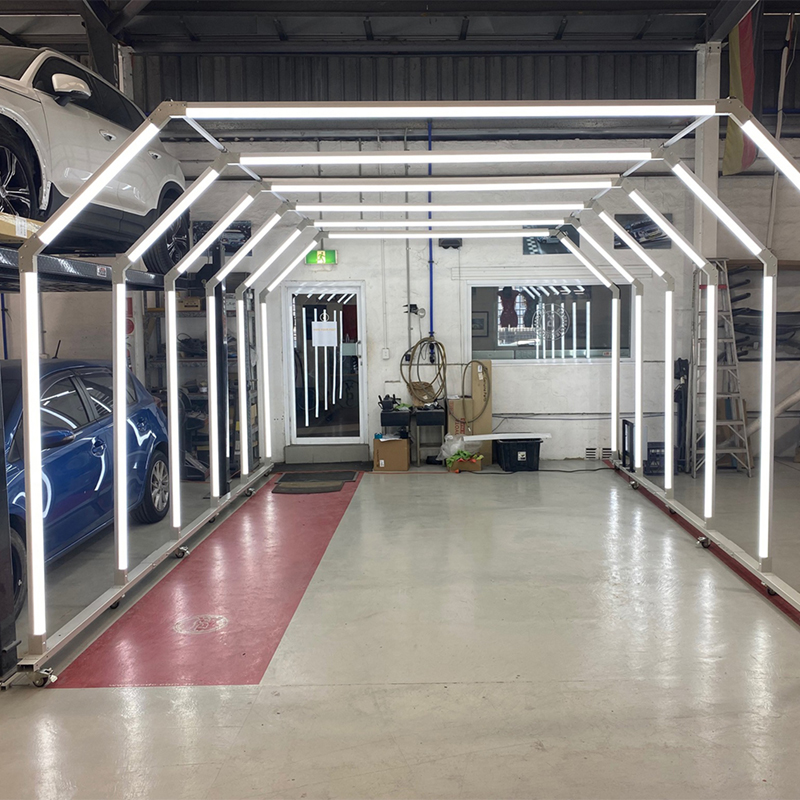
For a standard detailing bay, 5000K remains the undisputed industry standard. This specific rating perfectly mimics midday sunlight on a clear day. It provides an incredibly neutral baseline for technicians. Specifically, it allows detailers to perform accurate color matching for touch-ups and assess interior stains without color distortion. More importantly, technicians can work long eight-hour shifts without the harsh glare that causes eye strain. If you are building a versatile bay that handles everything from basic washes to deep interior extractions, 5000K is your most reliable workhorse.
When the job shifts to heavy paint correction, many veteran detailers prefer to switch to a slightly cooler spectrum. The stark, icy white output found between 6000K and 6500K creates extreme contrast on the clear coat. This intense contrast causes micro-marring and leftover polish residue to pop out instantly against the dark background of the paint. It is an unforgiving spectrum. That is exactly what you want when chasing perfection.
Kelvin Range | Visual Appearance | Best Application | Eye Fatigue Level |
|---|---|---|---|
4000K - 4500K | Warm White | Final Delivery / Showroom Display | Very Low |
5000K - 5500K | Pure Daylight | General Detailing / Color Matching | Low |
6000K - 6500K | Icy Cool White | Heavy Paint Correction / Spotting Swirls | Moderate to High |
A common pitfall is focusing entirely on the Kelvin rating while ignoring how that light interacts with physical pigments. Color Temperature dictates how the light source itself looks. In contrast, the Color Rendering Index dictates how accurately that light reveals the true color of the object beneath it. Manufacturers measure CRI on a scale up to 100, with 100 representing flawless natural sunlight.
Imagine purchasing a cheap 5000K garage light from a big-box hardware store. While it might look white to your eyes, a low CRI rating means it is missing crucial color frequencies. Under this low-quality fixture, a vibrant Ferrari red might look dull or slightly orange. To ensure flawless color matching and accurate paint assessment, professional buyers must always seek out fixtures with a CRI of 85 or higher. A CRI of 90 remains the gold standard for high-end automotive work.
The compounding and polishing phase requires intense, highly focused illumination. The ideal setup operates between 5000K and 6500K. You need that sharp, directional beam to cut through the polish residue. Detailers often rely on localized inspection beams in this spectrum to check their work panel by panel.
Applying a ceramic coating is a race against time and chemistry. As the coating flashes, it creates a subtle rainbow effect on the surface. Spotting high spots requires incredibly even, bright, and neutral lighting. A strict 5000K environment is best here. Cooler lights can wash out the subtle rainbow hues of a flashing coating. This makes high spots harder to detect until the coating cures.
In contrast to the clinical lighting needed for correction, final presentation requires a different approach. High-end exotic car shops often utilize a slightly warmer spectrum in their delivery bays. This subtly warmer glow makes glossy, freshly coated paint look incredibly deep and inviting. It creates the perfect ambiance for customer handover photos.
Recent market shifts reveal a massive transition toward ergonomic and tunable lighting environments in high-end automotive care. Rather than being locked into a single spectrum, modern detailing facilities are investing in smart, adjustable LED systems. These advanced controllers allow technicians to seamlessly transition from a 4000K warm tone up to a piercing 6500K beam. This adaptability reduces blinding glare on bright white cars while aggressively highlighting deep scratches on jet-black paint. The industry now recognizes that illumination is a dynamic instrument. It must adapt to the specific metallic flake of the vehicle while prioritizing the long-term optical health of the detailer.
Relying on traditional residential bulbs or old-school warm shop fixtures is a recipe for disaster in paint correction. Anything below 4000K introduces too much yellow into the reflection. This acts as a visual filler, hiding swirl marks and creating a false sense of achievement. You might think the panel is flawless, only to be disappointed outside.
On the opposite end of the spectrum, some shop owners mistakenly buy cheap LED strips that push 7000K or higher. They wrongly assume brighter is always better. These ultra-cool lights heavily distort the vehicle true color. Furthermore, heavy exposure to this concentrated blue light spectrum causes severe visual fatigue for technicians working long shifts.
While color is critical, output volume and build quality matter just as much. A professional detailing bay typically requires between 70 to 100 lumens per square foot of workspace. High-quality fixtures, like the advanced PC tubes found in premium hexagonal grid systems, deliver massive lumen output with highly efficient wattage. Calculating the total square footage of your bay and matching it to the total lumen output is a necessary mathematical step in shop design.
Staring at a raw, exposed LED diode is blinding and counterproductive. A premium setup utilizes milky polycarbonate diffusers. These covers spread the harsh light evenly and reduce eye fatigue. More importantly, they create a clean, crisp light line on the car body. Observing how this straight line bends across the panels is exactly how experienced detailers spot minor dents and clear coat texture.
If your inspection area also doubles as a prep wash bay, moisture resistance is non-negotiable. A standard indoor fixture will quickly short out in this environment. You must ensure your car wash light carries a strict IP54 or IP65 waterproof rating. This guarantees the internal drivers are completely sealed against high-pressure water spray and heavy chemical humidity.
A common mistake is placing all fixtures directly overhead. Overhead illumination is fantastic for the hood and roof, but it leaves the lower half of the vehicle in dark shadows. To truly master a vehicle finish, you must install vertical wall fixtures or utilize low-angle portable stands. Illuminating doors and complex bumper curves from a horizontal angle with a dedicated LED tunnel light is the secret to a fully corrected car. Ensure all bulbs match in color temperature to maintain a consistent visual baseline.
Ultimately, the success of any high-level detailing job relies heavily on what the technician can actually see. You cannot fix a defect that remains hidden in the shadows or masked by yellow light. An overhead setup operating in the sweet spot between 5000K and 6500K, backed by a high Color Rendering Index, is the ultimate diagnostic tool for achieving flawless paint. Stop chasing ghost holograms in the sun. Upgrade your workspace with professional-grade illumination. We highly recommend exploring the meticulously engineered lighting solutions at Contation LED. Their advanced systems deliver the precise color temperature, high CRI, and durable waterproof ratings required for flawless automotive detailing. Evaluate your current setup and invest in fixtures that let your hard work truly shine.
For strictly hunting down defects like swirl marks and dual-action holograms, a cooler color temperature between 6000K and 6500K is highly effective. This specific spectrum creates a very sharp, high-contrast reflection on the clear coat. It makes the edges of microscopic scratches stand out vividly against the surrounding paint.
While standard warehouse fixtures provide adequate brightness, they almost always lack a high Color Rendering Index. They frequently push the wrong color temperature, often leaning too warm or aggressively blue. Professional automotive correction requires fixtures specifically engineered to mimic daylight with a CRI of 90 or higher to ensure accurate color representation.
It certainly can be if it is used without a proper frosted diffuser. Prolonged exposure to 6000K and above can cause significant eye fatigue and headaches over an eight-hour shift. This is exactly why many professionals prefer a neutral 5000K for general shop illumination, reserving the harsher 6000K beams specifically for localized inspection tasks.
A fixture designed for a wash bay heavily prioritizes waterproofing, such as an IP65 rating, and broad illumination to ensure the vehicle is thoroughly cleaned. Conversely, an inspection tunnel prioritizes specific, dialed-in color temperatures, exceptional CRI ratings, and specialized anti-glare diffusers engineered for meticulous paint compounding.
Yes, to a certain extent. Brightly colored vehicles, such as stark white or metallic silver, reflect an overwhelming amount of cool light. This causes a blinding glare that actually makes it harder to see defects. For these lighter colors, a neutral 4500K to 5000K often works much better. Darker vehicles absorb more light and benefit greatly from cooler 6000K beams.
A typical professional hexagon grid setup varies based on the number of grids. However, high-quality panels operate efficiently to deliver massive lumen output without overloading shop circuits. Calculating the total wattage per panel ensures safe electrical planning and prevents tripped breakers during heavy machinery use.
This happens when your indoor lighting lacks the correct color temperature or sufficient CRI. Low-quality bulbs fail to properly illuminate the subtle chemical flashing process. Upgrading to a pure 5000K daylight fixture ensures high spots are clearly visible before the coating fully cures.


