


Views: 0 Author: Site Editor Publish Time: 2026-10-14 Origin: Site


Transforming a standard parking bay into a high-end detailing studio requires more than just a fresh coat of paint. The rising popularity of honeycomb-style illumination has completely revolutionized automotive spaces. Enthusiasts frequently mount these fixtures on vertical surfaces rather than traditional ceilings. This creative approach often creates a frustrating roadblock. Figuring out exactly how many panels are needed for a seamless wall installation feels like a complex geometry problem.
This comprehensive guide breaks down the math, standard dimensions, and strategic layout planning required for your project. By understanding these core principles, you can confidently purchase the correct amount of fixtures. A hexagon light system offers incredible versatility for both cozy single-bay setups and massive commercial warehouses.
Recent market analyses highlight a massive shift in vehicle storage utilization. Upgraded property trends indicate garages are rapidly transitioning from dusty storage units into multi-purpose lifestyle spaces. This evolution sparks a massive surge in demand for lighting solutions blending high lumen output with striking architectural aesthetics. Consumers no longer settle for utilitarian overhead bulbs. They seek customizable geometric configurations acting as both a functional light source and a bold design statement. This shift underscores the importance of precisely calculating wall space to achieve a coveted custom-built studio look.
Key Takeaways:
A typical two-car bay comfortably accommodates five to eight standard-sized geometric grids horizontally. This depends heavily on your preferred spacing and border design.
Opting for a modular approach provides immense flexibility. You are never restricted to edge-to-edge coverage.
Pre-packaged bundles usually offer better cost-efficiency and simplify the math compared to purchasing individual tubes.
Always leave at least one to two feet of clearance from the floor, ceiling, and adjacent corners. This breathing room is crucial for routing wires and hiding power supplies.
Establishing the baseline measurements of your specific environment is the critical first step. Most residential parking structures follow relatively predictable sizing conventions. A standard one-car layout typically features a width between 12 and 16 feet. Expanding into a two-car space pushes that width to roughly 20 to 24 feet. Expansive three-car structures often exceed 30 feet in width. Equally important is the ceiling height. This vertical limitation usually hovers between 8 and 10 feet. It directly dictates the maximum number of panels you can safely stack without cramping the room.
Beyond raw architectural dimensions, you must carefully factor in everyday obstacles. Measuring total square footage is entirely different from measuring usable surface area. Windows, entry doors, bulky workbenches, and wall-mounted pegboards significantly reduce the available real estate for a flush garage light installation. Always take your tape measure and map out the uninterrupted drywall space before making any purchasing decisions.
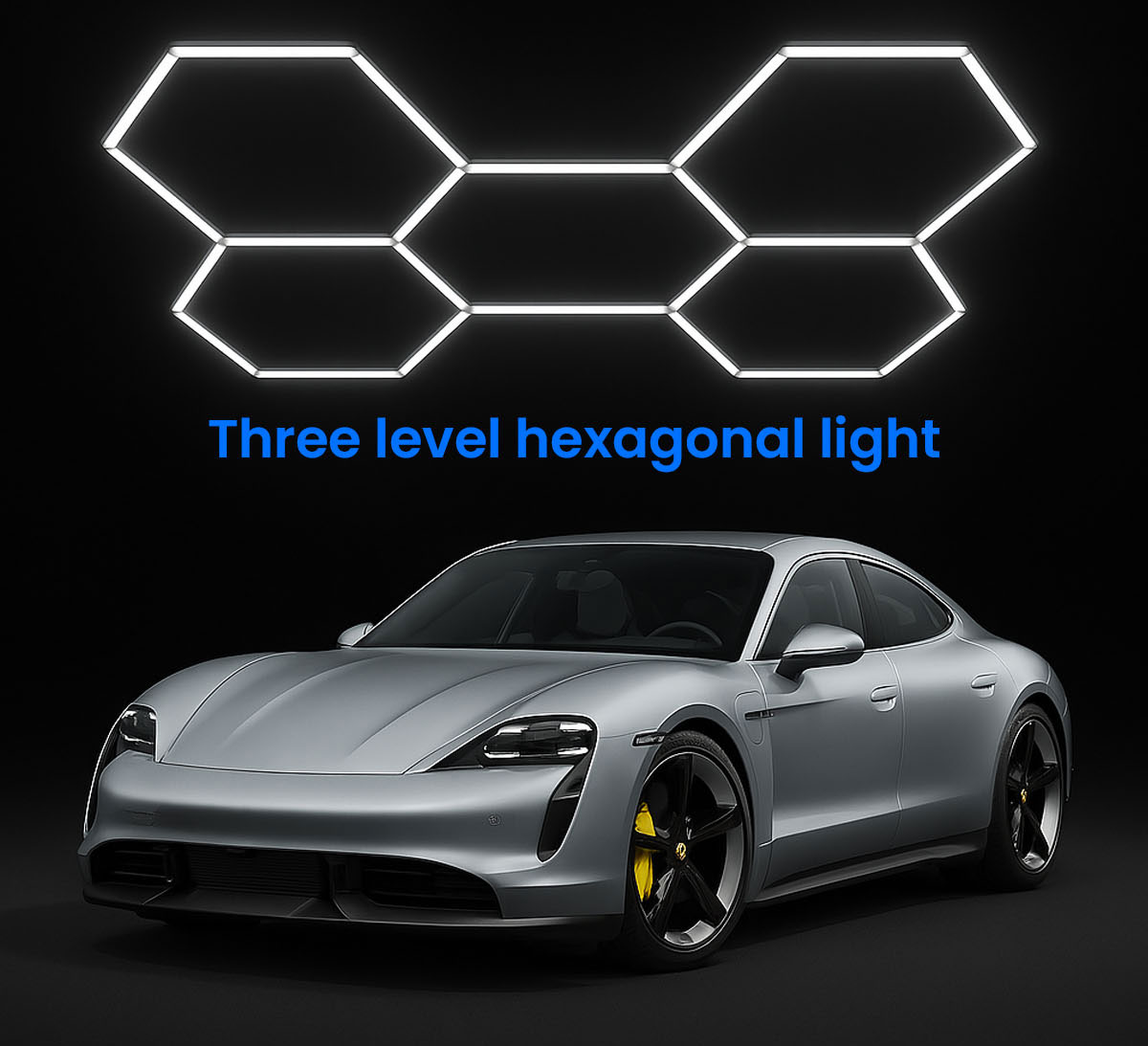
Grasping the exact measurements of the hardware itself is essential for setting up your coverage calculations. While manufacturing tolerances vary slightly across the industry, professional-grade units follow strict standards. For instance, advanced systems feature a robust 168W power draw paired with a crisp 6500K color temperature. These premium units often include a three-stop switch for adjustable brightness. Most standard individual LED tubes measure around 15.5 to 17.5 inches in length. When you snap these pieces together using polycarbonate connectors, a single assembled geometric shape typically spans about 30 to 35 inches across its diameter.
Furthermore, recognizing pre-configured bundle sizes drastically streamlines your planning phase. A highly popular 14-hex grid generally measures roughly 8 feet by 16 feet once fully assembled. Knowing these standard footprints allows you to mentally map out the coverage area. This makes it significantly easier to envision how a large matrix will interact with your existing architecture.
When reaching the purchasing stage, you generally face two distinct paths. You can buy a ready-made bundle or piece together a bespoke system. For the vast majority of commercial and residential applications, investing in a standard bundle is undeniably the safest route. These comprehensive packages eliminate guesswork. They arrive with the precise ratio of tubes, Y-connectors, 120-degree elbows, and power supplies needed.
In contrast, building a fully custom modular hexagonal light setup is ideal when tackling irregular architecture. Dodging a protruding electrical panel or forming a specific brand logo makes a bespoke approach mandatory. While this requires meticulous planning, the tailored aesthetic is unmatched.
To simplify your decision, review this direct comparison between standard and custom approaches:
Feature | Pre-Packaged Kits | Custom Configurations |
|---|---|---|
Installation Speed | Fast and straightforward with provided templates. | Time-consuming and requires precise planning. |
Cost Efficiency | Highly economical due to bundled pricing. | Premium cost due to individual part sourcing. |
Design Flexibility | Fixed shapes like 5-hex or 14-hex grids. | Unlimited shapes and architectural wrapping. |
Wiring Complexity | Simplified with pre-calculated power drops. | Requires custom load calculations to prevent overloads. |
Armed with your room dimensions and hardware specs, determining the exact number of required fixtures becomes a straightforward mathematical process. Start by measuring your total usable width and height in inches. Next, subtract the necessary border clearance. Leaving a 12-inch gap on all sides provides a visual framing effect. Specifically, it ensures you have adequate room for cable management. Finally, divide the remaining usable width by the 30 to 35-inch diameter of a single assembled unit.
Let us explore a real-world engineering scenario to illustrate this formula. Imagine an uninterrupted surface measuring 20 feet wide by 9 feet tall. That equals 240 inches by 108 inches. After subtracting a 12-inch border from all sides, your workable area shrinks to 216 inches wide and 84 inches tall. If a single assembled unit is 33 inches wide, dividing 216 by 33 gives you approximately 6.5. This means you can comfortably fit a horizontal row of six full shapes across the space without overcrowding the edges. Vertically, dividing 84 inches by a roughly 28-inch height profile allows for exactly three stacked rows. Consequently, a matrix of 18 total units fits this specific area perfectly.
Designing your matrix is where practical illumination meets creative expression. The edge-to-edge grid is a highly sought-after layout. It is designed to blanket the entire surface in brilliant and shadowless illumination. While this approach maximizes brightness, it is also the most resource-intensive route.
Alternatively, the accent layout utilizes a smaller and concentrated cluster of geometric shapes. Positioning a 5-hex bundle directly behind a parked sports car or a detailing bay creates a stunning focal point. This avoids the premium price tag of full-room coverage. Integrating these vertical arrays with an existing workshop light setup yields phenomenal results. The wall-mounted tubes cast light horizontally. This effectively eliminates harsh shadows typically cast by overhead fixtures. Intricate tasks instantly become easier to manage.
Mounting these intricate arrays on a vertical plane introduces unique practical challenges compared to a standard ceiling drop. The primary decision revolves around your mounting method. Direct-to-drywall installation requires meticulously placing anchors and screws through the tiny mounting holes of the polycarbonate connectors. This demands absolute precision. Many senior installers prefer building a lightweight aluminum frame instead. Assembling the LED matrix onto the frame while it lays flat on the floor saves hours of frustrating ladder work. You simply hoist the entire rigid structure onto the wall.
Wiring and power distribution require equally rigorous planning. Large grids draw significant wattage. They inevitably require multiple power drops. Hiding these cables on a vertical surface is much trickier than tucking them into an attic space. You must plan safe routing paths. Utilizing paintable cable raceways or feeding the wires directly through the drywall into adjoining stud bays maintains a clean and wire-free aesthetic.
It is natural to question whether the investment in a geometric matrix is truly worthwhile. Standard fluorescent tubes are readily available. The value proposition extends far beyond mere aesthetics. A high-quality honeycomb system drastically reduces harsh shadows. It disperses light from multiple intersecting angles. This creates an ultra-bright and uniform lumen output that standard directional bulbs simply cannot replicate.
The modular repairability of these systems is a massive long-term advantage. If a single traditional fixture fails, you often have to replace the entire heavy unit. With a modular matrix, a burnt-out section can be fixed rapidly. You simply pop out the single defective tube and snap in a replacement. This saves both time and money. Combining this practical durability with undeniable visual appeal explains why these systems dominate the market.
Successfully upgrading your space relies heavily on measuring your usable surface area and understanding hardware dimensions. Carefully weigh the convenience of pre-packaged bundles against the freedom of custom setups. A well-planned layout not only enhances visibility but completely redefines the atmosphere of the room. Always take the time to map out your envisioned design using painters tape directly on the drywall before finalizing your order. This simple tactile step guarantees a perfect fit and prevents costly miscalculations. Ready to transform your space with professional-grade illumination featuring 168W power, 6500K daylight brilliance, and adjustable brightness? Browse the extensive collection of geometric lighting bundles at Contation LED. Find the perfect configuration to elevate your garage or commercial workspace today.
Yes. These fixtures function exceptionally well as vertical installations. Mounting them on a vertical plane is an excellent strategy for side illumination. It drastically reduces shadows during meticulous detailing work. It also creates a striking visual backdrop for your vehicle or home gym.
As a general rule of thumb, intricate tasks require approximately 130 to 150 lumens per square foot. Geometric LED grids are engineered to be incredibly bright. They easily meet and often exceed this standard. This ensures you have crystal-clear visibility for any mechanical or detailing project.
No. The individual LED tubes are pre-manufactured to specific unalterable lengths. They feature integrated electrical contacts at both ends. You cannot cut or splice them. If you face space constraints, you must adjust your overall layout configuration. Utilizing fewer panels is the only safe solution.
Most modern systems are designed to daisy-chain a specific number of tubes. This is usually around 15 to 20 tubes per single power cable. For expansive grids, you will absolutely require two or more dedicated power cables. These can be plugged into standard wall outlets or professionally hardwired into your electrical system by a licensed electrician.
Installing them directly on drywall requires patience and precise measurements. Using the provided mounting clips and standard drywall anchors ensures a secure fit. However, many professionals recommend assembling the grid on a lightweight frame first. This method simplifies the mounting process and keeps the entire structure perfectly aligned.
A color temperature of 6500K is widely considered the industry standard for workspaces. This crisp daylight white provides maximum visibility. It reveals paint imperfections during detailing and keeps the environment looking modern and professional without causing eye fatigue.


