


Views: 0 Author: Site Editor Publish Time: 2026-10-20 Origin: Site


Are dark commercial spaces silently draining your property value? Let's face the reality of the field. Subterranean parking structures and industrial loading bays notoriously suffer from cavernous, dimly lit zones. These poorly illuminated areas do more than just look bad. They breed serious daily safety risks, ranging from minor fender benders to severe pedestrian hazards.
Facility managers are scrambling for modern illumination upgrades to fix these liabilities. Geometric grid systems have recently stolen the spotlight. But here is the critical question I hear on every job site: can these trendy, high-end fixtures actually survive the grueling, dirt-filled conditions of heavy-duty environments?
The short answer is absolutely. When sourced correctly, commercial-grade Polygonal Geometric LED Garage Lighting delivers unmatched brightness, rugged safety enhancements, and serious energy efficiency. Let's dive into the exact specs, real-world benefits, and practical deployment strategies you need to make these systems work in demanding industrial spaces.
Commercial Viability is Conditional: Hex grid systems dominate industrial facilities, but only if you spec commercial-grade fixtures. Leave the flimsy plastic consumer kits for residential garages.
Active Shadow Elimination: The multi-directional light output of geometric grids actively kills dark shadows. This is non-negotiable for pedestrian safety and precision forklift maneuvering.
Tangible Aesthetic ROI: Upgrading to geometric lighting instantly transforms depressing concrete bunkers into modern, high-end environments. This directly boosts perceived property value.
Material Specs Matter: For long-term survival, demand high Ingress Protection ratings and heavy-duty extruded aluminum housings for crucial thermal management.
Favorable Operational Expenditure: The upfront capital expenditure is higher than slapping up cheap fluorescent tubes. However, slashing energy bills and practically eliminating maintenance yields a rapid return on investment.
Looking at recent architectural data and facility management trends, there is a massive migration away from legacy high-bay lighting. Commercial logistics and parking sectors are undergoing a visual revolution. Why the sudden shift? It comes down to strict Occupational Safety and Health Administration visibility mandates and a growing demand for experiential commercial design.
Industry analysts note that retrofitting legacy concrete structures with high-lumen geometric LED systems is no longer just a luxury aesthetic choice. It has become a baseline standard for risk mitigation. Spaces adopting these multi-directional lighting grids report drastically fewer workplace accidents. Furthermore, these modernized facilities consistently attract higher-tier corporate tenants who demand premium, secure environments.
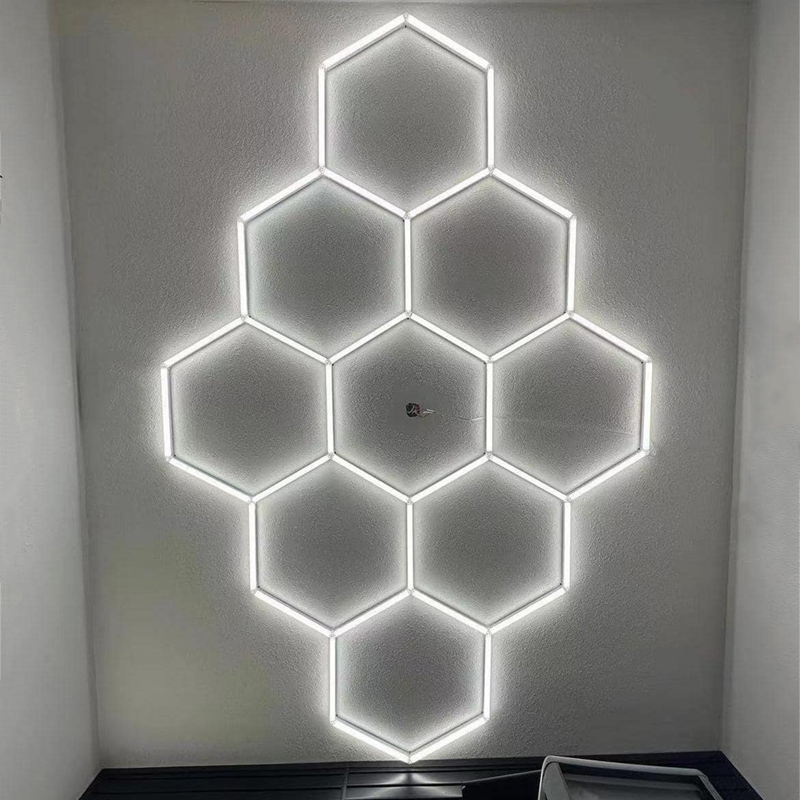
At its core, this lighting refers to a specific configuration of modular LED tubes. These tubes interlock to form a continuous honeycomb or geometric pattern across a ceiling. Traditional single-point high-bay fixtures require tedious individual hardwiring. In contrast, these modern systems utilize an intuitive plug-and-play modular architecture. This clever design allows electrical contractors to construct massive, scalable ceiling structures rapidly. The electrical current routes directly through the locking connectors. Consequently, a massive array covering expansive square footage can be powered by a surprisingly minimal number of electrical leads.
The visual impact of a glowing honeycomb ceiling is undeniably striking. However, the true functional value of Polygonal Geometric LED Garage Lighting lies in its advanced photometric engineering. Standard warehouse lights frequently create a harsh spotlight effect. This results in blinding hotspots directly beneath the bulb and dangerous, shadowy voids between fixtures.
Geometric LED tubes solve this by featuring 120-degree to 180-degree wide beam angles. When arranged in a hexagonal pattern, these wide angles create overlapping pools of light. This scientific principle of multi-source cross-illumination effectively cancels out shadows from multiple directions. It ensures uniform lux levels across the entire concrete floor plan.
Parking structures present a brutal set of infrastructural challenges. These environments typically feature low concrete ceilings. This instantly disqualifies traditional suspended high-bay fixtures that tall vehicles might strike. Parking garages are subjected to a relentless onslaught of vehicle exhaust. This leads to rapid carbon and brake-dust accumulation on light lenses. Security is also paramount. These facilities demand reliable, continuous 24/7 illumination to deter vandalism and prevent vehicle-to-pedestrian collisions. Any lighting system installed here must endure unforgiving operation without suffering from severe lumen depreciation.
Loading bays operate as the high-stress arteries of commercial logistics. Forklift operators frequently squint to read faded barcodes while maneuvering heavy pallets in fast-paced zones. Because loading docks are constantly exposed to the outdoors via massive bay doors, lighting fixtures face severe weather elements. They must withstand high humidity, freezing winter drafts, and wind-blown debris. Workers in these zones require absolute visual precision. They need to inspect cargo and operate heavy machinery safely without the distraction of flickering bulbs or dark corners.
Stress Factor | Parking Garages | Loading Docks | Lighting Requirement |
|---|---|---|---|
Air Quality | High exhaust and carbon dust | Dust, pollen, outdoor debris | Sealed polycarbonate covers |
Temperature | Moderate fluctuations | Extreme cold and heat exposure | Industrial LED drivers |
Clearance | Low ceilings with strike risks | High ceilings that are hard to reach | Low-profile or suspended mounting |
Operation | 24/7 continuous use | Shift-based or 24/7 use | High thermal dissipation via Aluminum |
The objective answer is a resounding yes, but with a critical caveat. Manufacturing quality dictates survivability. The market is currently flooded with cheap, white-label lighting kits designed strictly for residential weekend hobbyists. I have seen these consumer-grade units fail time and time again. They utilize thin plastic housings and low-tier LED chips that rapidly melt or burn out under the thermal stress of a commercial facility.
Conversely, true commercial-grade hexagonal lighting is engineered specifically for the trenches of industrial application. These premium systems feature reinforced locking connectors and integrated sealing gaskets for moisture resistance. Most importantly, they utilize extruded aluminum backings. These heavy-duty heat sinks ensure long-term diode survival even under 24/7 operation.
Empirical evidence demonstrates that high-lumen geometric lights are already thriving in rigorous environments. High-end commercial car washes currently utilize IP65-rated hex grids. These fixtures withstand constant power-washer spray and harsh chemical exposure while providing detail-level illumination. Modern logistics centers are adopting suspended geometric grids directly above quality-control inspection stations. This eliminates shadows during critical cargo checks. Similarly, luxury subterranean parking structures are leveraging these systems to modernize their spaces and drastically enhance security camera clarity.
In industrial environments, shadows are active safety hazards. The primary operational benefit of a hexagonal grid is its multi-angled light path. Light is cast from six different directions within each modular shape. Physical obstructions like a forklift mast, a structural concrete pillar, or an open delivery van hood do not plunge the surrounding area into darkness. This shadow reduction significantly decreases blind spots for drivers navigating tight corners.
The psychological impact of environmental lighting is well-documented. A parking garage illuminated by a sleek, futuristic geometric grid feels inherently safer and cleaner. It projects a more premium vibe than a damp concrete box lit by buzzing, flickering fluorescent tubes. For property owners, this aesthetic upgrade is a tangible financial asset. A premium visual environment dramatically improves tenant satisfaction. This provides the leverage needed for property managers to command higher parking rates.
When evaluating operational expenditures, commercial LED hex grids offer distinct financial advantages over legacy systems. By delivering significantly more lumens per watt, these geometric systems allow facilities to achieve higher overall brightness. Simultaneously, they slash electrical consumption.
Technology | Average Efficacy | Lifespan | Heat Output |
|---|---|---|---|
Metal Halide | 60 to 90 Lumens per Watt | 10,000 to 15,000 Hours | Very High |
T8 Fluorescent | 70 to 100 Lumens per Watt | 20,000 to 30,000 Hours | Moderate |
Commercial LED Hex Grid | 110 to 130+ Lumens per Watt | 50,000+ Hours | Low due to aluminum sinks |
Commercial ceilings are rarely empty canvases. They are heavily populated with complex HVAC ductwork, fire suppression sprinkler pipes, and thick electrical conduits. The modular nature of hexagonal lighting allows for unparalleled scalability and customization. Facility managers are no longer forced to work around rigid linear constraints. Specifically, the grid can be intentionally designed to weave seamlessly around existing ceiling infrastructure without compromising the overall lighting pattern.
Security remains a primary function of parking garage infrastructure. Traditional low-pressure sodium lights often suffer from dismal Color Rendering Indexes. This washes out colors and renders security footage grainy and monochromatic. Commercial-grade hexagonal lights typically feature a Color Rendering Index of 85 or higher. This high color accuracy ensures that security cameras capture true vehicle paint colors, accurate clothing descriptions, and clear facial features. These are vital details for liability protection and law enforcement investigations.
Assembling and hanging a massive, interconnected grid across thousands of square feet requires precision and alignment. It is undeniably more complex than simply hardwiring a single high-bay fixture. However, this challenge is easily mitigated by hiring professional commercial electricians experienced in modular systems. By utilizing suspended aircraft wire mounting systems, installers can level the grid perfectly. This works flawlessly even if the concrete ceiling above is uneven or intentionally sloped for water drainage.
Procuring commercial-grade hexagonal lighting kits requires a higher initial capital expenditure compared to purchasing bulk standard LED shop lights. To justify this, facility managers must analyze the Total Cost of Ownership. The return on investment is rapidly realized through immediate reductions in monthly energy bills. Furthermore, facilities can often claim local energy efficiency rebates. Add in a drastic reduction in maintenance labor costs, as premium LEDs boast lifespans exceeding 50,000 hours of continuous operation.
A geometric grid naturally introduces a larger physical surface area to the ceiling. This provides more ledges for dust, exhaust particulates, and cobwebs to accumulate over time. To combat this, maintenance protocols should dictate the selection of fixtures with smooth, completely sealed polycarbonate covers. Unlike open-diode strips, these sealed covers can be rapidly and safely cleaned. Maintenance staff can use commercial compressed air dusters or extending microfiber mops without risking damage to the delicate internal electronics.
For commercial loading docks and semi-open parking garages, environmental protection is non-negotiable. An Ingress Protection rating indicates a fixture's resistance to intrusive solids and liquids. Facilities should require a minimum of IP54 for enclosed garages. This ensures the lights are dust-protected and resistant to splashing water. Furthermore, an IP65 rating is absolutely mandatory for loading docks exposed to wind-driven rain, heavy humidity, and morning condensation. This makes the fixtures completely dust-tight and protected against direct water jets.
Thermal management is the single most critical factor in LED longevity. This is especially true in environments operating around the clock. Consumer-grade lights use cheap plastic housings that act as insulators. They trap heat and cause the diodes to burn out prematurely. Commercial-grade fixtures must utilize extruded aluminum bodies. Aluminum acts as a highly efficient heat sink. It actively draws thermal energy away from the LED chips and dissipates it into the surrounding air. When specifying commercial-grade LED garage lighting, always verify the housing material.
To ensure the lighting meets strict commercial safety standards, specific photometric data must be verified prior to procurement. Facility managers should look for system specifications that guarantee an efficacy of greater than 110 lumens per watt. In addition, to support security camera clarity and safe working conditions, the Color Rendering Index must exceed 85.
Commercial building codes and corporate insurance policies mandate strict electrical safety standards. Uncertified lighting systems present severe fire hazards and liability risks. Any geometric lighting system considered for commercial installation must possess recognized safety certifications. Look for UL, ETL, CE, or RoHS compliance. This proves the fixtures have passed rigorous independent safety testing.
Proper implementation begins with precise spatial planning. Facility managers must accurately measure the parking garage or loading dock to determine optimal grid placement. A key operational decision is whether to blanket the entire ceiling in a continuous grid or to strategically zone the lighting. In many commercial applications, it is highly cost-effective and visually impactful to install the geometric patterns directly over high-traffic driving lanes and active loading bays. Standard ambient lighting can then be utilized in deep, low-traffic storage corners.
The architectural reality of the space dictates the mounting method. Standard subterranean parking garages with low concrete ceilings require direct flush mounting. This ensures tall vehicles do not strike the fixtures. In contrast, high-ceiling loading docks or warehouse environments require suspended cable mounting. Suspending the grid on aircraft-grade steel cables lowers the light source to an optimal working height. This maximizes foot-candles on the floor while absorbing minor building vibrations caused by heavy machinery.
Massive lighting grids introduce complex electrical engineering challenges. Voltage drop is the most notable issue. If too many LED tubes are connected in a single series, the lights at the end of the run will appear noticeably dimmer due to power loss. Best practices dictate zoning the lighting grids into manageable sections. Each section must be wired to dedicated commercial drivers and circuits. Integrating these zones with commercial microwave motion sensors can exponentially increase energy savings by dimming the lights during off-peak hours.
When sourcing heavy infrastructure for commercial facilities, the integrity of the supply chain is just as important as the product itself. Purchasing large quantities of lighting through third-party e-commerce resellers carries significant operational risks. You face non-existent commercial warranties, inconsistent color temperatures across different batches, and a severe lack of replacement parts. Partnering directly with a specialized LED manufacturer ensures strict quality control. It guarantees batch consistency and provides direct access to engineering support for complex installations.
Based on the objective specifications required for industrial environments, sourcing from a dedicated manufacturer is highly advised. For facility managers looking to upgrade their spaces, reviewing specialized Polygonal Geometric LED Garage Lighting kits offers a reliable baseline for true commercial-grade quality. Direct manufacturers like Contationled provide the necessary durable aluminum housing, appropriate IP65 ratings, and customizable sizing required for large-scale facility upgrades. By choosing a proven manufacturer, you ensure that the final installation meets both breathtaking aesthetic goals and rigorous commercial safety standards. Visit Contationled today to engineer a custom lighting layout tailored perfectly to your facility's dimensions.
Hexagonal lighting has proven to be far more than a fleeting architectural trend. It is a highly functional, robust commercial solution. By upgrading legacy systems to modern geometric grids, facility managers can effectively eliminate dangerous shadows. This dramatically improves pedestrian and vehicular safety while significantly reducing long-term energy costs.
Furthermore, these fixtures provide a stunning visual upgrade. They transform dark, intimidating concrete spaces into bright, welcoming environments. If you are ready to elevate your commercial property, take the time to measure your facility and verify your required specifications. Consult with a direct manufacturer to deploy a custom lighting system that will serve your heavy-duty operations for years to come.
Yes. Commercial-grade hexagon lights output thousands of lumens and offer a wide 120-degree to 180-degree beam angle. This multi-directional light path effectively eliminates dark shadows and provides daylight-level visibility. This ensures safe forklift operation, accurate inventory scanning, and secure manual labor operations even during night shifts.
High-quality LED lighting performs exceptionally well in cold temperatures. They often operate more efficiently and last longer than in hot environments. However, it is critical to select fixtures with an appropriate rating, such as IP65. This protects the internal diodes and electrical connectors against condensation, freezing moisture, and wind-blown dust typical in semi-open structures.
Maintenance is highly efficient. Most premium commercial systems feature a modular, plug-and-play design utilizing locking pin connectors. If an individual LED tube fails or sustains physical damage from a forklift mast, it can be unclipped and replaced independently in minutes. There is no need to dismantle the entire ceiling grid or disrupt daily operations.
No. Despite their massive luminous output, they utilize highly efficient LED technology. They typically produce over 110 lumens per watt. They draw significantly less power than traditional fluorescent or metal halide commercial fixtures. When paired with smart motion sensors and dimming drivers, they become an incredibly cost-effective solution for continuous facility operation.
Absolutely. While they are frequently flush-mounted to flat concrete ceilings in low-clearance parking structures, they are equally adaptable to high bays. They can be securely suspended using aircraft-grade steel cables. This makes them perfect for the high, uneven, or exposed-beam ceilings commonly found in commercial loading docks and large distribution centers.
The total cost depends entirely on the square footage, ceiling height, and the specific IP rating required for the environment. While the initial capital expenditure for commercial-grade aluminum fixtures is higher than standard LED shop lights, the long-term savings are substantial. Factoring in reduced energy consumption, minimal maintenance, and potential energy rebates, the return on investment is typically realized within the first few years of operation.
Yes, provided you specify dimmable drivers during the procurement process. Many commercial-grade geometric lighting systems can be seamlessly integrated with 0-10V dimming systems, microwave motion sensors, and smart building management systems. This allows facility managers to automate lighting levels based on occupancy and natural daylight availability, further maximizing energy efficiency.


