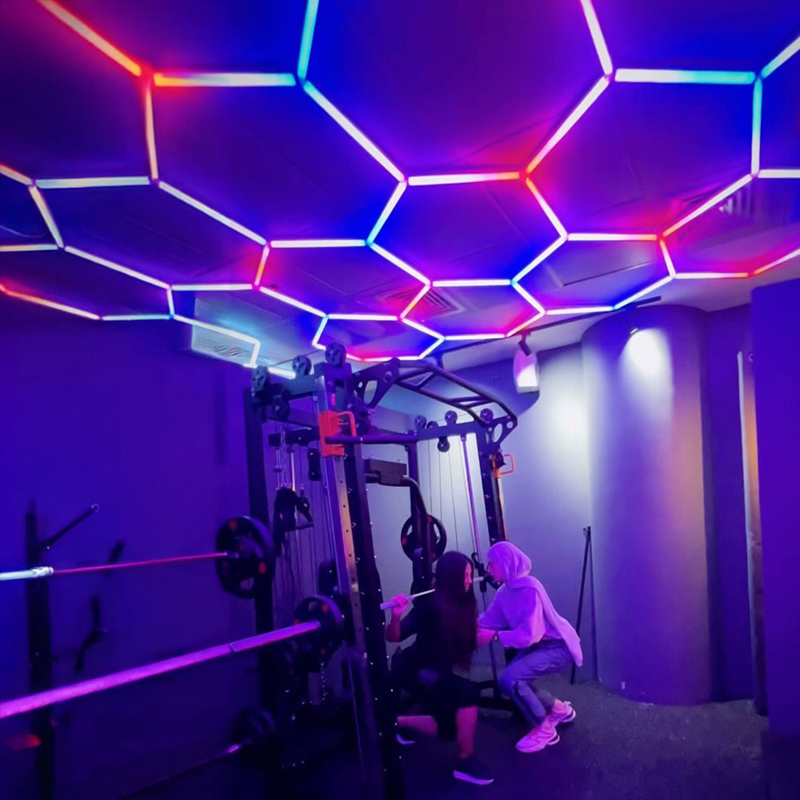
The rising popularity of modular lighting grids in commercial spaces has flooded the market with thousands of overseas suppliers. These geometric setups range from high-end auto detailing shops and modern architectural offices to hardcore commercial gyms. While these fixtures often look identical in heavily edited product photos, budget-tier white-label lights frequently hide dangerous engineering flaws.
Facility managers, electrical contractors, and B2B distributors face incredibly high stakes. Melting connectors and rapid light decay are major pain points. Catastrophic power supply failures can quickly turn a stunning architectural upgrade into a massive liability. In this comprehensive technical guide, we will break down the exact safety, performance, and environmental certifications you must demand from your supplier before executing a wholesale order.
The global push toward energy-efficient commercial infrastructure is fundamentally changing procurement standards. Recent market data indicates a sharp transition away from disposable, unverified lighting toward architectural-grade systems. Modern detailing bays and commercial fitness centers now operate around the clock. This continuous operational load demands industrial-grade reliability. Procurement managers are no longer just looking at aesthetics. They are prioritizing verified safety and long-term lumen maintenance to meet strict Environmental, Social, and Governance mandates. Sourcing a Customizable Hexagon RGB Light Wholesale package now requires a rigorous technical audit of the manufacturer.
Key Takeaways
Safety First: UL, ETL, and CE certifications are non-negotiable requirements. They prevent electrical fires and ensure safe, compliant installation in rigorous commercial settings.
Environmental and Health Compliance: RoHS and FCC certifications guarantee your lighting systems are free from hazardous heavy metals. They also ensure the grids will not cause electromagnetic interference with critical shop equipment.
Durability Matters: Ingress Protection ratings, specifically IP54 or IP65, alongside IK impact ratings, are vital. Commercial garages exposed to heavy dust, moisture, and physical impact require these robust enclosures.
Brand vs White-Label: Certified lighting utilizes fire-retardant polycarbonate materials and guarantees lumen maintenance. Low-cost platform alternatives frequently suffer from rapid light decay and severe thermal management issues.
Wholesale Customization: Procurement teams can safely source customized setups by verifying the manufacturer's ISO 9001 factory credentials. Always request legitimate, third-party laboratory test reports.
Why Certifications Are Crucial for Commercial Hexagon LED Lights
Commercial applications demand far more than weekend DIY projects. Procuring modular lighting in bulk requires strict adherence to global safety standards. This protects both the physical facility and its daily occupants.
The Hidden Dangers of Uncertified Lighting
Picture a professional auto detailing bay running 14 hours a day under intense illumination. In such demanding environments, the market saturation with unbranded lighting systems becomes a genuine hazard. The internal components of these uncertified fixtures routinely lack basic thermal management and fail-safe electrical mechanisms.
Common failure points include power supplies that burn out under continuous commercial loads. Flimsy aluminum connectors melt due to microscopic electrical arcing. Without certified aluminum heat sinks and fire-retardant polycarbonate housings, accumulated heat easily triggers catastrophic hardware failure. Worse, it can cause electrical fires. Inferior LED chips experience rapid light decay. They often lose up to 30 percent of their initial brightness within just a few months of operation.
Liability, Insurance, and Building Codes
Recent industry analyses highlight a rapid professionalization within the automotive detailing and commercial fitness sectors. This drives a massive year-over-year increase in demand for architectural-grade lighting. Businesses are shifting toward smart, sustainable infrastructure. Consequently, procurement managers heavily prioritize verified safety over mere aesthetics.
Installing uncertified fixtures represents a severe legal and financial liability. Commercial insurance policies typically embed strict clauses requiring all newly installed electrical equipment to be listed by a recognized testing laboratory. If an unverified lighting grid sparks property damage, insurance providers possess the legal right to deny the claim entirely. Local municipal building inspectors will demand proof of safety certifications before signing off on commercial renovations. Failing a code inspection due to non-compliant hardware inevitably delays project openings. This results in bleeding revenue and reputational damage for the contractors involved.
The Core Electrical Safety Certifications You Must Demand
To effectively mitigate operational risks, procurement teams must demand documented proof of electrical safety. The following three certifications represent the undisputed global benchmark for lighting reliability.
UL Certification
In North America, the UL listing remains the gold standard for electrical safety. Underwriters Laboratories operates as an independent, globally recognized testing organization. They rigorously evaluate products against extreme safety standards. For LED lighting, standards such as UL 1598 for Luminaires and UL 8750 for LED Equipment are strictly applied.
A UL-certified lighting system has survived extreme stress testing. This encompasses temperature profiling, electrical shock hazard evaluation, and comprehensive fire risk assessments. When a manufacturer invests the substantial capital required for UL certification, it clearly demonstrates a commitment to utilizing premium internal components. These include isolated LED drivers and properly gauged copper wiring.
ETL Mark
Issued by Intertek, the ETL mark serves as a widely accepted alternative to the UL listing across the United States and Canada. Importantly, ETL tests products to the exact same published safety standards as Underwriters Laboratories.
The primary distinction lies in the testing timeline. ETL certification is often faster for manufacturers to secure. This allows compliant, safe products to reach the market efficiently. For commercial building inspectors and insurance adjusters, the ETL mark carries the exact same legal and safety weight as a UL listing. Buyers should view the ETL mark as an ironclad indicator of regulatory compliance.
CE Mark
For products distributed within the European Economic Area, the CE mark is a mandatory legal requirement rather than an optional upgrade. It acts as the manufacturer formal declaration that the product complies with all applicable EU directives regarding health, safety, and environmental protection.
Compliance typically involves passing the Low Voltage Directive to prevent electrical shock, alongside the Electromagnetic Compatibility directive. While the CE mark can sometimes be self-certified, reputable B2B suppliers will always provide a Declaration of Conformity. This must be backed by independent, third-party laboratory testing to validate their claims.
Certification
Primary Region
Testing Focus
Legal Status
UL
North America
Fire, shock, and mechanical hazards
Highly recommended / Code requirement
ETL
North America
Fire, shock, and mechanical hazards
Equivalent to UL / Code requirement
CE
Europe
Safety, health, and environmental
Mandatory for EU market entry
Health, Environmental, and Interference Standards
Beyond immediate electrical hazards, commercial lighting must never negatively impact the health of occupants. It must also never interfere with other critical business operations.
RoHS Compliance
Originating in the European Union, the RoHS directive strictly restricts the use of specific hazardous materials commonly found in electronic products. Sourcing RoHS-compliant lighting ensures that the plastics, circuit boards, and internal wiring of the grid do not harbor dangerous levels of lead, mercury, cadmium, or hexavalent chromium.
This certification is vital for modern enterprises prioritizing corporate social responsibility and environmental sustainability. It protects the technicians installing the lights. It also guarantees that the hardware can be safely recycled at the end of its operational lifespan.
FCC Certification
In technology-dense commercial environments, electromagnetic interference is a serious concern. LED drivers and complex RGB controllers naturally emit radio frequency energy during operation. Without proper shielding and meticulous circuit design, this energy easily disrupts nearby electronic devices.
FCC certification ensures that the lighting system complies with federal regulations. The grid will not interfere with essential diagnostic equipment, Wi-Fi networks, or wireless security systems. This is particularly critical when sourcing a Customizable Hexagon RGB Light Wholesale order. Dynamic color-changing controllers have a much higher propensity for emitting radio frequency interference if they are not masterfully engineered.
Performance and Durability Ratings for Hardcore Garage Environments
While electrical safety ensures the lights will not cause harm, physical durability ratings guarantee the investment will actually survive. Industrial workshops and detailing bays expose lighting to extreme, unforgiving conditions.
Ingress Protection Ratings
The Ingress Protection rating system classifies the degree of protection an electrical enclosure provides. It measures resistance against the intrusion of solid objects like heavy dust and liquids like pressurized water.
For standard climate-controlled offices, a basic rating is generally sufficient. Commercial garages demand much higher ratings to prevent premature failure.
IP54 Rating: Offers robust protection against dust ingress and splashing water from any direction. This serves as the minimum recommended standard for general auto repair shops.
IP65 Rating: Completely dust-tight and highly protected against low-pressure water jets. This rigorous rating is mandatory for wet environments like car washes, paint correction bays, or spaces utilizing pressure washers.
LM-79 and LM-80 Test Reports
Do not rely on inflated marketing numbers. Buyers should request LM-79 and LM-80 test reports, standardized by the Illuminating Engineering Society.
LM-79 tests the electrical and photometric measurements of the complete luminaire. It provides objective data on total luminous flux, wattage, and efficacy. Meanwhile, LM-80 measures the lumen maintenance of the LED packages over extended timeframes. It delivers empirical data to calculate the exact point at which the light output degrades to 70 percent of its original brightness. Certified LM-80 data ensures your investment will maintain its brilliance for years.
Brand Manufacturers vs Cheap Platform Alternatives
Procurement managers are often tempted by the stark price discrepancy between verified brand manufacturers and unbranded alternatives found on major e-commerce platforms. The exterior aesthetics may look identical on a screen. However, the physical engineering and material science behind these fixtures differ drastically.
Material Quality: Polycarbonate vs Cheap Plastics
The optical housing of a light tube serves two critical functions. It provides flawless light diffusion and internal component protection. Certified B2B suppliers exclusively utilize high-grade, fire-retardant polycarbonate. This premium material is highly impact-resistant and UV-stabilized to prevent yellowing. It typically carries a UL94 V-0 flammability rating, meaning it will self-extinguish within 10 seconds if exposed to a direct flame.
Low-cost white-label alternatives frequently utilize low-density polystyrene or recycled acrylics to slash manufacturing costs. These brittle materials lack thermal resistance. Under continuous heat exposure, they warp, discolor rapidly, and act as a dangerous accelerant in the event of a fire.
The Connector Pin Problem
The modular nature of these grids relies entirely on the electrical connections joining the tubes. This junction is the absolute most common point of failure in low-quality models.
Certified fixtures utilize robust, pure copper internal connectors. Copper provides minimal electrical resistance. This allows current to flow seamlessly across massive, interconnected grids without generating excess heat. Cheap platform alternatives typically utilize thin, copper-clad aluminum or pure aluminum pins. Aluminum has much higher electrical resistance. Daisy-chaining multiple grids together generates significant thermal load at these connection points. Over time, this heat literally melts the plastic connectors, leading to short circuits and potential facility fires.
Feature Component
Certified Brand Manufacturers
Cheap Platform Alternatives
Commercial Impact
Housing Material
UV-Stabilized Polycarbonate
Polystyrene or Recycled Plastic
Polycarbonate prevents yellowing and resists impact.
Flammability
UL94 V-0 Self-extinguishing
Unrated / Highly Flammable
V-0 rating is often required for building codes.
Connector Pins
Pure Copper
Aluminum / Copper-clad aluminum
Copper prevents melting and electrical arcing.
Internal Wiring
18 AWG or thicker
22 AWG or thinner
Thicker wiring safely handles high continuous loads.
Electrical and environmental certifications establish the non-negotiable baseline for safety. However, they do not guarantee that a specific lighting system is the right functional fit for your facility. Commercial buyers must evaluate practical application factors and raw performance specifications before executing a bulk purchase.
Coverage Area and True Lumen Output
The primary purpose of installing a geometric grid is to achieve uniform, shadow-free illumination. Purchasing an arbitrarily sized kit often leads to severely under-lit workspaces or blinding glare. For high-detail environments like paint correction bays, you need a minimum of 70 to 100 foot-candles at the working surface.
When evaluating suppliers, demand specific photometric data. Industrial-grade hexagon lights should deliver an efficacy of 110 to 120 lumens per watt. Ensure the Color Rendering Index is above 90 for accurate paint reflection. A standard one-car garage bay requires a 5-hexagon array outputting roughly 50,000 lumens. A sprawling commercial detailing bay requires a massive, multi-grid system exceeding 150,000 lumens to eliminate shadows entirely.
Plug-and-Play Installation Mechanics
In the commercial sector, skilled labor costs can quickly exceed the cost of the hardware itself. If the system requires complex hardwiring for every individual tube, your installation budget will skyrocket. Procurement managers must heavily prioritize modular, plug-and-play designs.
High-quality systems feature intuitive interlocking mechanisms. These secure both the electrical connection and the physical structure simultaneously. This modularity drastically reduces the hours required for initial installation by licensed electricians. It also significantly simplifies future maintenance.
Customization Capabilities
Commercial spaces rarely conform to standardized dimensions. Standard white-light grids at 5000K or 6500K are excellent for visibility. However, modern venues like e-sports arenas, high-end dealerships, and boutique gyms frequently require tailored aesthetics to align with brand identities.
Working directly with an established factory to secure a Customizable Hexagon RGB Light Wholesale system is the smartest approach. This ensures you receive synchronized DMX512 controllers, high-output SMD5050 LED chips, and custom grid dimensions that perfectly fit your floor plan. Direct manufacturers engineer the power distribution specifically for bespoke shapes. This guarantees zero voltage drop occurs at the far ends of the grid while maintaining full safety compliance.
Warranty and After-Sales Support
A robust warranty serves as the ultimate indicator of a manufacturer confidence in their engineering. Fly-by-night platform sellers frequently disappear, rendering their supposed long-term warranties completely useless.
Legitimate commercial lighting manufacturers provide comprehensive warranties backed by dedicated after-sales support teams. A strong warranty explicitly covers the LED drivers and guarantees lumen maintenance. If a component fails, replacement parts are dispatched immediately to minimize operational downtime.
How to Verify a Supplier Certifications Before Buying in Bulk
Understanding which certifications to demand is only the first step. Verifying their authenticity is critical. The global supply chain is unfortunately rife with trading companies falsely claiming manufacturer status and forging compliance documents.
Audit the ISO 9001 Factory Certificate
Before discussing technical specifications or bulk pricing, request the supplier ISO 9001 Quality Management System certificate. This vital document proves that the factory undergoes independent audits regarding their raw material sourcing, assembly protocols, and quality control processes.
If the scope of the ISO certificate mentions trading or sales rather than manufacturing, you are likely dealing with a broker. Buying directly from an ISO-certified factory ensures consistent product quality across massive wholesale batches. It also eliminates unnecessary middleman markups.
Scrutinize the Actual Test Reports
Never accept a simple logo photoshopped onto a website. A vague compliance stamp on a PDF brochure is not proof of certification. Procurement teams must request the actual, full-length test reports from recognized testing laboratories like Intertek, SGS, or TUV.
Conduct thorough due diligence when reviewing these documents. Ensure the applicant name on the test report matches the exact legal name of the supplier you are paying. Verify that the specific model numbers listed on the certificate align precisely with the SKUs you intend to purchase. Finally, for UL or ETL marks, use the respective organization online public directory. Input the file number and independently verify its active status.
Conclusion
Procuring modular lighting systems in bulk requires far more than comparing price tags. Ignoring UL, CE, RoHS, and IP standards is a dangerous gamble. It risks severe property damage, voids commercial insurance policies, and threatens the safety of facility occupants.
By demanding verified manufacturer test reports and prioritizing high-grade polycarbonate materials over brittle plastics, buyers protect their investments. Investing in rigorously tested, commercial-grade fixtures guarantees brilliant, shadow-free illumination and years of zero-maintenance reliability.
If you are ready to upgrade your facility without compromising on safety or engineering quality, explore our Customizable Hexagon RGB Light Wholesale options. Partnering with a verified, ISO-certified manufacturer ensures your next architectural lighting project is executed flawlessly, safely, and brilliantly.
FAQ
Are cheap Hexagon LED lights from online marketplaces safe?
Generally, no. While they may illuminate initially, budget-tier lights from massive online marketplaces are rarely engineered to withstand continuous commercial use. They frequently lack authentic UL or ETL certifications, utilize dangerously thin internal wiring, and rely on high-resistance aluminum connectors. Under the continuous electrical load required for commercial spaces, these substandard components generate excessive heat. This poses a significant risk of melting the plastic housings and triggering electrical fires.
What is the difference between UL and CE for Hexagon lights?
UL is the preeminent safety standard for North America. It indicates that the fixture and its power supply have passed rigorous independent testing specifically for fire safety, electrical shock prevention, and thermal management. Conversely, CE is a mandatory regulatory mark for products sold within the European Economic Area. CE ensures compliance with EU directives regarding health, safety, and environmental protection. However, CE is largely a self-declaration process by the manufacturer, whereas UL mandates strict third-party laboratory testing.
Do I need IP65-rated Hexagon LED Lights for an indoor garage?
The required IP rating depends entirely on the specific activities performed within the space. For a standard indoor parking garage or a dry residential setup, a basic IP20 rating is perfectly sufficient to protect against solid objects and basic dust. If the space is utilized for professional auto detailing, car washing, or heavy woodworking, the environment will contain high levels of airborne moisture, chemical sprays, and fine particulate matter. In these harsh commercial environments, upgrading to an IP54 or IP65 rating is absolutely essential to prevent internal corrosion and dangerous electrical shorts.
Can I get a custom RGB lighting order that is fully certified?
Yes, it is entirely possible to procure custom RGB lighting grids that meet all commercial safety standards, provided you collaborate with a reputable direct manufacturer. The key to RGB certification lies in the external components. Because dynamic systems require complex color controllers and variable power supplies, these specific components must carry FCC certification to prevent electromagnetic interference, alongside UL or CE marks for electrical safety. Reputable factories build custom shapes using standardized, pre-certified LED strips and drivers. This ensures that the final bespoke configuration remains fully compliant with strict building codes.
How do I calculate the power load for a massive hexagon grid?
You must calculate the total wattage of all interconnected tubes and divide it by your local voltage to determine the amperage draw. For instance, a standard commercial grid drawing 1200 watts on a 120-volt circuit requires 10 amps. Always factor in a 20 percent safety margin to prevent breaker tripping. Never exceed the maximum load capacity of a single power driver. High-end commercial drivers typically max out at 1000 watts, meaning massive grids will require multiple isolated power supplies.
Do I need a certified electrician to install plug-and-play LED hexagons?
While the modular tubes themselves utilize simple plug-and-play connectors that anyone can assemble, connecting the primary power driver to your building electrical main absolutely requires a licensed electrician. Commercial building codes mandate that all hardwired connections to the breaker panel be executed by certified professionals. This ensures proper grounding, balances the circuit loads, and maintains your facility insurance compliance.