


Views: 0 Author: CYNA Publish Time: 2026-03-09 Origin: Site


Most people rarely notice lighting fixtures when they first enter a commercial space.
What they remember instead is the atmosphere.
Whether the space feels open or crowded, calm or energetic, comfortable or hurried.
These impressions come from many subtle elements, and one of the most influential among them is often lighting.
For many years, lighting in commercial interiors functioned mainly as background infrastructure. Its purpose was simple: provide enough brightness for people to see and move comfortably.
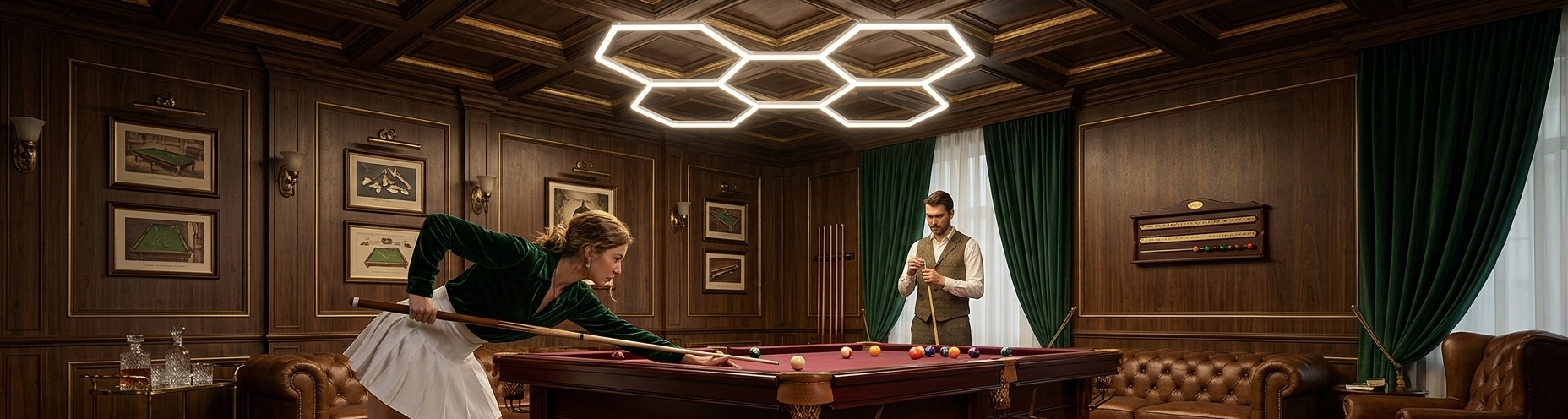
Linear lights, downlights, and panel fixtures all served this role well. They were dependable and practical, but rarely memorable.
As commercial spaces began placing greater emphasis on user experience, lighting gradually took on a new role.
Designers started looking beyond brightness. They began considering how light interacts with spatial rhythm, architectural form, and visual order.
This shift opened the door for new lighting structures.
Hexagonal LED honeycomb lighting has gained attention within this context.
Its appeal does not come solely from its geometric appearance. What truly distinguishes it is the sense of organization it introduces into a ceiling layout.
When multiple hexagonal units connect together, they create a repeating pattern that spreads across the space. Even without consciously examining it, visitors often perceive the order it brings.
This experience differs from traditional lighting systems.
Linear fixtures emphasize direction.
Honeycomb lighting forms a network.
Instead of guiding the eye along a single axis, it distributes visual balance across the ceiling. In larger commercial environments, this pattern can subtly influence how people perceive movement and orientation within the space.
Lighting alone does not determine spatial experience, of course.
Materials, colors, layouts, and sound all contribute to the atmosphere of an environment. Yet lighting is often one of the first elements the eye encounters, which makes it particularly influential.
The growing interest in honeycomb lighting reflects a broader change in how commercial interiors are designed.
Lighting fixtures are no longer viewed only as equipment.
They are increasingly treated as part of the spatial language.
This transformation has not happened overnight. It has developed gradually as commercial environments continue to evolve.
As competition between spaces grows stronger, details begin to matter more. A well-organized lighting structure can quietly enhance the perception of professionalism and modernity.
Designers today are exploring a wider range of lighting systems for that reason.
Hexagonal honeycomb lighting is only one option among many, but it offers a particularly clear visual statement.
It allows lighting to move beyond simple illumination and participate directly in shaping the identity of a space.
And when lighting begins to define space, the role of lighting design naturally expands as well.


