


Views: 0 Author: Site Editor Publish Time: 2026-09-22 Origin: Site


Geometric lighting creates a massive visual impact in modern displays, but only when color scenes are properly calibrated. Properly configured installations command attention and elevate the surrounding environment. Poorly configured RGB arrays often look cheap, disjointed, and unprofessional. Buyers consistently face the difficulty of achieving accurate brand colors, maintaining consistent brightness, and programming seamless dynamic scenes across large, interconnected lighting grids. Common pitfalls include inaccurate RGB blending, elusive hues that refuse to render correctly, and controller limitations that restrict creative execution. Overcoming these challenges requires a clear understanding of diode capabilities and software integration. This guide introduces a technical framework for evaluating and selecting the right lighting hardware and control systems to ensure display success, focusing heavily on color accuracy, spatial layouts, and long-term scalability.
Maintaining brand identity in retail and commercial environments requires exact color matching. Visual merchandising relies on consistency. The lighting must accurately reflect specific RGB hex codes associated with a brand's logo or theme. When deploying RGB hexagon lights in these spaces, the hardware must translate digital color values into precise physical output. A slight shift from a deep corporate blue to a washed-out cyan breaks visual cohesion and diminishes the perceived quality of the display.
Color Rendering Index (CRI) plays a massive role when these fixtures illuminate adjacent products or architectural features. Pure RGB diodes excel at saturated colors but possess a low CRI. This makes surrounding objects look flat or unnatural. High-CRI lighting ensures that apparel, merchandise, and skin tones look accurate under the glow of the display. Retailers must evaluate how the ambient spill from the geometric grid affects the primary merchandise on the floor.
| Environment | Primary Lighting Goal | Recommended Color Temperature | CRI Requirement |
|---|---|---|---|
| Retail Apparel | Accurate fabric color representation | 3500K - 4000K | 90+ |
| Fitness Studios | High energy, clear visibility | 4000K - 5000K | 80+ |
| Barber Shops | Skin tone accuracy, shadow reduction | 4500K - 5000K | 95+ |
| Nightclubs | Saturated ambient mood lighting | Variable RGB | N/A |
Fitness studios, gyms, and barber shops often require a hybrid approach. These environments demand neutral whites ranging from 4000K to 5000K to ensure clarity, focus, and safety during detailed tasks or heavy physical activity. They also benefit from high-energy RGB scenes for mood shifts. You might transition a spin class from a brightly lit warmup to an intense, neon-drenched sprint. The lighting system must seamlessly switch between functional high-lumen white and saturated color scenes without requiring dual overlapping fixtures.
Entertainment spaces prioritize immersion and reactivity over static illumination. Gaming and streaming setups require high-refresh-rate dynamic scenes that synchronize with on-screen action or audio cues. Software synchronization through platforms like Razer Chroma, Corsair iCUE, or SignalRGB allows the lighting grid to act as an extension of the digital environment. Latency becomes a primary metric here. The transition from static ambient lighting to reactive visual feedback must be instantaneous to maintain the illusion of immersion.
Marathon gaming sessions and long streaming broadcasts introduce the need for visual comfort. Staring at highly saturated, rapidly flashing LEDs causes rapid eye strain. Incorporating warmer tones between 2700K and 3000K creates a cozy, welcoming environment that mitigates fatigue. The ideal setup balances intense RGB reactivity during active gameplay with ambient, warm comfort lighting during downtime or casual viewing. Selecting hardware that handles both extremes effectively dictates the long-term usability of the entertainment space.
Automotive showrooms and high-end detailing workshops present a unique lighting challenge. The primary requirement is high-lumen, cool white task lighting, typically between 6000K and 6500K. This color temperature maximizes clarity, highlights paint corrections, and reveals microscopic imperfections in clear coats. Functional visibility is non-negotiable when working on or displaying luxury vehicles. The geometric grid must output sufficient lux to serve as the primary overhead light source.
These spaces also utilize vibrant RGB accent scenes during vehicle handovers, promotional video shoots, or evening showcase events. The trade-off between functional visibility and aesthetic presentation requires careful hardware selection. A grid that only produces RGB colors will fail as a detailing light. A pure white grid lacks the dramatic flair needed for marketing. Systems deployed in these environments must feature dedicated high-output white diodes alongside their color-mixing capabilities to satisfy both operational and promotional demands.
Standard RGB diodes produce colors by mixing varying intensities of red, green, and blue light. This method creates millions of saturated colors but possesses a severe technical limitation when attempting to produce pure white or warm white. Mixing standard RGB to create white often results in a noticeable bluish, purplish, or pinkish tint. The light appears artificial and fails to provide the clarity required for task lighting or accurate color rendering.
| Diode Type | Composition | Best Use Case | Limitations |
|---|---|---|---|
| Standard RGB | Red, Green, Blue | Saturated colors, gaming setups | Cannot produce clean white light; poor CRI. |
| RGBW | RGB + Cool White (6000K) | Garages, modern retail, showrooms | Warm tones still require mixing and may look unnatural. |
| RGBWW | RGB + Warm White (2700K) | Cozy streaming rooms, hospitality | Lacks the stark clarity needed for detailed task work. |
| RGBCCT | RGB + Warm & Cool White | High-end commercial, hybrid spaces | Requires complex 6-pin controllers and heavier wiring. |
To resolve this limitation, specifiers must look toward RGBW or RGBWW systems. These fixtures incorporate a dedicated white diode directly onto the LED chip alongside the red, green, and blue emitters. When neutral whites (4000K-5000K) or warm tones (2700K-3000K) are required, the system bypasses the color mixing process and powers the dedicated white diode. This guarantees a clean, accurate white light that functions perfectly for task illumination while retaining the ability to trigger dynamic color scenes on demand.
Translating digital hex codes to physical LED output involves complex foundational mixing of red, green, and blue. Red dictates warmth and vibrancy. Green brings brightness and natural tones. Blue provides depth and coolness. Inputting a specific hex code into a control app does not guarantee an exact physical match. The physical output depends heavily on the specific color gamut of the LED chip and the light-altering properties of the fixture's diffuser.
Elusive hues like deep browns, metallic golds, or subtle pastels are notoriously difficult to replicate using standard full-brightness RGB mixing. Standard diodes naturally push toward high saturation, making muted or complex colors appear overly bright or completely inaccurate. Achieving these specific tones requires advanced calibration within the control software.
Operators utilizing customizable RGB hexagon lights must often adjust the "BLACK" levels within their controller apps. LEDs emit light, so they cannot project black. Adding black to a digital color mix forces the controller to dim specific diodes. This darkens the overall output to achieve tones like burnt orange or navy blue that standard full-brightness systems struggle to produce. Manual visual calibration remains a necessary step for exact brand matching.
Wall placement serves direct-view applications where the lighting acts as a primary visual feature rather than an ambient source. Streaming backgrounds, retail feature walls, and nightclub entryways utilize vertical grids to immediately capture attention. These fixtures sit directly in the viewer's line of sight, meaning the physical appearance of the light source matters just as much as the illumination it provides.
Glare management becomes a primary factor for RGB hexagon wall lights. Bare diodes or poorly diffused channels create harsh hotspots that ruin camera feeds and cause visual discomfort for passing foot traffic. Selecting the correct diffusion material is mandatory. Frosted polycarbonate covers blend the individual LED pixels into a smooth, continuous bar of light, maximizing the richness of the color scenes. Clear covers expose the internal components and create aggressive glare. Viewing angles must also be calculated. The grid should maintain color consistency whether viewed head-on or from a sharp side angle in a narrow retail corridor.
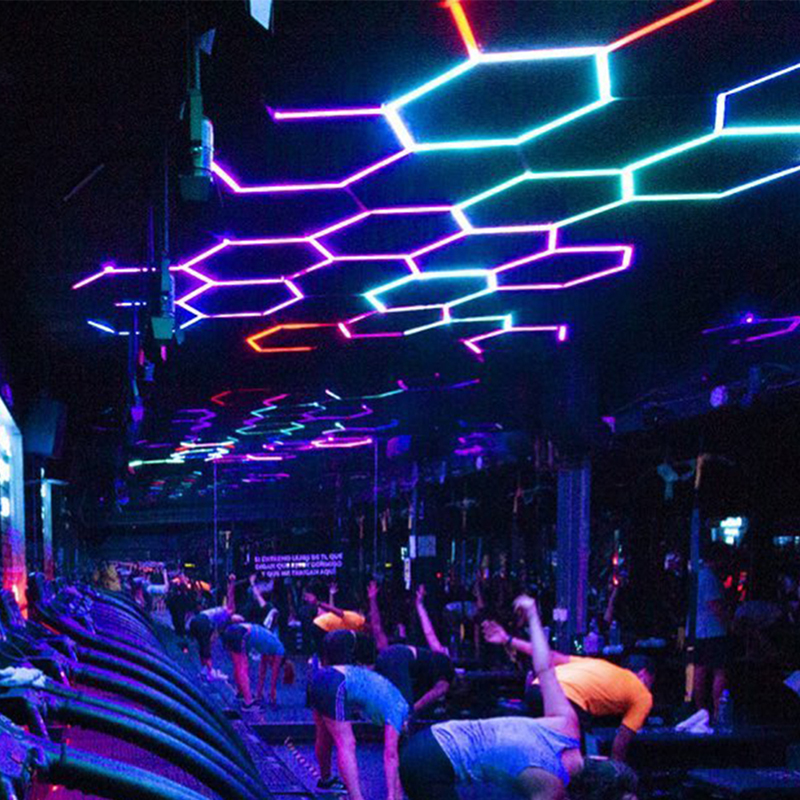
Ceiling installations serve a fundamentally different purpose. They provide broad spatial illumination across large areas like gyms, garages, and event halls. The goal shifts from direct visual impact to creating an immersive ambient wash that dictates the atmosphere of the entire room. Creative patterns and grid layouts must be tailored to the specific dimensions of the space before purchasing hardware.
A sprawling, edge-to-edge honeycomb design works perfectly for a large fitness center, distributing light evenly across the floor. Focused, disconnected clusters serve a barber shop better, highlighting specific styling stations without overwhelming the waiting area. Buyers must map the ceiling dimensions and account for obstacles like HVAC vents or fire sprinklers before finalizing their grid design.
| Ceiling Height | Mounting Method | Light Spread Characteristics |
|---|---|---|
| 8 to 10 Feet | Direct flush mount to drywall | Intense, focused light; sharp shadows on the floor. |
| 10 to 14 Feet | Short cable suspension (1-2 ft drop) | Even ambient wash; excellent color blending. |
| 15+ Feet | Long cable suspension (3+ ft drop) | Requires high-lumen output; colors may dilute before reaching the floor. |
Structural mounting considerations dictate the success of RGB hexagon ceiling lights. Direct mounting to drywall requires appropriate anchors to handle the cumulative weight of the aluminum or plastic channels. For open-ceiling commercial spaces, grid suspension techniques using aircraft cables allow the lighting to drop down to an optimal height. The distance from the light source to the subject directly affects color saturation and shadow casting. Mounting the grid too high dilutes the color scenes. Mounting it too low creates harsh, distracting shadows on the floor.
The technical architecture of the LED strip defines what kind of dynamic scenes are possible. Non-addressable systems wire all diodes on a single circuit. When a command is sent, the entire grid changes to one color simultaneously. These systems excel at displaying solid brand colors, providing basic strobe effects, or washing a room in a single static hue. They are reliable, easy to wire, and require simple controllers.
Addressable, or pixel-mapped, systems incorporate Integrated Circuit (IC) chips along the LED strip. These chips allow the controller to send independent data to individual nodes or specific segments of the grid. This technology enables color changing hexagon lights to display flowing gradient animations, multi-color chases, and complex reactive scenes. Choosing between the two depends entirely on the display outcome. Static architectural highlighting requires non-addressable reliability. High-energy entertainment spaces demand the flexibility of addressable pixel mapping.
The controller ecosystem acts as the brain of the display. Basic proprietary mobile apps operating over Bluetooth or local Wi-Fi offer user-friendly interfaces for selecting colors and triggering pre-programmed scenes. These work well for small, isolated installations. Large commercial environments require professional lighting protocols like DMX512 or Art-Net. These standards allow the hexagon grid to integrate seamlessly with other stage lighting, audio systems, and centralized architectural control panels.
Cloud-dependent smart controllers introduce risks in commercial environments. Relying on external servers for basic lighting functionality creates vulnerabilities regarding internet outages and long-term software support. If a manufacturer discontinues their cloud service, the lighting grid may lose its programmable features entirely. Commercial operators should prioritize controllers that offer robust offline functionality, local network control, and secure protocol standards to ensure the longevity and security of their display infrastructure.
Expanding a geometric grid across a large surface area introduces the physics of electrical resistance. Voltage drop occurs when power travels through long runs of interconnected LED strips. As the voltage decreases toward the end of the run, the LEDs lose their ability to produce accurate colors. A grid programmed to display pure white may look crisp at the power source but gradually shift to a faded yellow or muddy red at the furthest edges. This color degradation ruins the seamless aesthetic of the display.
| System Voltage | Max Continuous Run (Before Drop) | Recommended Injection Strategy |
|---|---|---|
| 5V DC | Approx. 10 to 15 feet | Inject power at both ends and every 10 feet. |
| 12V DC | Approx. 16 to 32 feet | Inject power at both ends and the middle of the run. |
| 24V DC | Approx. 33 to 50 feet | Inject power at the start and end of the entire grid. |
Mitigating voltage drop requires precise electrical planning. Installers must calculate the maximum run length specified by the diode manufacturer before voltage drops below acceptable thresholds. Utilizing power amplifiers and planning multiple power injection points along the grid ensures consistent voltage delivery to every segment. Heavy-gauge wiring must be routed behind the scenes to deliver fresh power to the middle and ends of extensive layouts. This guarantees uniform color saturation across the entire installation.
Complex grid layouts place significant mechanical stress on proprietary connectors. The Y-connectors and 120-degree elbows that form the honeycomb shapes must bear the structural tension of the expanding grid. Poorly manufactured plastic connectors can crack or lose electrical contact under the weight of the assembly or due to slight misalignments on uneven mounting surfaces. Ensuring the physical assembly is supported independently of the electrical connectors prevents localized failures and dead zones within the display.
Thermal management dictates the lifespan and color accuracy of the diodes. High-density LED strips generate substantial heat, especially when running full-brightness white or complex addressable scenes. Enclosing these strips in plastic channels traps the heat, accelerating diode degradation and causing permanent color shifting over time. Aluminum hexagon channels act as functional heat sinks, drawing thermal energy away from the diodes and dissipating it into the surrounding air. Proper thermal management preserves the hardware investment and ensures the color scenes remain vibrant and accurate for years.
A: Standard RGB lights struggle to produce true warm white, often looking artificial. For accurate warm tones (2700K-3000K) ideal for cozy gaming setups, you must specify RGBW or RGBWW fixtures that include a dedicated white diode.
A: Matching brand colors requires inputting specific RGB values into the controller app, but physical output may vary based on the diode's color gamut and the fixture's diffuser. Achieving elusive hues often requires manual calibration, including adjusting black levels to darken the tone.
A: Faded or shifted colors (often turning yellowish or red) at the end of a run are caused by voltage drop. This is mitigated by injecting additional power at specified intervals along the grid.
A: While they offer high visual impact, pure RGB lights are generally not bright enough for detailed task work. For functional garage or workshop lighting, select systems that combine high-lumen cool white LEDs (6000K-6500K) with RGB accent capabilities.
A: Most systems offer basic static colors and pre-programmed scenes via an offline physical remote. However, creating custom color codes, setting schedules, or syncing with other smart devices typically requires a 2.4GHz Wi-Fi connection and a compatible app.


