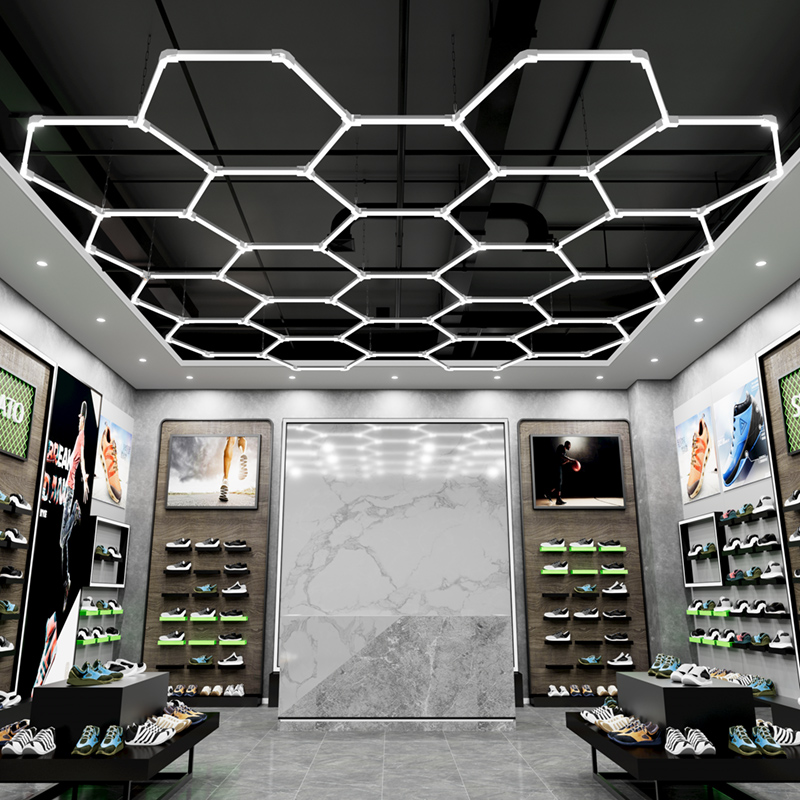
Are harsh gym lights ruining your daily workouts? Bad beam angles create dark corners and blinding glare. This turns what should be an energizing environment into a frustrating one. As residential fitness spaces evolve, geometric lighting has emerged as the ultimate upgrade. Visual appeal is only half the equation. From an engineering standpoint, you need the exact optical angles to build a flawless and highly functional workout setup.
Understanding Beam Angles in Lighting: The Engineering Perspective
To make an informed decision regarding gym illumination, we must first look at the physics of light distribution. A beam angle measures how light dissipates from a luminaire's center. It represents the angle between two planes where the intensity drops to 50 percent of its maximum center strength.
Narrow beams typically range from 15 to 45 degrees. They act much like theatrical spotlights by concentrating intense lumens into a tiny area. While excellent for highlighting retail displays, this sharp contrast is highly detrimental in a physical workspace. Wide beams spanning 90 to 120 degrees act as floodlights. They distribute photons outward on a broad lateral axis. This ensures light reaches the floor evenly. You can illuminate heavy equipment without forcing your optic nerves to adjust constantly between extreme brightness and deep shadows.
Over the past two years, the fitness interior design sector has seen a massive shift. Market data reveals a strong trend of homeowners replacing flickering fluorescent tubes with hyper-personalized geometric setups. Industry analysis indicates that modern garage-to-studio transformations rely heavily on omnidirectional lighting. This design choice effectively mimics the immersive, high-energy atmospheres of luxury commercial gyms.
Why Honeycomb Grids Are the Ultimate Choice for Home Gyms
Standard linear fixtures emit illumination along a single rigid axis. This inevitably casts long directional shadows. If you stand parallel to a linear tube, your own body blocks the light from reaching your workspace. The geometric shape of a honeycomb grid solves this organically. It pushes light outward in 360 degrees across six intersecting axes.
When integrating a high-quality Hexagonal LED Light Panel system, the interconnected nodes create a continuous omnidirectional source. This wrap-around effect ensures that three-dimensional objects like power racks and barbells are lit from multiple angles simultaneously.
Environmental design plays a documented role in human motivation. Transforming a dusty garage into a futuristic training zone provides immediate visual structure. The clean lines turn a flat ceiling into a striking architectural centerpiece. Unlike fixed-dimension traditional fixtures, these honeycomb systems operate on a highly adaptable modular framework. You can construct custom grids scaled perfectly to your room's unique dimensions. This adaptability concentrates lumens exactly where the physical activity occurs.
The Verdict: The Optimal Beam Angle for Geometric Lighting
When evaluating photometric data alongside ergonomic safety standards, the verdict is definitive. A 120-degree beam angle is the industry standard and the absolute best choice. Optics engineering dictates that this specific spread maximizes lateral room coverage. It achieves this without compromising the necessary downward foot-candles hitting your floor mats.
A primary goal of any dedicated workout space is uniform illuminance. Hotspots occur when light is too concentrated. This creates pools of blinding white surrounded by dangerous dim zones. A 120-degree angle ensures the light cones emitted from each segment of your Hexagonal LED Light Panel overlap seamlessly in the air. This precise intersection cancels out minor shadows. It results in a smooth flat wash of light across the entire room.
Handling heavy cast iron requires pristine depth perception. Narrow angles cast high-contrast silhouettes that can easily obscure a stray dumbbell left on the floor. By projecting light outward rather than strictly downward, a 120-degree spread illuminates the vertical surfaces of your machinery safely. You can clearly see the J-hooks on your squat rack preventing dangerous missteps during exhausting sets.
Core Comparison: Narrow vs. Wide Beam Angles
To objectively illustrate why 120 degrees dominates the fitness space, let us compare the photometric impacts of the primary lighting options.
Feature
Narrow Beam 30° - 60°
Wide Beam 120°
Light Distribution
Highly concentrated spotlight effect
Broad ambient canopy effect
Shadow Profile
Sharp and high-contrast
Soft and heavily diffused
Glare Rating UGR
High risk of ocular fatigue
Extremely low minimal eye strain
Best Application
Art galleries and retail displays
Functional fitness and detailing studios
How Ceiling Height Dictates Your Setup
Although 120 degrees remains the constant ideal, real-world performance depends heavily on your room architecture. The Inverse Square Law of Light dictates that intensity drops exponentially as distance increases. Understanding your vertical space is vital for a successful installation.
Many basement gyms feature ceilings hovering between 7.5 and 9 feet. In these confined spaces, a wide spread is mandatory. A narrow fixture mounted close to your head creates aggressive spotlighting directly underneath. The 120-degree angle fans out immediately upon leaving the diffuser. This ensures total floor coverage even in cramped quarters.
Custom outbuildings or large garages often boast ceilings exceeding 12 feet. The physical distance causes the light to dissipate significantly before hitting the floor. To compensate for this height, you do not narrow the beam angle. Instead, you must increase the lumen output. Upgrading to a high-lumen Hexagonal LED Light Panel ensures the wide beam retains enough raw intensity to push down to your lifting platform. Look for systems delivering 110 to 120 lumens per watt to guarantee adequate brightness.
Minimizing Glare During Workouts: The Role of Beam Spread
Maintaining a low Unified Glare Rating is paramount to preventing ocular fatigue and spatial disorientation during intense physical exertion.
Imagine lying flat on a bench preparing for your heaviest pressing set of the day. Your field of vision is directed straight up at the ceiling. If the room features concentrated narrow-beam diodes, the raw intensity strikes your retina directly. This blinding effect causes your pupils to contract sharply. It temporarily impairs your vision and makes it incredibly dangerous to unrack a loaded barbell.
Wider angles inherently solve this glare issue. They diffuse the luminous flux over a significantly larger surface area. Instead of a laser-like photon concentration hitting the eye, the horizontal spread makes the light perceptibly softer. Physical construction works in perfect tandem with optics. Premium lighting systems utilize milky polycarbonate covers to scatter light as it exits the fixture. When paired with the 120-degree spread, these diffusers effectively break up the harshness of individual LED diodes.
Installation Tips to Maximize the Beam Angle
Acquiring the correct hardware is only the first step. Strategic spatial execution is required to fully leverage the photometric benefits of that 120-degree spread.
A frequent mistake in DIY installations is centering a small grid in the middle of a massive room. This leaves the perimeters completely dark. For optimal ambient performance, position the outer edges of your lighting grid roughly 1.5 to 3 feet away from the nearest wall. This specific offset allows the wide beam to strike the upper half of the walls. It bounces light back into the room center to create an artificially brighter feel.
The Light Reflectance Value of your paint directly interacts with your lighting setup. Dark matte colors possess a low Light Reflectance Value meaning they absorb the wide beam. You may need a larger grid to achieve your desired brightness. Crisp white walls or large mirrors continuously bounce the diffuse light maximizing the efficiency of your setup.
Actionable Selection Guide for Premium Panels
The market for geometric lighting has exploded recently. Substandard fixtures often misrepresent their specifications or utilize cheap diffusers that cause severe glare. As a lighting engineer, I recommend verifying key metrics before finalizing a purchase.
Ensure the manufacturer explicitly states a genuine 120-degree beam angle. Look for a Color Rendering Index above 85 to accurately reveal the colors of your weight plates. Prioritize systems equipped with plug-and-play modular connectors. The housing should feature durable aluminum and polycarbonate to withstand heavy lifting vibrations. For instance, top-tier Hexagonal LED Light Panel setups utilize AC100-240V wide voltage drivers and deliver a crisp 6500K daylight white. This specific combination guarantees optical performance matches structural integrity.
Frequently Asked Questions
How many lumens do I need for a standard home gym?
For a highly functional fitness space, lighting engineers generally recommend targeting 30 to 50 foot-candles at floor level. Translated to raw output, a standard two-car garage gym requires roughly 15,000 to 20,000 total lumens. High-efficiency honeycomb systems outputting 110 to 120 lumens per watt can easily achieve this target while keeping energy consumption remarkably low.
Are honeycomb lights suitable for low basement ceilings?
Absolutely. In fact, they are one of the best solutions for low clearance areas. Because the 120-degree beam angle disperses light horizontally immediately upon exiting the diffuser, it prevents the severe spotlighting effect common with traditional recessed cans. The ultra-thin profile of the tubes also preserves precious vertical headroom for overhead presses and jump rope routines.
Can I dim these panels to change the brightness?
Many premium systems are compatible with dimming technologies. You must verify this specific feature before purchase as base models are often non-dimmable. Dimming the LED driver reduces the total lumen output but does not alter the physical 120-degree beam angle. The light will still spread evenly across the room providing a softer glow for recovery or yoga sessions.
What color temperature is best alongside a 120-degree beam angle?
Lighting experts consistently recommend a crisp cool white color temperature between 5000K and 6500K for fitness environments. This range closely mimics natural daylight. When combined with a wide beam spread, daylight-balanced lighting provides optimal visual clarity. Biological studies indicate that cooler temperatures actively suppress melatonin production increasing alertness during heavy training sessions.
Do I need an electrician to install the system?
The physical assembly of the geometric grid is a straightforward plug-and-play process. The tubes push securely into modular connectors. Connecting the assembled grid to your home power supply depends on your existing infrastructure. If your ceiling has a standard plug-in outlet, you can often just plug the system in. If the setup requires hardwiring directly into a ceiling junction box, electrical safety codes strongly dictate hiring a licensed electrician.
Conclusion
A 120-degree beam angle is the definitive secret to maximizing your honeycomb lighting setup. This specific spread eliminates harsh shadows and dramatically reduces eye strain during floor exercises. By carefully considering your ceiling height and room reflectivity, you can optimize this wide angle to create a flawless environment. Ready to upgrade your space with professional-grade illumination? Evaluate your room dimensions and explore the precision-engineered systems at Contation LED to select the perfect lighting configuration for your daily training needs.