


Views: 0 Author: Site Editor Publish Time: 2026-06-25 Origin: Site


Look closely at modern commercial spaces across social media feeds today. You will likely notice a striking geometric grid illuminating the ceiling. These intricate lighting setups instantly capture attention. They dramatically elevate the atmosphere of any room. However, effective illumination must offer much more than just visual appeal. Buyers must evaluate these systems on their functional merits. Reliable long-term performance remains critical. Shadow-free visibility is essential for detail-oriented workspaces.
This guide provides an evidence-based framework for evaluating these unique grids. We will explore how to properly size and implement these fixtures. You will discover exactly how they perform in both commercial and residential settings. Readers will learn the specific metrics needed to separate high-quality systems from subpar alternatives. By the end, you will know how to build a reliable, high-performance lighting environment.
Core Function: Hex grids eliminate single-source shadows, providing high-visibility, multi-directional illumination ideal for detail-oriented work.
Primary Applications: Dominate in auto-detailing shops, modern residential garages, commercial gyms, and high-end retail spaces.
Evaluation Metrics: Quality depends heavily on Color Rendering Index (CRI), structural rigidity (polycarbonate vs. cheap plastics), and safe daisy-chain power limits.
Implementation Reality: Successful installation requires accurate ceiling mapping, load calculations, and understanding flush vs. suspended mounting methods.
Traditional linear tubes often create a harsh lighting environment. Single-bulb fixtures project light strictly downwards. This directional beam inevitably creates severe shadows. Uneven light pooling causes significant eye strain over time. Important surface defects hide easily in these dark zones. Workers struggle to see fine details clearly. You often have to move portable work lamps around the room. This constant adjustment wastes time and reduces productivity. Standard shop fixtures simply cannot wrap light around three-dimensional objects effectively.
A well-designed Hexagonal Light solves this fundamental issue. The geometric structure forces light rays to overlap from multiple angles. This intersecting design virtually eliminates annoying blind spots. Light hits objects from the front, sides, and above simultaneously. You experience uniform illumination across the entire work surface. Shadows disappear entirely. Detail-oriented tasks become much easier to perform. Visual clarity improves drastically for anyone operating beneath the grid.
Upgrading your facility lighting directly influences customer perception. A brilliant geometric grid immediately signals professionalism. It visually separates your workspace from outdated competitors. Clients subconsciously link clean, bright environments to high-quality service. This psychological edge helps justify premium pricing in service-based businesses. Detailers, salon owners, and workshop managers consistently see enhanced customer trust. A modern ceiling layout acts as a powerful marketing tool. Your physical space becomes an instant showcase of quality.
Automotive professionals demand flawless visibility. Standard shop lights fail to reveal subtle paint defects. High-end detailing requires precision lighting.
Defect Detection: High CRI metrics allow technicians to spot swirl marks easily. Paint corrections require accurate reflections. Ceramic coating applications demand perfectly even light distribution.
Visual Centerpiece: Modern residential garages treat vehicles as display pieces. A sleek grid highlights the car's bodylines beautifully. It transforms a simple storage area into a premium showroom.
Fitness spaces require a delicate balance of brightness and comfort. Athletes need clear visibility without suffering from blinding glare.
Glare Reduction: Clients frequently look upwards during exercises like bench presses. Direct, harsh bulbs cause immediate eye discomfort. Diffused hexagon LED lights provide high-lumen output gently. The frosted polycarbonate covers soften the intensity effectively.
Zoning Features: Scalable grid designs naturally define specific workout zones. You can map lighting layouts directly over lifting platforms. This creates structured, dedicated areas within a large open floor plan.
Retail and grooming environments rely heavily on accurate color representation. Visual appeal drives customer satisfaction directly.
Color Accuracy: Hair styling requires precise color matching. Retail product displays need vibrant illumination. High-quality grids prevent colors from looking washed out or unnatural.
Architectural Impact: These fixtures create an immediate architectural focal point. Business owners avoid expensive structural renovations. A ceiling grid instantly modernizes the entire room visually.
Digital creators face unique technical lighting challenges. Camera sensors capture light differently than the human eye.
Flicker-Free Technology: High-framerate video recording demands stable light frequencies. Cheap LEDs cause severe banding and flickering on camera. Premium hex grids utilize advanced drivers to ensure clean stream lighting.
Ambient Fill: Multi-directional beams provide excellent fill light for studio settings. Streamers eliminate harsh facial shadows without needing bulky softboxes.
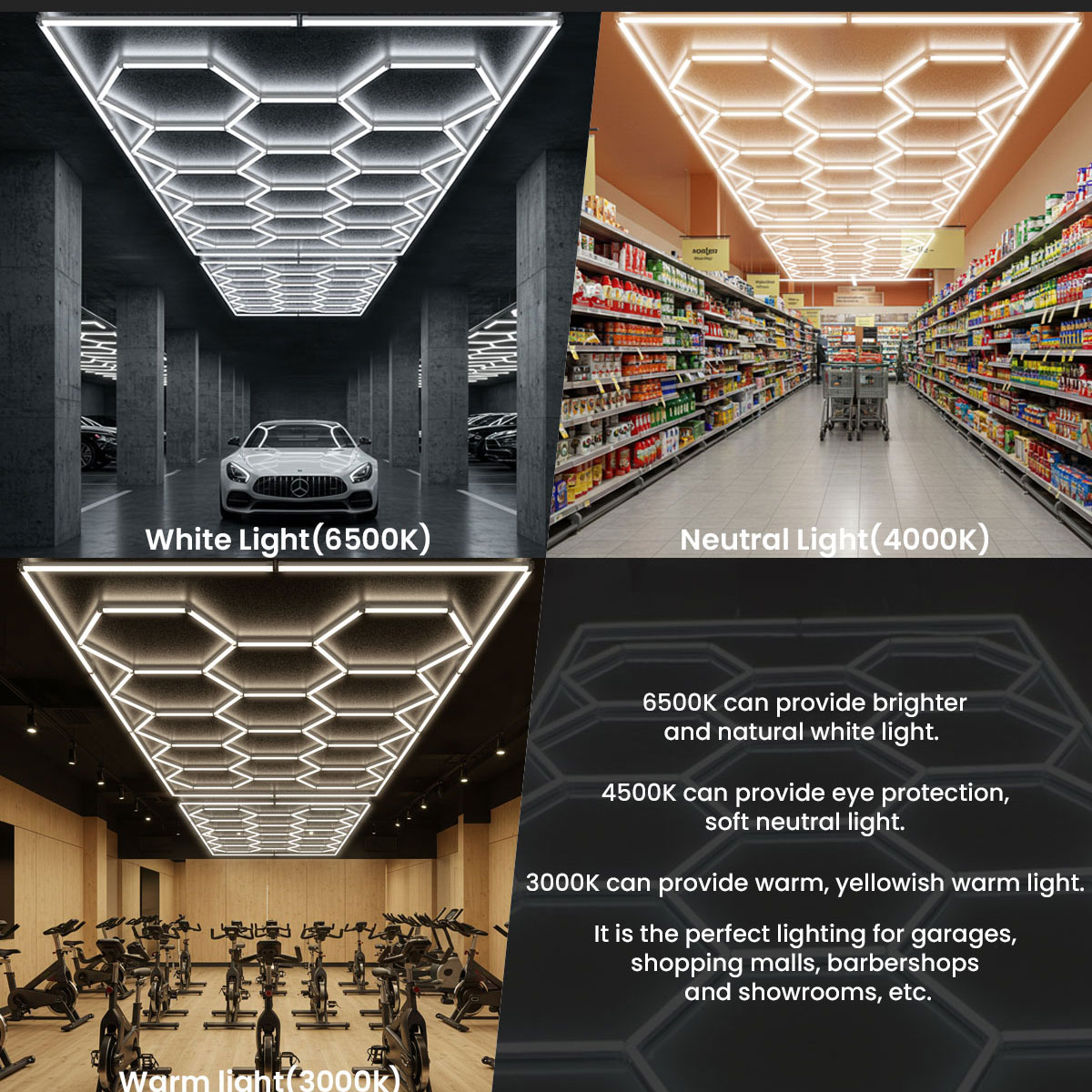
Total wattage does not tell the whole story. You must assess total lumens per square foot. Industry professionals measure this illuminance as Lux. Standard residential garages require different Lux levels compared to commercial workspaces. Detail shops often target 750 to 1000 Lux at the working surface. A basic home garage might only need 300 Lux. You should calculate the actual light hitting your floor. Efficacy matters greatly. Professional tubes deliver more lumens per watt, saving long-term energy.
A high Color Rendering Index is absolutely non-negotiable for task lighting. CRI measures how accurately a light source reveals true colors. Sunlight scores a perfect 100. Lower CRI ratings wash out vibrant colors completely. Reds look dull, and blues appear gray. You should always demand a CRI of 90 or higher. This ensures paint colors, hair dyes, and retail products look vibrant. Working under low CRI lighting leads to costly color-matching mistakes.
Durability varies wildly between different manufacturing brands. You must inspect the housing materials closely.
Feature | Professional Grids | Cheap Kits |
|---|---|---|
Housing Material | Aviation-grade aluminum / Rigid Polycarbonate | Brittle PVC / Thin plastics |
Heat Dissipation | Excellent thermal management; prevents LED burnout | Traps heat; causes warping and premature failure |
Diffuser Quality | Thick, frosted covers for even light spread | Thin, transparent covers that expose harsh LED diodes |
Structural Rigidity | Holds shape perfectly when suspended from ceilings | Sags in the middle; requires constant readjustment |
Aviation-grade aluminum backings dissipate heat rapidly. Rigid polycarbonate covers resist impacts effectively. In contrast, cheap PVC kits warp under normal operating temperatures. Brittle plastics crack easily during installation.
Large installations demand careful power management. You must evaluate the quality of the pin connectors. Professional kits use secure, lockable joints. This prevents accidental disconnections over time. You must understand the maximum safe daisy-chain limit. Linking too many tubes to a single power supply causes dangerous voltage drops. The lights at the end of the chain will appear visibly dimmer. Pushing limits further risks catastrophic fire hazards. Always follow the manufacturer's maximum connection guidelines.
You must evaluate your physical space before purchasing a system. Different ceilings require entirely different mounting approaches.
Flush Mount: This method attaches the grid directly to drywall. It works perfectly for flat, finished ceilings. You will use standard screws and anchors. The flush mount maximizes vertical clearance in tight spaces.
Suspended/Dropped: Many commercial buildings have high, exposed ceilings. You might navigate around complex HVAC ductwork. Suspended installations use adjustable aircraft cables. This drops the lighting grid down to an optimal working height. It creates a stunning floating effect in the room.
Mapping your existing power supply is a crucial first step. You cannot simply plug a massive grid into any available outlet. Large commercial setups draw significant amperage. You may require a licensed electrician to evaluate your panel. They might need to split heavy loads across multiple breakers. Installing dedicated switches ensures safe, reliable operation daily. Ignoring electrical capacity often leads to tripped breakers and disrupted workflows.
Physical construction requires patience and spatial awareness. The modular design involves dozens of connecting pieces.
Map the Layout: Draw your exact grid pattern on paper first. Count all the straight tubes and angled connectors.
Floor Assembly: Always assemble the entire grid on the floor initially. Do not attempt to build it piece-by-piece in the air.
Align Connectors: Pay strict attention to Y-connectors and 120-degree elbows. Misaligning these joints throws off the entire geometric shape.
Test the Power: Plug the system in while it sits on the floor. Verify every single tube illuminates properly.
Lift and Secure: Enlist multiple people to lift the completed grid safely. Secure it evenly to your chosen mounting points.
Taking shortcuts during assembly usually results in frustrating teardowns. Precise planning ensures a smooth, successful installation.
You must weigh the upfront investment against long-term benefits. Modular hex grids generally carry a higher initial purchase price. However, traditional high-bay LED fixtures often require complex, labor-intensive wiring. High-bays also fail to eliminate shadows effectively. A modular grid acts as both functional lighting and architectural decor. It eliminates the need for additional drop ceilings or aesthetic renovations. The combined value of premium task lighting and spatial modernization often justifies the investment.
These systems are not universally perfect for every single environment. You should skip this upgrade if your space has extremely low ceilings. Clearances under seven feet make the grid feel claustrophobic. The visual impact diminishes entirely in cramped quarters. Furthermore, purely utilitarian storage areas rarely benefit from this design. If aesthetic return on investment is zero, standard linear shop lights suffice. Save your budget for spaces where visual presentation actually matters.
If a modular grid fits your goals, begin your project preparation immediately. First, measure the exact dimensions of your target ceiling area. Note any obstructions like garage door tracks or sprinkler heads. Next, verify the available amperage on your target electrical circuit. Confirm you have enough overhead power capacity. Finally, consult a professional lighting layout specialist. They can map the exact grid size to your room dimensions accurately. Proper planning guarantees a stunning final result.
A well-engineered hexagonal light stands as a legitimate, high-performance architectural solution. It completely transforms how spaces look and function. When sourced correctly, these systems eradicate shadows and enhance task visibility dramatically. They serve as a powerful upgrade for detailers, gym owners, and retail managers alike.
You must prioritize quality over the lowest available price point. Insist on high CRI ratings for accurate color representation. Verify safety certifications to protect your property from electrical faults. Ensure structural stability by choosing durable polycarbonate and aluminum materials.
Ready to upgrade your illumination? Start by measuring your ceiling space today. Utilize an online space-sizing calculator to determine your exact needs. Explore a curated catalog of commercial-grade grid kits to find your perfect fit. Book a professional consultation to secure your layout plan.
A: They are highly functional. These grids deliver exceptional high-lumen output designed specifically for detail-oriented tasks. The geometric shape provides multi-directional light spread, which drastically reduces shadows and outperforms standard linear shop lights.
A: It depends on the specific driver and transformer included. Many basic plug-and-play kits are non-dimmable. However, hardwired commercial versions often support standard 0-10V dimming systems. Always verify dimming compatibility with the manufacturer before purchasing.
A: Assembly is physically straightforward, utilizing a simple snap-together design. Building the grid on the floor is easy. However, securely mounting it to the ceiling and tying it into existing electrical circuits requires moderate DIY skills or professional help.
A: These systems feature a highly modular design. If one tube fails, you can quickly unplug and swap that specific segment. You do not need to dismantle the entire grid, provided the brand sells individual replacement parts.


