


Views: 311 Author: Site Editor Publish Time: 2026-03-11 Origin: Site


Upgrading your workspace starts with the right Car Garage Light. For years, fluorescent tubes were the standard for workshops and home garages. However, the rise of LED technology has changed the math for homeowners and shop managers alike. If you are still using flickering fluorescent fixtures, you are likely losing money every hour they stay on.
Whether you need an Ultra bright LED for complex engine work or a stylish Polygonal LED setup to showcase your vehicle collection, understanding the efficiency gap is the first step. Let’s break down the data to see why the modern Car Garage Light is a financial powerhouse.
The most immediate difference between these two technologies is how much power they draw to produce light. Fluorescent bulbs use a gas-filled tube and a ballast to generate illumination, while an LED uses a semiconductor. This fundamental difference in physics leads to a massive gap in energy efficiency.
A standard 4-foot fluorescent tube usually consumes about 32 to 40 watts. To get the same brightness from an LED, you only need about 15 to 18 watts. This means you instantly cut your energy usage by more than 50% just by switching the bulb. When you scale this across a multi-car garage with eight or ten fixtures, the monthly savings on your utility bill become significant.
We measure the true value of a Car Garage Light by its "Luminous Efficacy." Bright LED options often provide 100 to 140 lumens per watt. Fluorescents usually struggle to reach 80 lumens per watt, and that number drops as the bulb ages. By choosing an Ultra bright LED, you get more "usable" light for every dollar you spend on electricity. It makes the LED the clear winner for anyone trying to lower their overhead costs.
When calculating savings, you must include the cost of your time and replacement parts. Fluorescent lights have a notorious "fail rate" involving both the bulbs and the ballasts. Every time a ballast hums or a tube flickers, it costs you money to fix it.
A high-quality Car Garage Light featuring LED technology is rated for 50,000 to 100,000 hours. In contrast, fluorescent tubes typically last between 10,000 and 15,000 hours. You would need to buy and install four or five fluorescent bulbs just to match the lifespan of a single Polygonal LED fixture.
Fluorescent systems require a ballast to regulate the voltage. These components often fail before the bulbs do. When a ballast dies, you either spend $20 on a new part or replace the entire fixture. Most LED designs are "ballast-free" or use integrated drivers that are much more reliable. By eliminating the ballast, you remove the most common point of failure in garage lighting. This makes the LED a "set it and forget it" solution for busy garages.
To truly understand the "Calculating Your Long-Term Energy Savings" part of our title, we need to run the numbers. Let's look at a typical three-car garage setup over a 5-year period.
Assume you have 6 fixtures running 8 hours a day. In many regions, electricity costs about $0.15 per kWh.
| Lighting Type | Total Watts | Yearly kWh | Yearly Cost | 5-Year Total |
| Fluorescent (T8) | 240W | 700 kWh | $105 | $525 |
| Bright LED | 108W | 315 kWh | $47 | $235 |
| Savings | 132W | 385 kWh | $58 | $290 |
The $290 saved in the table above only accounts for electricity. If you add the cost of replacing two sets of fluorescent tubes and one failed ballast over those five years, your total savings jump closer to $400. This often means your new Polygonal LED system pays for itself in less than 24 months. After that point, the light is essentially "free" compared to the old system you were running.
If you use your garage for detailing, light quality is just as important as energy savings. Fluorescent lights often have a low Color Rendering Index (CRI). This makes it hard to see swirl marks on paint or the true color of interior fabrics.
A High-quality Car Garage Light with a CRI of 90+ allows you to see the vehicle exactly as it will look under the sun. Ultra bright LED arrays are designed to minimize shadows and hot spots. This precision helps detailers catch imperfections quickly, reducing the time spent on a job.
Sometimes, "too bright" is an issue when looking for specific paint defects. A Dimmable LED system allows you to lower the intensity to spot subtle ripples in the clear coat. Fluorescent lights are rarely Dimmable, and when they are, the fixtures are extremely expensive and prone to buzzing.
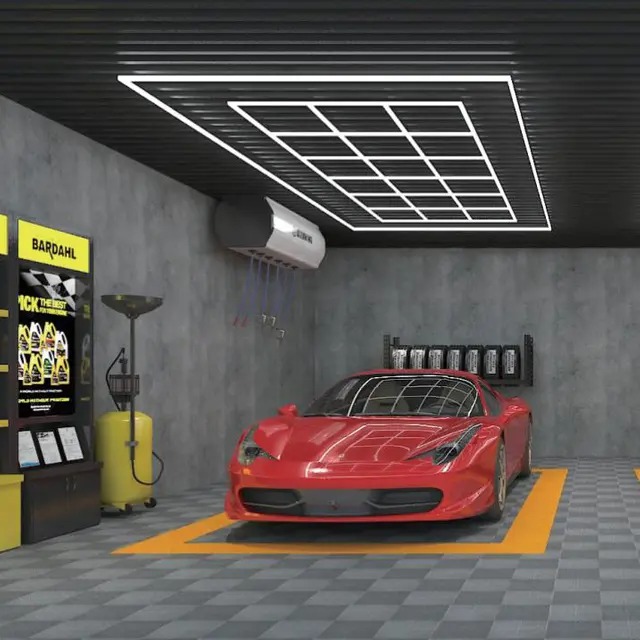
Modern Polygonal LED systems, such as hexagonal grids, provide light from multiple angles simultaneously. This reduces the need for portable work lights. By integrating this into your ceiling, you create a professional environment that is both efficient and visually stunning. This layout is the gold standard for high-end Car Garage Light installations.
Being eco-friendly often goes hand-in-hand with saving money. Fluorescent tubes contain mercury, a toxic heavy metal. This makes disposal difficult and sometimes expensive if your local laws require hazardous waste recycling.
LED lights contain no mercury. When a Bright LED finally reaches the end of its life, it is much easier to recycle. You don't have to worry about a bulb breaking and releasing toxic vapors into your home or shop. This peace of mind is part of the "long-term" value that isn't always captured in a simple energy bill.
Because they use less than half the energy, LED fixtures significantly reduce the carbon emissions associated with your property. For commercial shops, this can even lead to tax credits or energy rebates from local governments. Many utility companies offer "instant rebates" for businesses that upgrade to Ultra bright LED systems, which further reduces your initial investment cost.
Many garages are unheated. If you live in a cold climate, you know that fluorescent lights take a long time to "warm up." They often flicker or look dim when the temperature drops below freezing.
An LED Car Garage Light loves the cold. Semiconductors actually operate more efficiently in cooler temperatures. When you flip the switch, you get 100% brightness instantly. There is no waiting for the gas to ionize or for the flickering to stop.
The solid-state design of an Ultra bright LED makes it resistant to vibrations—like those caused by power tools or heavy garage doors closing. Fluorescent tubes are fragile glass envelopes. One accidental bump with a ladder can shatter them. The durability of a Polygonal LED casing ensures that your investment stays protected even in a busy, high-traffic workspace.

You might be worried that switching to a new Car Garage Light requires expensive electrical work. The good news is that LED technology is very flexible.
If you like your current fixtures, you can buy "Plug-and-Play" LED tubes. These work with your existing fluorescent ballasts. However, for maximum "Long-Term Energy Savings," we recommend "Ballast-Bypass" tubes. These require a simple rewiring of the fixture to remove the ballast entirely, which eliminates the energy used by the ballast itself.
For the best visual results, many owners choose integrated Polygonal LED or shop light fixtures. These are lightweight and often "linkable," meaning you can plug one into the other using a simple daisy-chain cord. This allows you to cover a large ceiling area using only one or two power outlets. It is a DIY-friendly project that instantly transforms the look of your garage.
The biggest mistake you can make is waiting to upgrade. Every month you delay is another month you pay double for electricity.
If your current fluorescent setup costs you $10 a month and an LED setup would cost $4, you are essentially paying a $6 "procrastination tax" every month. Over a year, that is $72. In two years, you’ve spent $144—enough to buy a high-end Ultra bright LED kit.
Look for Bulk Packs: Buying 4 or 10 fixtures at once usually drops the price per unit by 20%.
Check for Rebates: Visit your local utility's website before you buy.
Prioritize CRI: If you do paint work, don't settle for anything less than CRI 90.
The debate between LED and fluorescent lighting is over. While fluorescents served us well for decades, they cannot compete with the "Long-Term Energy Savings" of a modern Car Garage Light. Between the 50% reduction in power usage, the 5x longer lifespan, and the superior light quality for detailing, the move to LED is the smartest investment you can make for your workspace. Whether you choose a functional Bright LED shop light or a high-end Polygonal LED design, your wallet—and your eyes—will thank you.
Q1: Can I replace just the bulbs in my fluorescent garage lights with LED?
Yes. You can use "Type A" bulbs (Plug-and-Play) which use the existing ballast, or "Type B" bulbs (Ballast-Bypass) which require removing the ballast for better efficiency.
Q2: How many lumens do I need for a 2-car garage?
For a standard garage, aim for 15,000 to 20,000 lumens total. If you are doing work for detailing, you may want an Ultra bright LED setup that reaches 30,000 lumens to eliminate all shadows.
Q3: Are LED lights safe for eyes in a workshop?
Yes, as long as they are high quality. Look for flicker-free drivers and frosted covers if you find raw LED chips too glaring. Dimmable options also help you adjust the light to a comfortable level.
At our factory, we don't just assemble parts; we engineer high-performance lighting solutions from the ground up. Our strength lies in our rigorous quality control and our deep understanding of the professional automotive environment. We use advanced automated testing to ensure that every Car Garage Light we ship provides consistent brightness and survives the vibrations of a real-world shop.
Our facility focuses on B2B partnerships, providing Durable and High-quality Polygonal LED systems that help our clients reduce their overhead. We understand that for a professional shop, a light is a tool. That is why we prioritize high CRI and efficient heat dissipation in all our Ultra bright LED designs. When you work with us, you are getting the direct benefit of a factory that stands behind its craftsmanship and is committed to your long-term energy savings.


