


Views: 0 Author: Site Editor Publish Time: 2026-09-23 Origin: Site


Capturing consumer attention in high-stimulus environments without overshadowing the product itself presents a major challenge in modern visual merchandising. Trade show booths and retail floors often suffer from sensory overload. Poorly implemented accent lighting distracts from the merchandise. It creates harsh glare and causes camera flicker in user-generated content. Exposed cabling and inconsistent color rendering make the entire display look unprofessional. You need a structural approach to lighting that directs visual flow rather than competing with it.
Applying modular lighting strategically solves this friction point. Configuring RGB hexagon wall lights provides a scalable, customizable framework. This setup directs visual flow, enhances brand identity, and increases display engagement without washing out the core product. When treated as architectural elements, these panels transform a standard shelf or pedestal into a high-conversion focal point.
The primary goal of display lighting is creating a distinct visual boundary. You must isolate the product from background noise. A successful display uses light to draw the eye directly to the merchandise. The panels should never overpower the item on display. They act as a supporting structure, building a physical and luminous frame that commands attention.
Luminance ratio dictates visual hierarchy. The product must always remain the brightest point in the visual field. The lighting array serves as a mid-ground accent. If the surrounding panels emit more lumens than the directional spotlights hitting the product, the merchandise becomes a silhouette. You must balance the ambient glow of the background with crisp, high-intensity foreground illumination. Field technicians typically use a light meter to ensure the foreground product receives at least three times the lux of the background panels.
| Lighting Layer | Target Illuminance (Lux) | Primary Function |
|---|---|---|
| Foreground (Product) | 1500 - 2000 Lux | Highlight details, textures, and true colors. |
| Mid-ground (Hexagon Panels) | 300 - 500 Lux | Provide architectural framing and brand color accents. |
| Background (Ambient Store Light) | 150 - 300 Lux | General navigation and spatial awareness. |
Brand alignment requires strict color discipline. Do not rely on default manufacturer presets or random rainbow waves. The lighting color and geometric layout must map directly to established brand guidelines. A cohesive display uses specific hex codes and structured shapes to reinforce brand identity, ensuring the lighting feels native to the product rather than bolted on. Installers should program the controllers to match the exact Pantone colors of the brand.
Building a closed or semi-closed loop of panels around a central pedestal isolates high-value items. This halo effect creates a dedicated zone of focus. You arrange the modules to form a continuous border, leaving the center empty for the product. This works exceptionally well for sneakers, tech gadgets, and jewelry displays.
Spatial requirements dictate the success of the halo. You must maintain an optimal distance between the light edge and the product. Placing the panels too close causes unwanted color casting on the merchandise, distorting its true appearance. A standard rule is maintaining a 12-to-18-inch gap between the inner edge of the halo and the physical product. This distance allows the ambient glow to frame the item without contaminating its surface color.
Staggered, linear arrangements draw the eye from the periphery directly to the high-ticket item. You can configure the panels to act as arrows or pathways. By starting a line of lights near the floor or the edge of a wall and angling it toward the center display, you physically guide the customer's gaze.
Retail settings rely heavily on visual psychology. Customers naturally read displays from left to right and bottom to top. Building ascending pathways with the panels capitalizes on this behavior. A sequence that starts low on the left and climbs toward a central product pedestal creates a sense of elevation and premium value. You can enhance this by programming a subtle light chase effect that moves in the direction of the product.
Symmetrical framing projects stability, precision, and order. You use perfectly balanced, mirrored layouts for luxury goods, high-end electronics, and structured products. Symmetry communicates engineering and perfection. It works best when framing a single, highly technical item placed dead center in the display.
Asymmetrical framing feels dynamic, modern, and organic. You deploy off-center, unbalanced configurations for lifestyle brands, streetwear apparel, and creative products. Asymmetry creates movement. It encourages the eye to wander across multiple products within a larger display area, making it ideal for shelving units holding varied merchandise.
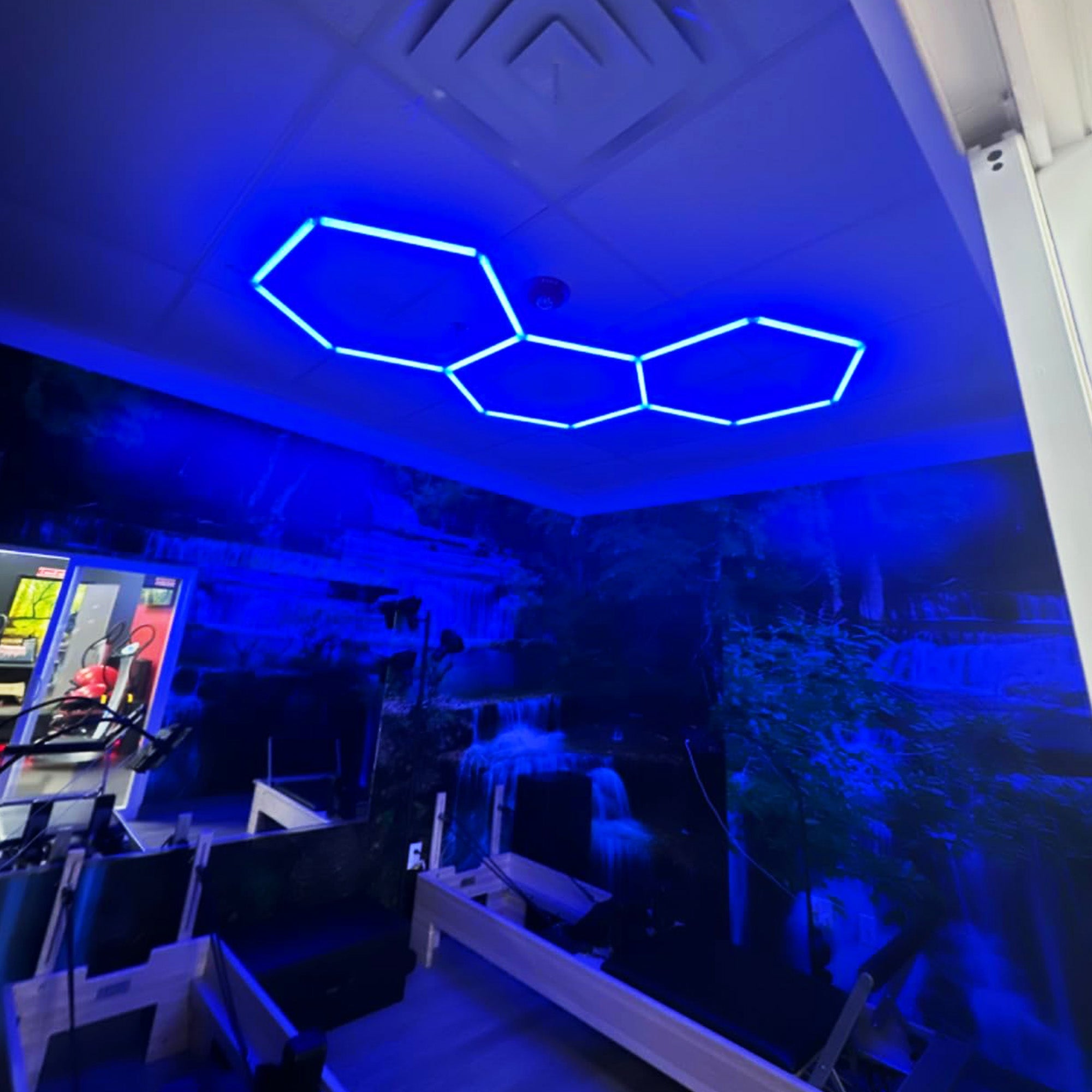
Edge-to-edge diffusion separates professional installations from amateur setups. You must evaluate the density of the internal LEDs and the thickness of the diffusion layer. Budget panels often display visible LED hotspots. These bright dots pierce through the plastic cover, cheapening the display aesthetic and causing severe glare.
Panel finish impacts ambient light reflection. Glossy finishes reflect overhead store lighting, creating distracting glare even when the panels are turned off. Matte finishes absorb stray light. They provide a smooth, uniform glow when illuminated and blend cleanly into the background when powered down. Always specify matte diffusion for retail environments to prevent unwanted reflections from ceiling track lights.
Standard RGB hexagon lights often struggle with accurate white-light rendering. They mix red, green, and blue diodes to simulate white, which usually results in a muddy, bluish, or pinkish tint. This low Color Rendering Index (CRI) becomes a massive liability if the ambient glow spills onto the merchandise.
If the installation requires white light, or if the panels are positioned close enough to cast light on the product, you must use RGBIC or RGBW variants. The addition of a dedicated white diode ensures true color representation. This prevents the product's actual colors from looking distorted or washed out under the accent lighting. High-CRI white diodes ensure that red fabrics look vibrant and white plastics do not look yellowed.
High-frequency PWM dimming is a non-negotiable requirement for retail displays. LEDs dim by turning on and off rapidly. If this frequency is too low, the human eye won't notice, but a smartphone camera will. Low-frequency panels cause visible banding, rolling black lines, and severe flickering when customers film the display.
User-generated content drives modern retail marketing. If a customer records a video of your product and the background lighting flickers aggressively, they will likely delete the video. You must source panels with a PWM frequency of at least 1000Hz. For displays that might be filmed in slow motion, specify panels with a 3000Hz refresh rate to guarantee smooth, flicker-free videography for social media sharing.
Consumer-grade app controls relying on Bluetooth or standard Wi-Fi fail in commercial environments. They drop connections, require manual pairing, and lack centralized management. You cannot rely on a floor manager's smartphone to keep a multi-store display running smoothly.
Commercial scalability demands robust control ecosystems. You need DMX compatibility, Matter integration, or centralized smart hubs. These systems allow for hardwired reliability and remote management. Automated retail environments also require hardware-level scheduling features, ensuring the displays power on, switch to the correct brand colors, and power down without human intervention.
| Control Type | Connectivity | Best Use Case | Reliability in Retail |
|---|---|---|---|
| Consumer App | Bluetooth / Wi-Fi | Single small display, temporary pop-up | Low (Prone to interference) |
| Smart Hub (Matter/Zigbee) | Mesh Network | Medium retail floor, multi-fixture sync | Medium to High |
| DMX Controller | Hardwired (Cat5/XLR) | Large permanent installations, trade shows | Very High (Zero latency) |
Transitioning a wall display into a three-dimensional canopy creates an immersive product zone. You can extend the array from the vertical surface directly overhead using RGB hexagon ceiling lights. This wraps the product in a cohesive lighting environment, drawing customers into a dedicated physical space.
Ceiling mounting requires strict structural adherence. You cannot rely on standard adhesives for overhead installations. You must use drop-ceiling clips, toggle bolts, or direct-to-stud screw mounts. Weight distribution is critical. Calculate the total weight of the overhead array and ensure the suspension hardware exceeds the load requirements by at least a factor of three. Use aircraft cable and gripples for suspended arrays to ensure precise leveling.
Standard USB or low-wattage adapters fail when daisy-chaining multiple panels. Pushing too many modules on a single weak power supply causes voltage drop. The panels at the beginning of the chain will shine brightly, while the panels at the end will appear dim, yellowed, or fail to light entirely. 5V systems are particularly susceptible to this over short distances.
You must calculate power injection points to mitigate this. Check the manufacturer's maximum panel count per power supply. If a layout exceeds this number, you must run secondary power lines to inject voltage midway through the sequence.
Relying solely on double-sided tape in commercial environments invites disaster. Temperature fluctuations, humidity, and the sheer weight of a large array will eventually cause the adhesive to fail. Panels detaching and falling onto merchandise or customers is a severe liability. Furthermore, strong adhesives often rip the paint and drywall paper upon removal.
Permanent or semi-permanent displays require hybrid mounting solutions. Use custom backboards painted to match the wall. You can screw the panels directly to this backboard and mount the entire assembly using French cleats or Z-clips. This allows for secure installation, easy cable routing behind the board, and damage-free removal at the end of the campaign.
Integrating customizable RGB hexagon lights with motion sensors or RFID tags elevates the display from static to interactive. Proximity sensors detect when a customer approaches the physical product. This data triggers a programmed lighting response, instantly capturing the shopper's attention.
Interactive framing relies on contrast. Program the lights to hold a dim, static color when the aisle is empty. When a customer steps within three feet of the product, the sensors trigger a bright, dynamic pattern or a sudden shift to the brand's primary color. This sudden environmental change forces the customer to look directly at the merchandise. Use passive infrared (PIR) sensors for general proximity or time-of-flight (ToF) sensors for precise distance triggering.
Rapid, chaotic color-changing modes trigger visual fatigue. Fast strobes and rainbow waves distract entirely from the product. The customer ends up staring at the lights instead of the merchandise. You must exercise restraint when programming the display.
Slow-fade, breathing, or static color changing hexagon lights create ambiance without overwhelming the eye. A slow, pulsing blue works perfectly for water-resistant tech or outdoor gear. A warm, static amber elevates leather goods and luxury watches. The movement should be subtle enough that it registers in the peripheral vision without demanding direct focus. Set fade times to a minimum of five seconds to ensure smooth transitions.
Lighting colors must pair logically with product materials. Color temperature heavily influences how materials are perceived. You must match the background accent color to the physical properties of the item on display.
| Product Material | Recommended Accent Color | Visual Effect |
|---|---|---|
| Metals, Glass, Silver | Cool Blues, Crisp Whites (6000K), Cyans | Enhances reflectivity and communicates modern engineering. |
| Wood, Leather, Gold | Warm Ambers, Oranges, Soft Yellows (2700K) | Highlights organic textures and communicates heritage. |
| Matte Plastics, Synthetics | High-Contrast Brand Colors | Creates a bold, graphic silhouette against the background. |
The greatest risk in display lighting is the array becoming the subject of the photo while the product is ignored. If the background is too bright, smartphone cameras will expose for the lights, turning your product into a dark shadow.
Implement strict dimming protocols to mitigate this. Run the panels at 30% to 50% of their maximum brightness. Simultaneously, utilize secondary, high-CRI directional spotlights aimed directly at the product. The product must reflect more light than the background panels emit. Test the setup by taking photos with a standard smartphone on auto-exposure to ensure the product remains clearly visible.
A single dead panel breaks the visual continuity of the frame. In a highly structured geometric layout, one dark spot ruins the entire aesthetic. Sourcing a replacement months later often results in mismatched color temperatures due to different manufacturing batches.
Mandate the purchase of 10% to 15% surplus panels from the exact same manufacturing batch during the initial order. This ensures perfect color consistency during replacements. Ensure the chosen brand utilizes modular connectors that allow you to pop out a single defective unit without dismantling the entire wall array. Keep the spare panels in climate-controlled storage on-site.
The flat top edges of hexagon panels accumulate dust rapidly in high-traffic retail spaces. Over time, this dust layer dulls the aesthetic and blocks the edge-to-edge diffusion. Dirty panels communicate neglect to the consumer.
Establish a strict, regular cleaning schedule. Maintenance teams must use dry microfiber cloths and non-abrasive cleaning solutions. Never use harsh chemicals or rough paper towels, as these will scratch or cloud the matte diffusion layers, permanently damaging the light output. For large arrays, use compressed air dusters to clear debris from the seams between panels.
Using uncertified electronics in commercial spaces violates fire codes and lease agreements. Budget panels sourced from unverified vendors often lack proper internal shielding and thermal management. Running these arrays for 12 to 24 hours a day creates a significant fire hazard.
Verify all certifications before procurement. The panels, power supplies, and control modules must carry UL, CE, or ETL certifications. Keep documentation of these certifications on-site to satisfy fire marshals and building management inspections. Ensure all power supplies are mounted in well-ventilated enclosures to prevent thermal throttling.
A: Maintain a 12-to-18-inch gap between the inner edge of the lighting array and the physical product. This distance prevents unwanted color casting on the merchandise while maintaining a tight, effective visual frame.
A: Flickering is caused by a low Pulse Width Modulation (PWM) frequency. LEDs dim by turning on and off rapidly. Commercial displays require high-frequency LEDs (1000Hz or higher) to sync with camera shutter speeds and ensure smooth videography.
A: Yes, many systems offer audio-sync capabilities via built-in microphones or software integration. However, you should avoid using audio-reactive modes for static product displays, as the rapid, chaotic flashing creates visual fatigue and distracts from the merchandise.
A: Standard double-sided tape often degrades over time and rips drywall paper or paint upon removal. For commercial spaces, use command strips, custom backboards, or French cleats to ensure safe, damage-free removal.
A: The cleanest method is routing cables directly through the drywall behind the starter panel. Alternatively, use rigid cable raceways painted to match the wall color, or mount the entire array on a false backing board that conceals all wiring.
A: Standard RGB panels display only one solid color across the entire panel at a time. RGBIC panels contain independent control chips, allowing multiple colors and smooth gradients to flow across a single panel or segment simultaneously.
A: No. They are designed strictly as accent lights to build visual frames and ambient backgrounds. They must always be paired with high-CRI directional spotlights to properly illuminate the actual product.


