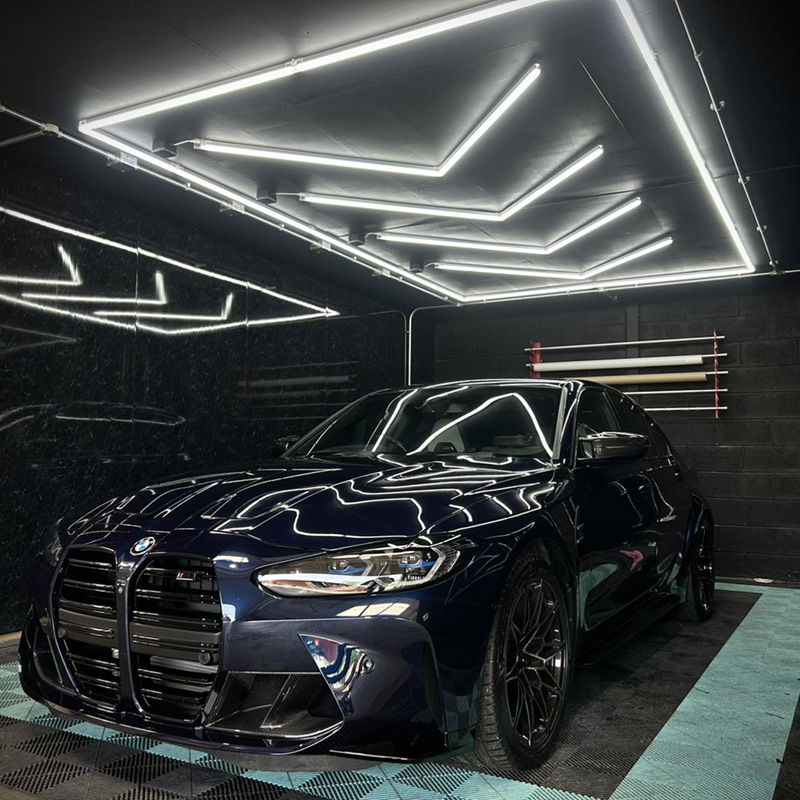
Picture a bustling commercial car wash or a high-end detailing bay on a busy Saturday morning. High-pressure wands blast away heavy grime. Hot wax hits cold metal. The air quickly turns thick with atomized water and harsh chemical vapor. In this chaotic and heavily saturated environment, technicians frequently find themselves squinting through a thick haze. They struggle to see if they missed a subtle patch of dirt or a hard water spot. Traditional fluorescent and incandescent bulbs simply fail under these extreme conditions. They produce a blinding glare when their light strikes suspended moisture. Furthermore, outdated fixtures introduce severe electrical safety risks and demand constant, frustrating maintenance.
The definitive solution to this operational nightmare lies in modern illumination technology. Purpose-built LED fixtures are engineered specifically to conquer adverse microclimates. By cutting through dense fog and completely sealing out corrosive moisture, these advanced systems transform hazardous wash bays into safe workspaces. In this comprehensive guide, we will explore the exact science behind LED visibility. We will dissect critical safety ratings and outline how upgrading your facility hardware dramatically boosts your bottom line.
Key Takeaways
Superior Visibility: High-lumen, directional LED fixtures penetrate heavy fog and water spray with ease. This ensures technicians never miss residual dirt during the cleaning process.
Maximum Safety: Fixtures boasting IP65 ratings or higher hermetically seal out moisture and dust. This entirely mitigates the risk of catastrophic electrical shorts in wet zones.
Chemical Resistance: Purpose-built wash bay LEDs utilize durable polycarbonate lenses and treated aluminum housings. They resist rapid degradation from alkaline soaps and acidic wheel cleaners.
Precision Detailing: An optimal color temperature of 5000K to 6000K closely mimics natural daylight. This creates the ideal spectrum for flawless paint correction.
High ROI: Transitioning to LED technology slashes facility electrical loads by up to 70 percent. It also virtually eliminates the steep labor costs associated with frequent bulb replacements.
The Unique Challenges of Lighting in Wet Working Environments
Operating a commercial auto facility involves managing one of the most demanding indoor environments imaginable. The relentless combination of pressurized water, rapid temperature fluctuations, and caustic cleaning agents creates a perfect storm. Standard commercial hardware degrades rapidly under these stresses.
Dealing with Constant Moisture and Fog
In an active wash bay, industrial hoses atomize water into a microscopic mist that hangs heavy in the air. This constant fog acts as thousands of tiny suspended prisms. When traditional omnidirectional light strikes this mist, the light scatters erratically in every direction. This extreme scattering effect creates a washed-out glare. It significantly reduces visual clarity and makes it nearly impossible for workers to inspect lower rocker panels accurately.
The Danger of Electrical Hazards
Field technicians understand a fundamental rule of facility management. Water and electricity are a lethal combination. Outdated lighting fixtures frequently lack heavy-duty vapor-tight seals. When ambient moisture inevitably penetrates a standard metal housing, it triggers ground faults and constantly trips circuit breakers. In the worst-case scenario, it creates a severe shock hazard for employees standing on wet concrete. Guaranteeing workplace safety requires hardware engineered from the ground up for high-moisture exposure.
Chemical Corrosion on Fixtures
Beyond the sheer volume of water, these workspaces are highly corrosive. Daily operations rely heavily on a potent cocktail of harsh chemicals. Alkaline pre-soaks, heavy-duty degreasers, and acidic wheel cleaners fill the air. When these airborne chemical vapors settle onto standard metal light fixtures, they rapidly accelerate oxidation. Over a surprisingly short period, this chemical bombardment compromises the structural integrity of the housing and clouds the plastic lenses.
How LED Car Wash Lights Cut Through Moisture and Enhance Visibility
To overcome blinding glare and shadowy corners, facility managers are rapidly abandoning legacy bulbs. Advanced LED technology operates on entirely different optical principles. These modern diodes offer distinct visual advantages when bay conditions deteriorate.
High Lumen Output vs. Glare
The most profound advantage of LED technology in a foggy room is its inherently directional nature. Instead of throwing light in all directions and relying on inefficient metal reflectors, light-emitting diodes push a tightly focused beam directly toward the target area. By channeling illumination precisely onto the wet surface of the vehicle, LEDs drastically minimize stray light scattered into the surrounding vapor. This controlled output pierces through the mist. It virtually eliminates blinding glare and allows technicians to work with uncompromised vision.
The Role of Color Temperature
Achieving perfect visibility is not merely a matter of brute-force brightness. It is heavily dependent on the exact color of the light, measured in Kelvin. For wet working environments, the absolute industry standard ranges tightly between 5000K and 6000K. This specific daylight white spectrum provides crisp, high-contrast illumination. Under a 5000K canopy, soap scum and residual road film stand out with stark clarity against the clear coat. For professionals seeking flawless results, investing in high-quality LED Car Beauty Lighting ensures the vehicle finish is represented exactly as it would appear under the blazing midday sun.
Uniform Light Distribution
Modern lighting layouts are strategically mapped to eradicate dark spots. Whether a facility utilizes sleek linear vapor-tight tubes or geometric hex grid patterns, strategic placement ensures uniform light distribution across the entire bay. This seamless canopy of light is absolutely crucial for illuminating wheel wells and undercarriages. These notoriously difficult areas require the most aggressive scrubbing.
The Industry Shift Toward Sustainable Wash Bay Operations
Recent market analyses reveal a massive sector-wide shift in automotive facility management. The focus is now heavily on sustainable and eco-conscious operations. Driven by stricter municipal energy codes and broader environmental goals, modern car washes are rapidly abandoning power-hungry systems. Upgrading to smart, low-draw LED technology is no longer just a trend for ultra-premium detailing studios. It has become a baseline regulatory compliance strategy. As local power grids face higher demands, facilities that proactively adopt energy-efficient lighting position themselves to avoid future compliance penalties. They simultaneously maximize their operational margins in an increasingly competitive market.
Safety First: Understanding IP Ratings for Wet Environments
When evaluating any electrical equipment for a chemically harsh room, marketing claims mean very little without technical validation. The most objective metric for assessing fixture survivability is its Ingress Protection rating.
Decoding the IP Rating System
The IP rating system is a strict international standard used to define the exact levels of sealing effectiveness. The first digit signifies protection against solid bodies like dust and dirt, scaled zero to six. The second digit indicates the level of defense against liquids, scaled zero to nine.
IP65 vs. IP67 vs. IP69K
Understanding the specific operational demands of your bay dictates the necessary rating. Here is a practical breakdown relevant to auto facilities:
IP65: Completely dust-tight and protected against low-pressure water jets from any angle. This is the baseline standard for general wash bays and professional detailing shops.
IP67: Dust-tight and protected against temporary full immersion in water. Ideal for areas prone to heavy splashing or accidental flooding.
IP69K: The ultimate gold standard. Completely dust-tight and capable of withstanding close-range, high-pressure, and high-temperature spray washdowns. This is mandatory for automated direct-spray tunnels.
Thermal Shock Prevention
Beyond the threat of water ingress, thermal shock is a terrifying safety concern associated with traditional lighting. Halogen and metal halide bulbs generate blistering heat during operation. If a stray blast of cold water splashes onto a hot glass lens, the sudden thermal shock causes the fixture to shatter violently. Hazardous glass shards rain down onto the crew. Because LEDs convert the vast majority of their electrical energy into light rather than waste heat, they run significantly cooler. This fundamental shift in thermal dynamics completely eliminates the risk of shattered lenses.
Core Technology Comparison
To truly understand the operational leap LED provides, facility managers must look at the raw data. The table below highlights the stark contrast between legacy systems and modern engineering.
Feature
Traditional Metal Halide / Fluorescent
Purpose-Built Wash Bay LED
Energy Consumption
Extremely High up to 400W per fixture
Highly Efficient typically 100W to 150W
Lifespan
10,000 to 15,000 hours with rapid dimming
50,000 to 100,000+ hours with sustained brightness
Moisture Resistance
Poor prone to internal rusting and GFCI trips
Excellent IP65 to IP69K hermetically sealed
Heat Emission
Severe high risk of thermal shock shattering
Minimal aluminum heat sinks dissipate warmth
Light Direction
Omnidirectional causes heavy fog glare
Directional cuts through mist with precision
Color Rendering Index: The Secret to Perfect Automotive Illumination
For high-end studios offering premium services like multi-stage paint correction and ceramic coating application, basic illumination is woefully insufficient. Precision automotive enhancement requires high-fidelity, color-accurate lighting.
Why CRI Matters More Than Brightness
The Color Rendering Index measures the ability of a light source to accurately reveal the true colors of an object compared to natural sunlight. While lumen output dictates the sheer brightness of a room, CRI dictates the accuracy and depth of the colors you see. Standard warehouse lighting often hovers around a dismal 70 CRI. This flattens metallic flakes and washes out vibrant reds and blues.
Precision Work in the Detailing Bay
Inside a dedicated detailing bay, technicians hunt for microscopic defects. Fine spiderweb scratches, hologram swirl marks left by rotary buffers, and stubborn streaks of leftover polish residue are common targets. These minor imperfections are virtually invisible under cheap fluorescent tubes. High-CRI Car Detailing Shop Lights provide the razor-sharp visual clarity required for a detailer to execute flawless correction work. Simply put, if a detailer cannot see the defect, they cannot fix it.
Durability and Maintenance: Built for Harsh Environments
In a high-volume facility, operational downtime equates to a direct loss of daily revenue. When outfitting a bay, facility managers must prioritize rugged construction to minimize costly maintenance interruptions.
Vapor-Tight and Corrosion-Proof Housings
Premium fixtures are forged from materials specifically chosen for aggressive chemical resistance. The outer housings are typically molded from heavy-duty polycarbonate. This highly advanced thermoplastic polymer is renowned for its extreme impact resistance and glass-like optical clarity. Unlike traditional glass, a polycarbonate lens simply bounces off a stray wand strike without shattering. In addition, internal heat sinks and external mounting hardware utilize anodized aluminum. This effectively halts the rust and chemical degradation caused by daily exposure to caustic wheel acids.
The Extended Operational Lifespan
Legacy fluorescent tubes are notoriously fragile. They typically burn out quickly while suffering from severe lumen depreciation, which means they grow noticeably dimmer long before they actually die. In stark contrast, commercial-grade LED systems are conservatively rated for 50,000 hours of continuous operation. For a business owner, this translates to nearly a decade of maintenance-free reliability. You no longer need to halt tunnel operations and put employees at risk on slippery floors just to swap out dead bulbs.
Upgrading Your Facility: ROI and Energy Savings
Transitioning to modern illumination systems is a highly calculated business decision rooted in operational efficiency. Facility managers objectively evaluate the financial impact of equipment choices. The return on investment is primarily driven by drastic reductions in energy consumption.
Slashing Energy Bills
Traditional lighting systems are financial black holes. A standard metal halide bulb easily consumes 400 watts of electricity, bleeding a massive portion of that energy off as useless heat. Conversely, purpose-built LEDs designed for wet environments typically draw a mere 100 to 150 watts while delivering vastly superior lumen output. This represents an immediate energy reduction of roughly 70 percent per fixture. When these lights operate for 14 to 24 hours a day, the cumulative drop in kilowatt-hour usage directly inflates your bottom line.
Utility Rebates and Calculating ROI
To accelerate this green transition, many utility companies offer lucrative commercial rebate programs. These can offset 15 to 30 percent of initial hardware costs. When calculating the exact financial timeline of an upgrade, the math is incredibly compelling. Factor in the complete elimination of replacement bulbs and electrician labor, and a typical LED system entirely pays for itself within 12 to 18 months. After that brief payback period, those savings become pure retained profit.
Key Features to Look for When Buying LED Wash Bay Lights
Sourcing the correct hardware for a chemically harsh environment requires strict adherence to technical specifications. Consumer-grade residential lights fail catastrophically under industrial stress. Use this objective engineering checklist when outfitting your space:
Minimum IP65 Rating: This is an absolute non-negotiable requirement. Ensure the manufacturer explicitly guarantees protection against low-pressure water jets and total dust ingress.
Vapor-Tight Design: Look for hermetically sealed enclosures featuring heavy-duty silicone gaskets. These lock out invisible steam and chemical condensation.
Linkable Capabilities: For expansive facilities, selecting a linkable Garage Workshop Light system offers streamlined installation. Daisy-chaining allows multiple fixtures to connect in a continuous series, minimizing complex wiring and reducing points of potential water entry.
High CRI: To guarantee accurate color representation for final quality control inspections, verify the Color Rendering Index is at least 85.
Polycarbonate Construction: Demand products built with impact-resistant PC lenses and aluminum heat sinks to survive caustic chemical exposure.
Conclusion
Surviving and thriving in a wet, chemical-heavy workspace requires tools engineered specifically for the battle. Purpose-built LED lighting is far more than a simple aesthetic upgrade. It is a critical operational asset that drastically improves workplace safety, enhances visual precision, and drives facility efficiency. By cutting through heavy moisture without the blinding glare of traditional bulbs, these advanced fixtures empower technicians to deliver flawless results every single time. Ultimately, upgrading your illumination slashes utility overhead and eliminates frustrating maintenance cycles. Make the switch to resilient, waterproof LED technology today with solutions from Contation LED, and fundamentally transform the way your facility operates.
FAQ
Can I use standard LED garage lights in a car wash bay?
No. Standard residential LED fixtures lack the necessary vapor-tight silicone seals and appropriate IP ratings required by strict electrical safety codes for wet locations. Installing non-waterproof lights in an environment saturated with constant water spray inevitably leads to moisture ingress. This causes immediate fixture failure, rapid corrosion of internal diodes, and introduces a severe electrical shock hazard to your staff. Always specify fixtures that are strictly IP65-rated or higher.
What is the best color temperature for automotive detailing?
The scientifically ideal color temperature for automotive washing and detailing environments sits between 5000K and 6000K. This specific range is classified as daylight white. Unlike warm white, which casts a muddy yellow hue that hides paint imperfections, or cool blue, which causes severe eye strain, the 5000K to 6000K spectrum provides the highest possible visual contrast. This allows your team to easily identify hard water spots and delicate clear coat scratches without visual distortion.
Do LED wash lights cause glare in foggy conditions?
When properly engineered, they do not. Standard omnidirectional bulbs scatter light indiscriminately. This light bounces off suspended water droplets and creates a blinding wall of glare. High-quality LED wash lights are designed with tightly controlled directional beam angles. They utilize specialized frosted or clear polycarbonate diffusers. These advanced optical components focus the high-lumen output directly onto the vehicle surface, effectively piercing through steam and fog while significantly minimizing light scatter.
How do LEDs hold up against car wash chemicals?
Purpose-built LED fixtures are highly resilient to aggressive chemicals. Wash bays heavily utilize alkaline pre-soaks, acidic wheel cleaners, and hot polymer waxes. Premium wash lights counter this by using heavy-duty polycarbonate housings and coated anti-corrosive aluminum heat sinks. These specific industrial materials are chemically inert to most standard automotive cleaning agents. They effectively prevent the housing degradation, yellowing, and rapid rust that destroy cheap plastic fixtures.
Are commercial LED lighting systems difficult to install?
The physical mounting of commercial LED systems is generally straightforward. Many modern designs feature plug-and-play daisy-chain wiring that allows multiple units to link together seamlessly. However, because the installation occurs in a designated wet environment, strict adherence to local electrical codes is mandatory. It is highly recommended to employ a licensed electrician to ensure all junction boxes, conduits, and final connections are hermetically sealed against moisture.
How many lumens do I need for a commercial wash bay?
For a highly functional commercial wash bay, lighting engineers typically recommend aiming for 75 to 100 foot-candles at the floor level. To achieve this without overloading your electrical panel, look for high-output LED fixtures that deliver between 110 and 120 lumens per watt. Proper strategic spacing of these high-lumen fixtures ensures that lower door panels and undercarriages receive adequate illumination.
Are hexagonal grid lights suitable for wet environments?
Yes, provided they are specifically engineered for wet locations. Standard decorative hex grids used in dry showrooms will fail immediately in a wash bay. However, true wash-bay-rated hex grids feature IP65 or IP68 waterproof ratings, sealed silicone connectors, and durable polycarbonate tubes. When properly specified, these geometric systems provide excellent, shadow-free illumination that is perfect for professional detailing and washing.