


Views: 0 Author: Site Editor Publish Time: 2026-09-27 Origin: Site


Designing, installing, and dismantling static seasonal displays creates a massive logistical burden for retail managers, event coordinators, and architectural designers. Traditional seasonal lighting demands continuous reinvestment in single-use materials. It requires intensive labor for overnight changeovers and lacks the flexibility to adapt to micro-seasons or spontaneous promotional events. Transitioning from static fixtures to color changing hexagon lights establishes a permanent, programmable lighting infrastructure. This guide evaluates how these modular systems meet commercial and high-end display requirements. We balance upfront technical integration with long-term operational efficiency and aesthetic longevity. You will learn how to move away from disposable props and build a dynamic visual environment that shifts themes instantly through software control. Implementing this technology requires careful planning regarding power distribution, structural mounting, and network stability to ensure flawless execution during critical promotional periods.
Hidden costs of static displays drain operational budgets year-round. Facility managers constantly battle storage fees for off-season props. Large fiberglass pumpkins, artificial snow machines, and miles of standard string lights take up valuable warehouse space for eleven months of the year. Labor hours spent on installation and removal disrupt normal operations. Teams often work expensive overnight shifts to tear down autumn displays and install winter themes before doors open the next morning. Material waste from discarded single-use decorations directly conflicts with corporate sustainability goals.
Traditional string lights and static fixtures remain fundamentally inflexible. They cannot adapt to rapid retail shifts or event calendar changes. A red-and-green holiday setup becomes obsolete on December 26th. You cannot repurpose it for a New Year's promotion without a complete physical teardown. This rigid approach forces businesses into a reactive cycle. Teams spend weeks planning and executing a physical changeover for a display that only lasts a month. Furthermore, traditional incandescent or basic LED string lights suffer from high failure rates. A single broken bulb or a severed wire can darken an entire section. Maintenance crews waste hours troubleshooting dead zones while the display looks unprofessional to visitors.
Investing in dynamic infrastructure requires strict success criteria to ensure long-term viability. A high color rendering index (CRI) ensures that illuminated merchandise looks natural under the light. Poor CRI makes clothing, food, or vehicles look washed out and unappealing. Seamless modular connectivity prevents visible dark gaps between panels. The hardware must maintain the illusion of a single continuous light source rather than a collection of disjointed plastic shapes. Robust software integration allows for automated scheduling. The lighting shifts themes without human intervention, running on a pre-programmed calendar.
We must evaluate the return on investment model. Compare the initial capital expenditure of customizable RGB hexagon lights against amortized savings. Multi-season reusability eliminates recurring prop purchases. A single permanent installation serves Halloween, Christmas, and summer sales through simple software updates. The labor cost drops to near zero after the initial installation. Facility managers simply load a new digital preset instead of renting scissor lifts and hiring decorators. The physical infrastructure remains untouched while the visual environment transforms completely.
Wall-mounted configurations excel at visual merchandising. They create dynamic photo backdrops and interactive event exhibits. Vertical installations draw immediate attention to specific retail zones or architectural features. Structural requirements dictate careful planning before mounting. Vertical load-bearing capacity matters when stacking multiple panels. The cumulative weight puts stress on the lowest connectors and the bottom mounting points.
Achieving a flush-mount aesthetic requires precision. The display must look built-in rather than tacked-on. Recessing RGB hexagon wall lights into drywall creates a premium architectural finish. Surface mounting requires meticulous cable management to hide wires from eye level. Installers often use custom MDF backer boards. They route channels in the backer board to conceal data and power cables. This technique allows the entire array to sit perfectly flat against the wall, projecting a professional, high-end appearance.
Overhead deployments transform ambient environments entirely. You can transition from warm autumn tones to cool winter palettes instantly. Ceiling arrays envelop the entire space in a cohesive theme, altering the mood of the room from above. Installation complexities increase significantly during interior renovations or new builds. Integrating with existing trim wood demands precise measurements and custom carpentry.
Drop ceilings require specialized mounting brackets to distribute weight safely across the T-bar grid. You cannot simply screw panels into acoustic tiles. The tiles will sag and eventually collapse under the weight. Overhead cable routing must comply with strict local building codes regarding plenum-rated wiring. If the space above the drop ceiling acts as a return air plenum for the HVAC system, all exposed wiring must have a fire-resistant Teflon jacket.
Beyond retail, these systems elevate high-end residential spaces. Luxury garages use them to highlight vehicle contours and create showroom-quality lighting. Professional streaming rooms rely on them for season-responsive backgrounds. RGB hexagon ceiling lights provide unparalleled atmospheric control when installed with structural integrity in mind.
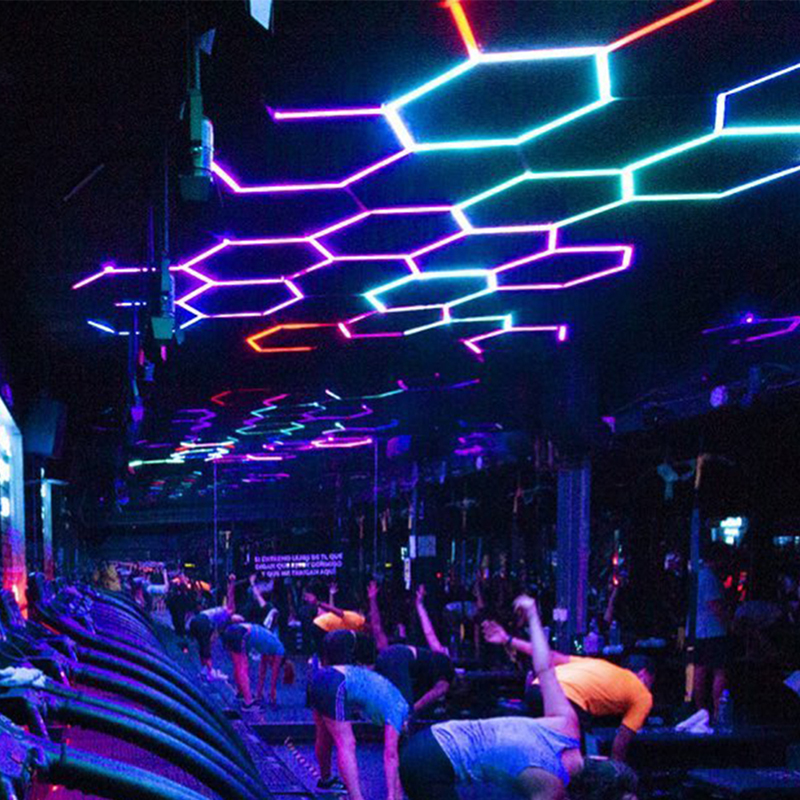
Diode quality dictates the visual impact of any seasonal display. Dedicated white diodes (RGBW) are absolutely essential for premium installations. They achieve pure seasonal whites, like crisp winter snow themes or clean architectural illumination. Standard RGB-mixed whites often appear muddy, casting an unwanted blue or pink tint across the room. When evaluating panels, always verify the diode configuration.
Lumen output determines visibility and effectiveness. High-ambient-light environments, such as retail storefronts or brightly lit garages, require powerful output. If the display cannot compete with natural sunlight or existing overhead fixtures, the seasonal effect fails. You need panels capable of pushing at least 800 to 1000 lumens per square meter to cut through ambient glare.
Control interfaces vary significantly across manufacturers. Proprietary mobile apps suit smaller setups or residential applications. However, DMX compatibility remains mandatory for commercial lighting consoles and large-scale event spaces. Custom scene creation allows designers to map specific colors to individual panels, creating intricate seasonal patterns like falling snow or flickering autumn leaves.
Scheduling features automate seasonal transitions based on the calendar year. Multi-zone synchronization coordinates complex animations across different rooms or entirely different buildings. A master controller can trigger a synchronized New Year's countdown across a retail chain's entire footprint simultaneously.
Physical connectors between panels must withstand environmental stress and minor building vibrations. Flimsy clips lead to signal degradation over long runs. Structural integrity suffers if connectors cannot bear the panel weight during vertical or overhead installations. You must define the maximum number of panels per controller before finalizing the design.
Exceeding this limit requires signal repeaters or additional power injections. Data signals degrade as they pass through multiple panels. If the data run is too long, the panels at the end will lag, flicker, or display the wrong colors. The internal copper traces on the printed circuit boards can only carry so much current before resistance causes a voltage drop.
Initial investments include the panels, smart controllers, mounting hardware, and professional installation labor. This upfront cost heavily exceeds traditional string lights or paper decorations. However, operational savings over a 3-5 year lifecycle easily justify the expense. You eliminate annual purchasing, off-site storage rentals, and repetitive labor costs.
Premium commercial-grade RGB hexagon lights outperform budget consumer alternatives significantly. High-uptime environments demand longevity. Cheaper panels suffer from diode burnout, plastic yellowing due to UV exposure, and brittle connectors. Investing in commercial-grade hardware ensures the display looks as vibrant in year four as it did on day one.
| Factor | Traditional Seasonal Lighting | Customizable Hexagon Lights |
|---|---|---|
| Installation Labor | High (Repeated every season) | High (One-time only) |
| Storage Requirements | Extensive (Requires warehouse space) | None (Permanent fixture) |
| Thematic Flexibility | None (Physically static) | Infinite (Software controlled) |
| Material Waste | High (Discarded props and broken bulbs) | Low (Long-lasting LED technology) |
| Long-Term ROI | Negative (Continuous sunk costs) | Positive (Amortized over multiple years) |
Large-scale LED arrays draw measurable power, requiring dedicated circuits for massive installations. However, LED technology remains highly efficient compared to legacy lighting. Compare this to traditional incandescent seasonal lighting. LEDs produce significantly less heat, reducing the load on HVAC systems in retail environments. They consume a fraction of the wattage while delivering superior brightness.
Automated scheduling further reduces off-hour waste. Facility managers can program the lights to power down completely after closing hours. Dimming panels by just 20% extends diode lifespan exponentially and cuts energy draw without a noticeable drop in visual impact. Smart power management ensures the display remains environmentally and economically sustainable.
Relying on double-sided cable tape risks catastrophic failure. Standard adhesives degrade under temperature fluctuations, humidity, and time. Ceiling deployments demand permanent, mechanical solutions. We recommend a strict two-step installation workflow for any professional environment.
Use cable tape strictly for temporary layout and alignment. Follow immediately with permanent hardware anchoring using screws, toggle bolts, or specialized mounting plates. This prevents panel detachment and potential injury. Achieving a built-in aesthetic requires strategic planning. Hide wiring and power supplies behind drywall or above drop ceilings. Integrate panels within custom ceiling trim wood. Routing channels into the wood allows the panels to sit flush, ensuring the display looks professionally integrated and lasts over time.
Voltage drop plagues extensive panel arrays. It causes noticeable and unacceptable color shifting. A pure white display might turn yellow, pink, or dim significantly at the end of the run. This happens because the electrical resistance in the internal wiring reduces the voltage available to the furthest panels.
Mitigation requires precise electrical calculations. Determine the total wattage of the array before purchasing power supplies. Utilize multiple power supplies to distribute the load evenly. Implement strategic power injection points every 15-20 panels, depending on the manufacturer's specifications. Running thicker gauge wire alongside the data run allows you to inject fresh power at regular intervals. This maintains consistent voltage, brightness, and color accuracy across the entire installation.
| Wire Gauge (AWG) | Maximum Distance for 12V Injection | Maximum Distance for 24V Injection |
|---|---|---|
| 18 AWG | 10 Feet | 25 Feet |
| 16 AWG | 15 Feet | 40 Feet |
| 14 AWG | 25 Feet | 60 Feet |
| 12 AWG | 40 Feet | 100 Feet |
Smart controllers often rely on standard 2.4GHz Wi-Fi or Bluetooth protocols. These consumer-grade networks fail in crowded commercial spaces. Hundreds of customer smartphones create signal interference, causing animation lag, dropped connections, or unresponsive panels. A seasonal display that freezes halfway through an animation looks broken.
Commercial displays require robust network stability. We strongly recommend hardwired Ethernet controllers for any critical installation. If wireless control is unavoidable, set up dedicated local networks (VLANs) with hidden SSIDs. This isolates lighting data from public Wi-Fi traffic. Securing the network infrastructure prevents connectivity dropouts during critical seasonal events and protects the system from unauthorized access.
A: They utilize programmable RGB or RGBW LEDs controlled via software. Users instantly switch color palettes, patterns, and animations to match any holiday or season without changing physical hardware.
A: Yes. High-end panels integrate with platforms like Razer Chroma, Apple HomeKit, or commercial DMX systems to sync perfectly with ambient room lighting and audio setups.
A: Permanent ceiling installations must utilize mechanical fasteners, screw-in mounting plates, or integration into custom trim wood. This ensures long-term safety, a flush aesthetic, and prevents falling panels.
A: Most standard power supplies support between 10 to 25 panels depending on wattage. Exceeding this limit requires additional power supplies and injection points to prevent voltage drop and color degradation.
A: LED technology is highly energy-efficient. Large arrays running at 100% brightness draw significant power, but utilizing scheduling software and dimming features optimizes energy consumption and extends diode lifespan.
A: Standard panels are designed for indoor use only. Outdoor installations require IP65 or IP67 rated panels with weatherproof connectors and sealed power supplies to withstand rain and humidity.


