


Views: 0 Author: Site Editor Publish Time: 2026-09-18 Origin: Site


Missed surface defects cost professional auto body shops heavily. Rework directly erodes profit margins and bottlenecks bay turnover. Standard overhead shop lighting limits your visibility on the floor. Uneven light distribution creates blind spots across complex vehicle panels. Harsh glare masks micro-scratches, sanding pigtails, and swirl marks. Localized shadows hide orange peel and uneven clear coats on lower doors. You cannot fix what you cannot see. Installing car workshop tunnel lights solves this problem completely. They provide an engineered optical environment built for the trade. These systems manipulate contrast and reflection precisely. Technicians can evaluate bodywork with absolute certainty. This accuracy extends from initial damage estimation to the final customer handover. We will break down how these lighting structures transform defect detection. You will understand their specific applications, structural requirements, and daily operational benefits on the shop floor.
Standard shop lighting relies on point-source fixtures mounted high above the floor. These create harsh, localized reflections on fresh clear coats. Bright spots blind the inspector instantly. Adjacent panels fall into deep shadow. You miss defects hidden in these dark zones. Standard fluorescent tubes fail to render paint color accurately. Low-CRI LED fixtures wash out paint depth. They make metallic flakes look flat and dull. Poor lighting compromises your entire quality control process. You cannot accurately gauge clear coat clarity. Technicians struggle to spot fine 3000-grit sanding marks. They miss buffer trails left from previous polishing stages. Relying on basic grid lighting guarantees missed imperfections. When a technician uses a dual-action polisher, the compound leaves a micro-marring haze. Point-source lights punch right through this haze. The panel looks glossy under the bulb but looks terrible in natural sunlight. You need a light source that reveals the true surface condition. Rotary polishers leave distinct holograms that shift depending on the viewing angle. A single overhead bulb will only reveal a fraction of these holograms. The rest remain invisible until the customer drives the car into direct sunlight.
Human eyes perceive surface anomalies through disrupted light patterns. Dents, scratches, and swirl marks break surface reflections. You need consistent contrast to spot these disruptions. A continuous arch of light creates uniform reflection bands. These bands stretch across the clear coat smoothly. Any surface imperfection breaks this smooth reflection immediately. The defect becomes obvious to the naked eye. Shadow reduction plays a vital role here. Overhead lights cast shadows on lower door panels. They leave rocker panels completely dark. Tunnel structures illuminate these lower areas perfectly. They wrap light around the entire vehicle profile. You gain total visual control over the exterior surface.
A detailing light tunnel uses a distinct structural geometry. It wraps around the vehicle completely. Traditional ceiling-mounted grids only light the top horizontal surfaces. Wrap-around designs illuminate vertical panels effectively. Doors, fenders, and bumpers receive direct, even light. Continuous illumination minimizes shadows cast by technicians. It reduces shadows from lifts and detailing equipment. Ambient visibility improves across interior detailing zones. Inspection areas benefit from consistent light distribution. If you use a mid-rise scissor lift, traditional overhead lights get blocked by the vehicle itself. The lower half of the car falls into darkness. A tunnel structure pushes light from the sides, bypassing the lift entirely.
| Lighting Feature | Standard Grid Lighting | Continuous Arch Tunnel |
|---|---|---|
| Vertical Panel Visibility | Poor (Heavy shadows on doors/bumpers) | Excellent (Direct wrap-around illumination) |
| Defect Contrast | Low (Point-source glare hides flaws) | High (Uniform reflection bands reveal flaws) |
| Equipment Shadowing | High (Lifts and tools block light) | Low (Multi-angled light fills shadows) |
| Interior Visibility | Inconsistent and dim | Bright and uniform across the cabin |
| Lower Rocker Illumination | Non-existent without floor lamps | Fully illuminated by lower arch segments |
High-intensity lighting can cause severe eye strain. Advanced tunnels use specialized diffusers to solve this. Appropriate prisms direct maximum lux onto the vehicle body. They shield the operator's direct line of sight. This prevents optical blow-out on highly reflective surfaces. Technicians perform multi-hour paint correction sessions daily. Reducing eye fatigue is mandatory for consistent quality. Glare mitigation protects technician vision over long shifts. It allows them to focus on micro-defects safely. Bare LED strips cause blinding glare and headaches. Engineered diffusers scatter the light evenly. You get intense illumination without the harsh glare. When you stare at a polished hood for three hours, raw LEDs will ruin your focus. The diffusers soften the beam just enough. They maintain the sharp edge needed to read the paint reflection. The angle of the prism ensures the light hits the paint, not the technician's face.
Automotive inspection requires strict technical lighting thresholds. You need a Color Rendering Index (CRI) of 95 or higher. This accurately gauges color match across adjacent panels. It reveals true metallic flake distribution. High CRI ensures clear coat clarity assessment. High-CRI LEDs prevent metamerism entirely. Metamerism happens when colors match under one light but clash under another. Painters need absolute color accuracy for blending. Detailers need to see the true condition of the paint. A high-CRI environment guarantees indoor visibility matches natural sunlight. You avoid costly repaints and customer complaints. If you spray a tri-coat pearl, you must see the mid-coat depth. Low CRI lights make pearls look muddy. High CRI lights show the exact flake orientation. Complex colors like Mazda Soul Red or metallic blacks require perfect lighting to match the factory finish.
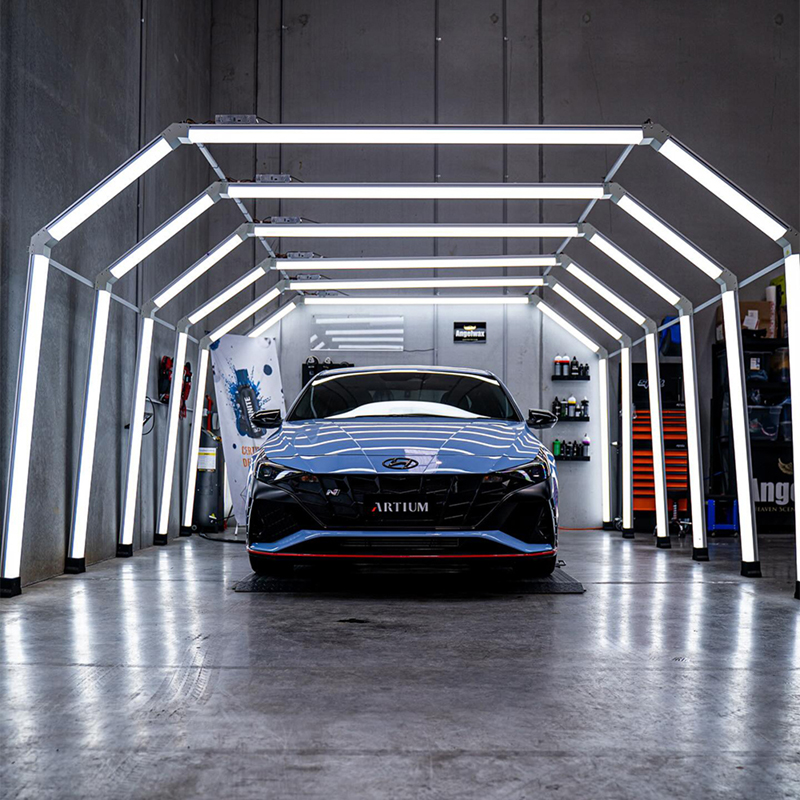
Even light distribution transforms the polishing stage. It aids in identifying buffer trails instantly. You can spot holograms before the vehicle leaves the bay. Compounding haze becomes obvious under continuous arches. Technicians can track their progress panel by panel. They know exactly when a surface is flawless. You eliminate the guesswork from heavy paint correction. The uniform reflection bands guide the polisher's path. You achieve mirror finishes with fewer passes. When you step down from a heavy wool pad to a foam finishing pad, the light shows the transition. You see the micro-marring disappear in real-time. This prevents over-thinning the clear coat. Ceramic coating application also benefits massively. High spots occur when excess coating is not leveled properly. These high spots cure into dark, oily-looking streaks. The tunnel lighting highlights these streaks immediately, allowing you to level the coating before it hardens.
PPF installation requires absolute precision and cleanliness. You need a completely shadow-free environment. This helps spot dust nibs quickly. Installers can see silvering and air bubbles clearly. You must catch these before the adhesive sets permanently. A car detailing light tunnel provides this necessary clarity. Shadows hide trapped moisture along lower edges. Even lighting exposes every flaw under transparent films. Vinyl wrap installers benefit equally from this setup. They can align complex graphics perfectly. They spot tension lines before the vinyl stretches too far. Squeegee strokes become more deliberate. You can see the slip solution evacuating from under the film. Whether you are doing a bulk installation or using pre-cut patterns, visibility dictates the final quality. The lower arch lights ensure the rocker panels and complex front bumpers receive the same attention as the hood.
Light inspection tunnels serve a dual-stage purpose for PDR. Estimating bays use them to map hail strikes accurately. You can count every single dent on the roof and hood. This ensures precise insurance quotes upfront. You avoid frustrating supplemental claims later. Post-repair quality checks rely heavily on these tunnels. They provide verifiable proof of a perfect repair. The reflection bands highlight any remaining high spots. Technicians can massage the metal back to factory specifications. The tunnel acts as the ultimate truth-teller for metalwork. A PDR tech reads the fog line of the reflection. If the line bends, the dent is still there. The tunnel provides hundreds of these lines simultaneously. Whether you are glue pulling from the outside or pushing from behind with rods, the continuous light arch provides the necessary visual feedback.
An LED light tunnel doubles as a premium display environment. Shops showcase flawless paintwork during client handovers. This validates the cost of high-ticket services. Customers see the perfection of your work immediately. The dramatic lighting boosts your marketing imagery significantly. You can take stunning photos for social media portfolios. High-quality visuals attract premium clientele to your shop. The tunnel becomes a powerful sales tool on its own. When a client walks in to pick up their ceramic-coated vehicle, the presentation matters. The arch lighting makes the gloss pop. It creates a memorable delivery experience. The psychology of the handover changes when the vehicle is presented under dedicated architectural lighting. It reinforces the premium nature of your detailing or bodywork services.
You must measure your existing bay dimensions carefully. Compare them against the required clearance for the structure. Factor in the maximum vehicle width you service. Consider ergonomics for personnel stationed within the structure. Technicians need room to move around the vehicle safely. Leave safe clearance around lifts and heavy equipment. Evaluate modular systems against fixed-frame options. Modular frames allow for future facility expansion easily. You can add sections as your business grows. You can reconfigure the arch if you move buildings. A standard bay might fit a passenger car, but what about a lifted truck? You must account for height clearance. Measure the distance from the floor to the lowest ceiling obstruction. Decide between floor-mounted systems and suspended ceiling mounts. Floor mounts require drilling into the concrete, while suspended systems rely on the structural integrity of your roof joists.
Do not just look at raw lumen output at the source. You must calculate the required lux at the vehicle surface. Lux measures light intensity over a specific area. Effective inspection requires high lux levels consistently. Modern LED tunnel configurations are highly energy efficient. They consume less power than legacy high-output shop lighting. You get brighter, cleaner light while lowering utility bills. LED technology directs light exactly where you need it. It wastes very little energy illuminating the ceiling. We measure lux at the paint surface. A reading of 1500 lux on the hood is ideal. You want that same 1500 lux reading on the lower doors. The inverse square law of light dictates that intensity drops rapidly as distance increases. Tunnel lights solve this by placing the light source closer to the vertical panels than any ceiling fixture could achieve.
Consider the environment where you will install the tunnel. Wash bays require strict IP54 or IP65 ratings. These ratings protect the fixtures from direct water spray. Sanding zones expose lights to heavy particulate matter. Sealed enclosures prevent dust ingress and internal damage. Address safety compliance regarding electrical enclosures. Commercial automotive environments have strict fire and safety codes. Ensure your chosen system meets all local regulations. Professional installation guarantees compliance with commercial building standards. If you run a pressure washer near the lights, IP65 is non-negotiable. Water ingress will short out the LED drivers instantly. Detailing chemicals like iron removers and strong all-purpose cleaners can degrade cheap plastics. Ensure the diffusers and aluminum housings are chemically resistant to withstand daily shop exposure.
These systems require upfront capital expenditure. You must calculate this against the reduction in rework. Measure the average monthly cost of customer returns. Factor in the revenue lost to missed insurance claims. Account for wasted labor hours spent fixing unseen defects. A proper lighting system eliminates these hidden costs. The return on investment becomes clear quickly. Faster inspection times increase your bay turnover rate. You process more vehicles with higher accuracy. Let's look at the math. If a technician spends an extra hour fixing a missed scratch, that is lost labor. If this happens twice a week, the costs compound. The tunnel stops this bleed. It acts as a final quality control gate. Vehicles do not leave the shop with defects, which protects your reputation and eliminates unpaid rework sessions.
You can source a pre-engineered modular kit. Alternatively, you can hire contractors for a custom build. Modular kits offer faster installation times. They come with proven photometric data straight from the factory. Custom builds allow for unique architectural integration. Evaluate warranty coverage for both options carefully. Consider replacement part availability over the next decade. Modular systems usually have readily available spare parts. Custom builds might require specialized repairs. Factor in the installation downtime for your facility. A modular kit goes up in a weekend. A custom build might shut down your bay for a week. Shipping and freight damage risks also vary. Modular kits ship in secure, standardized crates. Custom extrusions require specialized freight handling. Choose the route that minimizes disruption to your daily operations.
High-output lighting systems draw significant power. You risk overloading existing shop circuits if you are not careful. Outline the necessity of dedicated breakers for the tunnel. Professional electrical installation is strictly required. Do not attempt to wire these systems on existing lighting circuits. Consult a licensed electrician before purchasing the unit. They will assess your current panel capacity accurately. Proper wiring ensures safe and reliable operation daily. You might need a sub-panel installed. The LED drivers require clean, consistent voltage. Voltage drops will cause the lights to flicker. Determine if the system runs on 110V or 220V. Commercial 220V setups often run more efficiently and allow more fixtures on a single circuit. Plan your conduit routing to keep the shop floor clear of tripping hazards.
Working inside a high-intensity light tunnel causes strain. All-day exposure to bright LEDs leads to fatigue. You must manage this reality proactively. Suggest mitigation strategies like dimmable zones. Implement section-specific switching for different tasks. Technicians can turn off sections they are not using. Balance the tunnel lighting with ambient shop lighting. Extreme contrast between the tunnel and the shop causes headaches. Gradual lighting transitions protect your staff's vision. If a tech is working on the lower rocker, they do not need the overhead arch on full blast. Zoned switching solves this. Consider painting the bay walls a matte grey or black. This absorbs stray light and prevents harsh reflections from bouncing back into the technician's eyes. Controlling the ambient environment maximizes the effectiveness of the tunnel.
LED drivers have a specific operational lifespan. They will eventually need replacement after thousands of hours. You must evaluate the ease of replacing individual components. Can you swap a light bar without dismantling the arch? Diffusers may get scratched or clouded over time. Easy replacement keeps your inspection environment optimal. Choose systems designed for quick commercial maintenance. Avoid fixtures that require factory servicing for basic bulb changes. Dust buildup on the diffusers reduces lux output. You need a system that is easy to wipe down. The aluminum tracks should resist corrosion from detailing chemicals. Check the manufacturer's warranty periods for both the LEDs and the drivers. A solid commercial warranty ensures your investment remains operational without unexpected out-of-pocket repair costs.
A: Target 5000K to 6500K to mimic natural daylight, ensuring optimal contrast for spotting clear coat defects without blue-light distortion.
A: Despite high lumen output, LED technology is highly efficient. A standard tunnel typically draws less power than a traditional heated spray booth or older metal-halide shop arrays.
A: Yes, provided the specific car workshop tunnel lights carry an adequate Ingress Protection (IP) rating, typically IP65 or higher, to withstand direct water spray and humidity.
A: They eliminate shadows along the lower rocker panels and bumpers, allowing installers to see trapped air, moisture, or debris beneath the film from any angle.
A: Most modular systems feature plug-and-play connectors and lightweight aluminum framing, allowing a small team to assemble them in one to two days, though professional electrical connection to the mains is required.
A: Rather than total lumens, focus on lux (lumens per square meter). Effective inspection requires approximately 1,000 to 2,000 lux consistently distributed across the vehicle surface.


