


Views: 0 Author: Site Editor Publish Time: 2026-09-25 Origin: Site


Open-plan commercial spaces, retail environments, and experiential venues consistently struggle with directing foot traffic organically without relying on visual clutter or intrusive, static signage. Traditional wayfinding remains rigid. When store layouts change, promotions shift, or event flows require redirection, static lighting and printed signs cannot adapt. This inflexibility leads to customer bottlenecks, dead zones, and lost revenue opportunities. Facility managers often find themselves trapped between installing permanent architectural fixtures or relying on temporary floor stands.
Programmable, modular lighting systems offer a dynamic alternative. By leveraging subconscious visual cues, businesses can use spatial illumination to direct behavior seamlessly. Instead of telling customers where to go, dynamic lighting naturally pulls them in the desired direction. This guide evaluates how to implement these systems to optimize customer flow, the technical criteria for commercial deployment, and the realities of physical installation.
Deploying advanced lighting systems goes far beyond basic aesthetic appeal. In commercial environments, lighting must perform a functional role. We measure the success of these installations through improved traffic distribution, reduced congestion in known bottleneck areas, and increased dwell time in high-margin zones. If a lighting installation looks impressive but fails to influence how people navigate the floor plan, it has not fulfilled its primary spatial objective. Success requires mapping out current traffic flow deficiencies and programming the lighting array to actively correct them. You need to integrate your lighting strategy with existing heat-mapping cameras or foot-traffic analytics. By establishing baseline metrics before installation, you can quantify how specific chasing animations or color zones alter visitor behavior. We look for a measurable drop in transit time through entryways and a corresponding increase in stationary time near featured product displays.
Humans process spatial information continuously, but modern commercial environments often bombard visitors with cognitive overload. Explicit signage—hanging banners, floor decals, and printed directories—frequently gets ignored because the brain filters out excessive textual information. Subconscious navigation relies on ambient, environmental cues. The human eye naturally tracks motion and gravitates toward well-lit, high-contrast areas. By using subtle environmental shifts, you can guide visitors without requiring them to stop, read, and process directions. Think about how a person navigates a crowded airport terminal. They rarely read every sign. Instead, they follow the brightest corridors and the general flow of movement. When you apply this principle to retail or exhibition spaces, you remove the friction of conscious decision-making. Visitors simply follow the light.
Linear track lighting forces a single, rigid path. It works well for straight aisles but fails when you need to direct traffic through open-concept areas or create intersections. The modular structure of customizable RGB hexagon lights provides a distinct geometric advantage. The six-sided shape allows designers to create branching paths, organic clusters, and unique lighting systems that mimic natural, non-linear foot traffic patterns. You can build nodes where paths diverge, allowing the ceiling layout to mirror the floor plan perfectly. A 120-degree Y-split in a hexagon grid naturally suggests a fork in the road, prompting visitors to choose a direction without feeling forced. This organic branching capability makes hexagonal grids far superior to standard square or linear fixtures when dealing with complex, multi-zone floor plans.
Lighting directly influences the physical pace of your visitors. Cool, dynamic lighting with high color temperatures (5000K and above) naturally accelerates movement. We use this approach in transit corridors, entryways, and transition zones to keep traffic flowing and prevent bottlenecks. The crisp, blue-white spectrum suppresses melatonin and increases alertness, prompting people to walk faster. Conversely, warm, static lighting (2700K to 3000K) encourages pausing, relaxation, and interaction. By strategically placing warm color palettes over specific product displays or consultation areas, you subconsciously signal to customers that it is time to slow down and engage. Transitioning a ceiling grid from a cool 5500K chase sequence into a warm 3000K static pool effectively acts as a visual brake pedal for foot traffic.
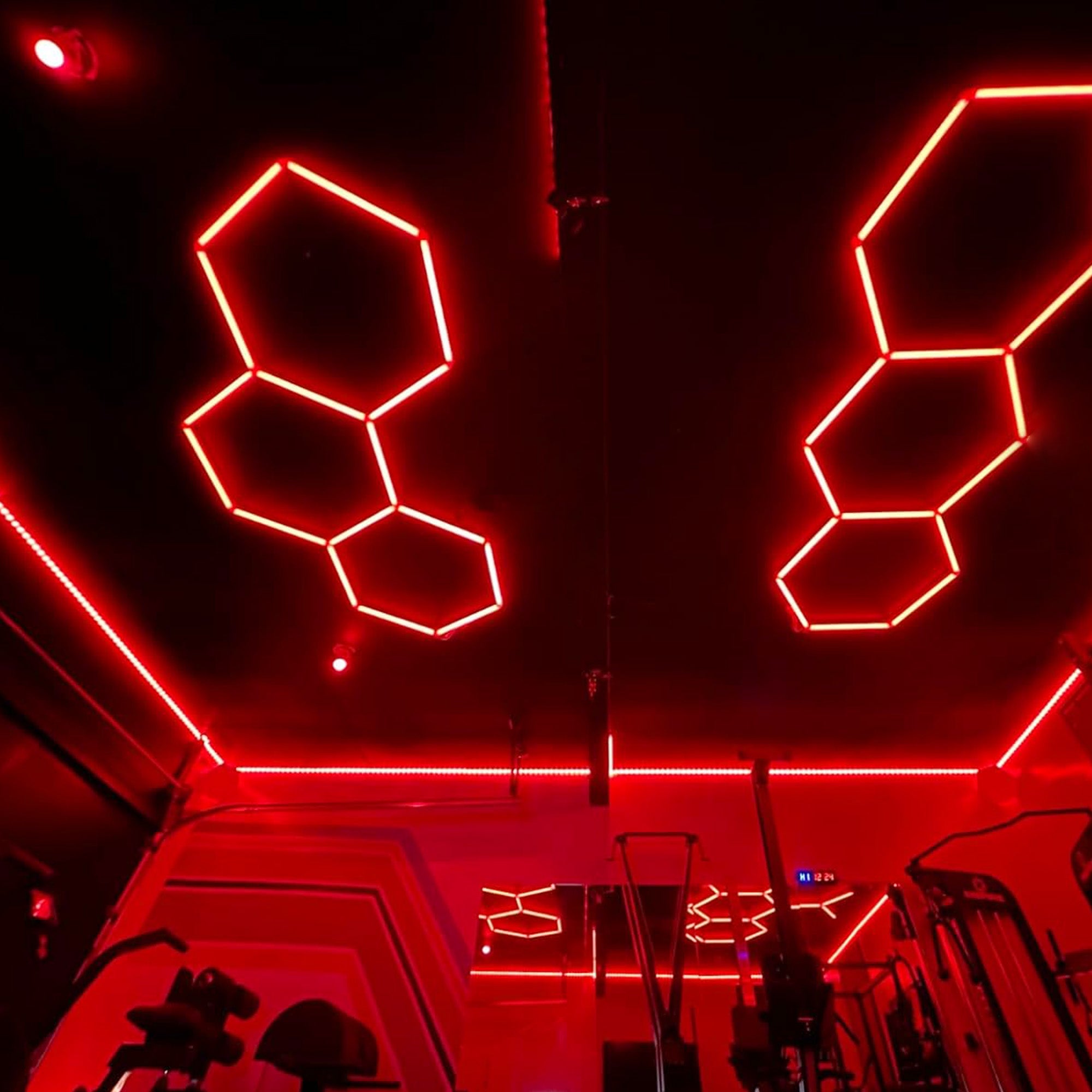
The true power of a modular lighting array lies in pixel mapping. By adjusting each module individually, the ceiling transforms into a digital canvas. This allows for complex, multi-directional animations rather than simple, global on/off states. Advanced RGB hexagon ceiling lights utilize addressable diodes, meaning a central controller can send unique color and intensity commands to every single panel in the grid. This level of control requires mapping the physical layout within lighting software, assigning a specific DMX address to each node. Once mapped, you can program sweeps, fades, and directional flows that move seamlessly across the entire ceiling structure, regardless of its physical shape.
You can utilize programmable nodes to create subtle chasing effects that act as digital breadcrumbs. Imagine a slow, pulsing wave of light that moves at three feet per second down a specific corridor. This gentle animation naturally pulls customers down aisles or toward key destinations. The motion must be fluid and appropriately paced. If the chase is too fast, it creates anxiety and visual discomfort. When paced correctly, visitors will instinctively follow the direction of the moving light without realizing they are being guided. We often program these chases to trigger based on time of day, directing morning traffic toward coffee counters and afternoon traffic toward general merchandise.
Massive floor plans often leave customers disoriented. Physical walls disrupt sightlines, but lighting can segment a space openly. Assigning specific color palettes to different areas visually breaks up the floor plan, helping customers orient themselves intuitively. For example, a technology section might feature crisp blue and white hexagonal clusters, while a lounge area transitions into deep ambers and purples. These color zones create invisible boundaries that organize the space logically. You eliminate the need for hanging department signs because the ceiling itself dictates where one zone ends and another begins.
When you need to highlight a specific area—such as a new product launch, a service desk, or a checkout counter—lighting provides the most immediate visual draw. Using high-intensity, contrasting colors on specific modular clusters draws immediate attention. If the surrounding ceiling array is operating at a dimmed, neutral tone, a sudden cluster of vibrant, saturated color acts as a visual magnet. This technique effectively pulls foot traffic across open spaces directly to high-priority zones. We frequently use this method to redirect flow during flash sales or to highlight temporary promotional displays without moving any physical infrastructure.
Commercial spaces require robust hardware. You must assess the necessity of high lumen output, especially for areas with significant daytime ambient light or large exterior windows. Weak LEDs will wash out completely under sunlight, rendering your wayfinding efforts useless. Equally critical is the role of frosted diffusers. Bare diodes create harsh glare and uncomfortable spotting on reflective surfaces below. High-quality polycarbonate diffusers scatter the light evenly across the hexagon's surface, creating a smooth, uniform glow that is comfortable to look at directly. Acrylic diffusers can yellow over time under UV exposure, so specifying UV-stabilized polycarbonate is mandatory for long-term installations.
Even in highly saturated RGB applications, commercial spaces require a high Color Rendering Index (CRI). Poor quality LEDs will visually distort the merchandise below them, making fabrics look dull or altering the appearance of food and cosmetics. Premium RGB hexagon lights often incorporate a dedicated white diode (RGBW) to ensure that when pure white light is needed, it renders colors accurately and consistently across the entire floor. You must also verify the binning process of the LEDs. Tight MacAdam ellipse binning ensures that every hexagon in a 500-panel array produces the exact same shade of blue, preventing a patchwork appearance.
Scaling up from a small display to a massive ceiling grid requires abandoning consumer-grade smartphone apps. Commercial control demands robust protocols. You must evaluate DMX compatibility, sACN, or Art-Net for synchronized, automated scheduling. These systems ensure zero latency, allow for individual tile addressing, and integrate seamlessly with existing architectural lighting controls. A standard DMX universe only handles 512 channels. Since each RGBW hexagon requires four channels, a single universe maxes out at 128 panels. Large installations require network-based protocols like sACN to manage dozens of universes simultaneously over standard Ethernet infrastructure.
| Control Protocol | Infrastructure Required | Channel Capacity | Best Application |
|---|---|---|---|
| Standard DMX512 | Shielded 5-pin DMX cable | 512 channels (approx. 128 RGBW panels) | Small to medium zones, single-room installations. |
| Art-Net | Standard CAT6 Ethernet | 32,768 universes | Large arrays requiring complex pixel mapping and media servers. |
| sACN (Streaming ACN) | Standard CAT6 Ethernet | 63,999 universes | Massive commercial grids, multi-floor synchronization, low network overhead. |
| Proprietary Wi-Fi | Wireless Router | Varies (typically low) | Residential or temporary pop-up displays only. Not recommended for permanent commercial use. |
Physical installation relies heavily on the quality of the structural connectors. Moving from a 10-panel display to a 500-panel ceiling grid spanning hundreds of square feet introduces significant weight and structural tension. Analyze the physical connectors carefully. Flimsy plastic clips will warp under the heat and weight of a large array. Commercial installations require rigid aluminum brackets, secure locking mechanisms, and independent suspension cables tied directly to the structural ceiling. You cannot simply rest a massive modular array on a standard drop-ceiling T-bar grid. We utilize Gripple aircraft cables attached to Unistrut spanning the true ceiling to ensure the array remains perfectly level and structurally sound.
Wayfinding becomes significantly more immersive when the lighting breaks the boundary of the ceiling. Continuing the geometric pattern from the ceiling down to the vertical plane creates powerful transition zones. Integrating RGB hexagon wall lights reinforces directional cues. When a chasing animation moves across the ceiling and cascades down a wall, it creates an unmistakable visual anchor that naturally draws visitors toward that specific architectural feature. This requires specialized corner connectors that maintain the electrical and data continuity through 90-degree inside or outside bends, ensuring the pixel map remains uninterrupted.
Structural columns and low bulkheads are often viewed as architectural obstacles that disrupt sightlines and floor flow. You can utilize modular lighting to turn these obstacles into active wayfinding beacons. Wrapping a concrete pillar in a hexagonal light grid transforms a dead space into a glowing, dynamic focal point. This technique not only hides unsightly structural elements but also provides 360-degree visibility for directional animations. When wrapping columns, you must account for the bending radius of the data cables and ensure the power supplies are accessible for maintenance, often hiding them within a nearby drop ceiling or access panel.
Flat lighting creates flat spaces. By using varying brightness levels between wall and ceiling installations, you can create a profound sense of depth. Keeping ceiling arrays slightly dimmed while pushing higher intensity to the back walls pulls customers further into the space. This manipulation of contrast tricks the eye, making narrow corridors feel wider and drawing foot traffic into areas that might otherwise be ignored. We program these intensity gradients directly into the lighting console, allowing the space to expand or contract visually based on the time of day or specific event requirements.
Modular RGB systems require a higher upfront commitment regarding hardware and programming compared to static troffer lights. However, the long-term adaptability provides massive operational flexibility. When floor plans change, seasonal promotions rotate, or new departments open, you do not need to hire electricians to physically rewire or relocate fixtures. You simply load a new software preset. The lighting adapts instantly to the new layout, saving significant labor time and preventing operational downtime. This flexibility allows facility managers to experiment with different traffic flow strategies without incurring physical renovation costs.
Large-scale LED arrays draw considerable power and generate heat. You must set realistic expectations regarding energy consumption. While LEDs are efficient, running thousands of diodes at full brightness impacts the electrical load. You must calculate the total wattage and plan for voltage drop over long cable runs. We typically inject power every 15 to 20 panels to maintain consistent brightness. Furthermore, the heat generated by the power supplies and the panels themselves must be accounted for in the building's HVAC calculations. Proper ventilation around the drivers and selecting panels with extruded aluminum heat sinks are mandatory steps for ensuring longevity.
Facility managers often debate between commissioning highly bespoke architectural lighting and utilizing premium off-the-shelf modular systems. Bespoke systems offer unique shapes but suffer from extended lead times, difficult maintenance, and complex replacement processes if a single component fails. Premium modular systems provide the aesthetic of custom architecture but rely on standardized parts. This ensures rapid replacement, reliable warranty support, and the ability to expand the system easily in the future. If a single hexagon fails in a modular system, a technician can swap it out in minutes without disrupting the rest of the array.
High-energy, dancing animations are highly effective for automotive showrooms, fitness centers, or experiential entertainment venues. However, traditional retail and corporate environments require a different approach. Implementing hyper-active, flashing color sequences in a high-end apparel store will cause visual fatigue and cheapen the brand aesthetic. Programming must be restrained and contextualized. The lighting should complement the environment, not overpower the merchandise or distract from the core business function. We recommend establishing a strict style guide for the lighting programmer, limiting the use of rapid strobes or highly saturated primary colors in favor of slow, elegant gradients.
Pacing is everything. Animations must be subtle and slow-moving in most commercial environments to prevent customer disorientation or discomfort. Rapid strobing or harsh color clashes trigger over-stimulation, causing visitors to leave the area rather than dwell. To mitigate this, lighting designers should utilize soft crossfades, limit the color palette to two or three complementary hues at a time, and keep motion sequences at a walking pace. Additionally, specifying flicker-free LED drivers is essential to prevent headaches and eye strain, especially in environments where customers spend extended periods.
Navigating commercial building regulations is a strict requirement. Suspended lighting arrays must comply with local fire codes. This means utilizing plenum-rated cabling (CMP) if the wires run through air-handling spaces to prevent toxic smoke in a fire. Components must carry valid UL or CE certifications, and the plastics used in the diffusers should meet UL94-V0 flammability standards. A massive grid of color changing hexagon lights requires independent rigging secured to the true ceiling. You must consult a structural engineer to verify the dead load calculations and ensure the suspension hardware meets local seismic requirements.
The technical risk of signal drop-off in large arrays is significant. Wireless protocols often suffer from interference in environments crowded with customer smartphones and building Wi-Fi. This results in lagging animations and panels that fall out of sync. To mitigate this, commercial installations must rely on hardwired data lines. Utilizing shielded CAT6 cables, proper DMX signal amplifiers, and opto-isolators ensures that the data packet reaches the first panel and the five-hundredth panel at the exact same millisecond. This hardwired approach guarantees flawless synchronization and prevents rogue data packets from causing random flickering.
A: They use subtle, programmable animations and color shifts to create subconscious visual paths. By leveraging the eye's natural tendency to track motion and contrast, these lights draw customers toward specific zones or guide them through complex floor layouts without relying on physical, printed signs.
A: Yes, commercial-grade systems use unified control protocols like DMX or sACN. This allows wall and ceiling arrays to function together as a single, continuous digital canvas, ensuring that chasing animations and color shifts transition flawlessly from the ceiling down to the vertical walls.
A: The six-sided geometry allows for multi-directional branching. This enables designers to create custom, organic layouts that can split traffic into different aisles, form intersecting nodes, or wrap around architectural obstacles seamlessly—something rigid linear tracks cannot do.
A: While they offer significant ambient light, they are generally designed for accent, experiential, and wayfinding purposes. To ensure optimal visibility and accurate color rendering of merchandise, they should be paired with dedicated architectural task lighting or high-CRI white downlights.
A: For commercial spaces, hardwired DMX controllers or centralized smart building systems are highly recommended over standard Wi-Fi or Bluetooth apps. Hardwiring ensures absolute reliability, schedule automation, individual module control, and zero latency across hundreds of panels.
A: Premium systems offer UL-listed components and plenum-rated cabling for safe installation. However, buyers must independently verify these specifications with the manufacturer and consult local building codes regarding suspended ceiling weight limits, electrical safety, and proper rigging techniques.


