


Views: 0 Author: Site Editor Publish Time: 2026-09-29 Origin: Site


Modular geometric lighting has transitioned from niche gaming setups to high-impact architectural elements in commercial, retail, creative offices, and premium residential spaces. The market is flooded with consumer-grade plastic fixtures that suffer from diode hotspots, proprietary app lock-in, and power limitations. This makes it difficult for facility managers and designers to source reliable, scalable systems for branded environments. We are establishing a rigorous framework to evaluate customizable RGB hexagon lights based on material durability, control protocols, lumen output, and installation infrastructure to ensure long-term performance and brand alignment.
Before selecting hardware, you must define exactly what the lighting system needs to achieve in your specific space. Buying fixtures based purely on aesthetic appeal without considering functional lighting requirements leads to poor site integration. You must determine whether the system will serve as primary task lighting or strictly as an ambient installation.
Task lighting requires high lumen output and dedicated white LEDs. If you are illuminating a showroom floor, a high-end garage, or a retail display, the fixtures must project usable light downward to illuminate the subjects below. Ambient lighting serves a different purpose. An ambient color changing hexagon lights installation acts as visual art. It sets a mood but does not replace the primary overhead lighting. Clarifying this distinction early prevents you from installing a system that is either blindingly bright or frustratingly dim for the room's intended use. You must match the lumen output to the specific foot-candle requirements of the workspace.
Premium environments require fixtures that look exceptional even when powered down. Consider how the fixture appears during daylight hours when the LEDs are off. Cheap plastic tubing looks exactly like cheap plastic tubing. It detracts from a professional atmosphere and lowers the perceived value of the space. High-quality systems utilize sleek, powder-coated aluminum frames and frosted diffusers. They act as modern, geometric architectural statements during the day. The unlit aesthetic carries just as much weight as the illuminated performance when designing for high-end clients.
You cannot finalize a geometric layout without assessing the physical realities of the room. Structural constraints dictate what is actually possible on site. We follow a strict site assessment protocol before ordering any hardware.
Corporate branding relies on strict color consistency. You cannot rely on generic color presets like "standard blue" or "basic red" when matching a company logo. The lighting system must support precise hex code inputs through its control interface. Furthermore, strict color rendering index (CRI) ratings matter when the light hits surrounding surfaces. High CRI ensures that the colors of your walls, furniture, and merchandise look natural and vibrant under the glow of the installation. Poor CRI results in washed-out, unnatural tones that negatively impact the brand experience.
Evaluating hardware requires looking past marketing claims and examining the physical components. The build quality dictates how the system will perform over thousands of hours of continuous operation. We evaluate fixtures based on thermal dynamics, modularity, and optical performance.
The housing material is the most critical factor for longevity. Extruded aluminum frames are mandatory for professional installations. They provide structural rigidity, preventing the grid from sagging over time. More importantly, aluminum acts as a highly efficient heat sink. LEDs generate significant heat at the junction point. If this heat is not dissipated, the diodes degrade rapidly. This degradation leads to color shifting, reduced brightness, and premature failure. Injection-molded plastic housings trap heat. They guarantee a shorter lifespan and inconsistent color performance across the array. We strictly specify 6063 aluminum alloy for its superior thermal conductivity and lightweight properties.
Standard consumer kits usually offer a basic 6-pack honeycomb configuration. Professional environments require much more flexibility. You need a system that offers various tube lengths, different node sizes, and multi-angle connectors. This modularity allows you to build truly custom layouts. You can design sprawling asymmetrical patterns, wrap the lights around corners, or integrate them into complex ceiling topographies. The connectors must lock securely with mechanical fasteners to maintain electrical continuity and structural integrity across large spans. Friction-fit plastic connectors will pull apart under the weight of a large grid.
Visible LED dots ruin the seamless look of a premium installation. This "dotted" effect happens when the diode density is too low or the diffuser is too thin. You must specify fixtures with high LEDs-per-meter counts. We recommend a minimum of 60 LEDs per meter for continuous lines of light. Combine this high density with thick, frosted polycarbonate diffusers. The diffuser scatters the light evenly, creating a solid, uniform bar of color. This combination is non-negotiable for professional-grade RGB hexagon lights. Thin diffusers will reveal the individual diodes, immediately cheapening the look of the installation.
Standard RGB chips mix red, green, and blue light to simulate white. This simulated white often looks muddy, with distinct blue or pink tints. It is entirely unsuitable for architectural illumination. RGBW architecture solves this by adding a dedicated white diode to the chip. This provides true, clean white light alongside vibrant colors. You must also evaluate the dimming curves. The transition from 100% brightness down to 1% should be smooth and flicker-free. Multi-use spaces require this precise control to shift from bright task lighting during the day to subtle ambient lighting at night.
| Specification | Consumer-Grade Systems | Professional Architectural Systems |
|---|---|---|
| Housing Material | Injection-molded ABS plastic | Extruded 6063 aluminum alloy |
| Thermal Management | Poor (traps heat, accelerates degradation) | Excellent (acts as an active heat sink) |
| Diode Architecture | Standard RGB (4-pin, muddy white) | RGBW (5-pin, dedicated true white diode) |
| Diffusion Quality | Thin plastic, visible diode hotspots | Thick frosted polycarbonate, seamless light |
| Mounting Method | Double-sided adhesive tapes | Mechanical anchors, suspension cables, standoffs |
| Connector Type | Friction-fit plastic clips | Screwed mechanical locking connectors |
The hardware is only as good as the system controlling it. Professional installations require robust, reliable control protocols that integrate seamlessly with existing infrastructure. We do not deploy systems that rely on standalone consumer applications.
Proprietary Wi-Fi or Bluetooth applications fail completely in commercial environments. These consumer apps suffer from frequent connection drops, strict device limits, and network security vulnerabilities. Commercial applications demand professional protocols. DMX512 controllers, Art-Net, or sACN are required for large-scale, synchronized environments. These protocols offer hardwired reliability. They allow you to address individual fixtures or specific zones without worrying about wireless interference. A standard DMX universe provides 512 channels of control. Since an RGBW fixture requires four channels (Red, Green, Blue, White), a single universe can individually control 128 segments. For larger grids, we utilize Art-Net nodes to expand the channel count across the local area network.
Your geometric lighting must integrate seamlessly with other architectural lighting fixtures and smart ecosystems within the same room. Unified scene control is essential. When a manager presses a button to activate a specific scene, the overhead lights should dim, the window shades should lower, and the hexagon grid should shift to a subtle, branded color. This requires compatibility with standard building management systems (BMS) or robust API access for custom programming via systems like Crestron, Control4, or Lutron.
Advanced control systems unlock dynamic capabilities. You can program complex schedules, ensuring the lights power on automatically before business hours and power down after closing. For experiential retail or entertainment venues, music synchronization creates highly immersive environments. Multi-zone control allows you to run different colors or patterns on different sections of the same grid. Always ensure there is a physical remote backup or a hardwired wall switch. Relying purely on digital interfaces or tablets introduces unnecessary risk if the local network goes down.
| Control Protocol | Primary Use Case | Reliability Level | Integration Capability |
|---|---|---|---|
| Bluetooth / Wi-Fi App | Small residential setups | Low (prone to interference) | None (closed ecosystem) |
| Zigbee / Z-Wave | Light commercial, smart homes | Medium (mesh network) | Moderate (requires compatible hub) |
| DMX512 | Theaters, clubs, large retail | High (hardwired) | Excellent (industry standard) |
| Art-Net / sACN | Massive arrays, stadium lighting | Very High (networked) | Excellent (unlimited scalability) |
The installation environment dictates the mounting hardware, layout strategy, and technical specifications of the fixtures. We approach ceiling and wall installations with entirely different methodologies.
Ceiling installations require careful structural planning. You must choose between suspension mounting systems and direct flush-mount installations. Aircraft cables allow you to suspend the grid below exposed ductwork, creating a floating effect. This is highly effective in industrial-style gyms or modern offices with open ceilings. Flush mounting works best for finished drywall ceilings. Grid planning is crucial for optimal light distribution. When installing RGB hexagon ceiling lights over vehicles or showroom floors, center the grid directly above the primary focal points to eliminate harsh shadows and highlight the merchandise. We use laser levels to ensure the grid is perfectly parallel to the surrounding walls.
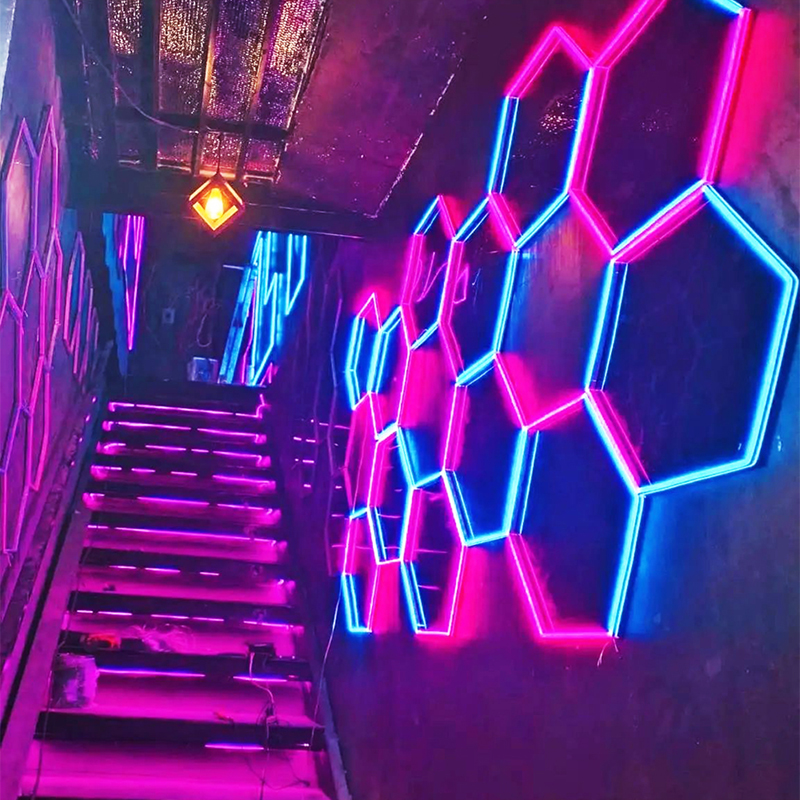
Vertical installations present unique challenges, primarily regarding cable management. You cannot hide wires simply by laying them on top of the grid as you can with suspended ceilings. RGB hexagon wall lights require in-wall cable routing for a clean, professional finish. Using standoffs creates a gap between the wall and the fixture, adding depth and allowing for subtle backlighting effects. Mechanical wall anchors and modular locking connectors are necessary to build seamless, floating geometric statement pieces that will not shift over time.
If the space is used for video recording, streaming, or broadcasting, flicker-free operation is mandatory. Standard LED drivers create a high-frequency flicker that is invisible to the human eye but highly visible on camera. This manifests as dark bands rolling across the screen. You must specify high-frequency PWM (Pulse Width Modulation) drivers. We require drivers with a PWM frequency of at least 3000Hz. These drivers ensure smooth, continuous light output that looks perfect on video, eliminating distracting banding or strobing effects.
Executing a large-scale geometric lighting project involves significant technical risks. Proper planning and precise execution are required to prevent costly failures. We mitigate these risks through strict engineering protocols.
Never attempt to build a large grid on the fly. You must use CAD software or manufacturer-provided layout tools to map out the grid beforehand. This digital planning allows you to calculate exact dimensions, verify clearances, and identify potential clashes with existing infrastructure. Most importantly, it allows you to plan power injection points accurately before mounting begins. Knowing exactly where the wires need to go prevents you from having to tear down drywall later to run additional power lines.
Power architecture limits the scalability of any LED system. You must calculate the total wattage based on the specific number of modules in your design. We follow the 80% rule for power supplies: never load a driver beyond 80% of its maximum rated capacity. If your grid draws 400 watts, you need a power supply rated for at least 500 watts. Simply daisy-chaining dozens of fixtures together will result in severe voltage drop. The lights at the end of the run will be noticeably dimmer and off-color compared to the lights near the power source. You mitigate this by implementing power injection points. This involves running parallel power lines from the driver and injecting fresh power into the grid at calculated intervals, ensuring uniform brightness across the entire installation.
Relying on adhesive tapes for commercial installations is a guaranteed path to failure. Heat, humidity, and time will degrade the adhesive, causing fixtures to fall. This is a severe safety hazard. You must use mechanical fastening methods. Secure the grid using heavy-duty drywall anchors, toggle bolts, or direct mounting into studs. Ensure the locking connectors between individual hex panels are fully engaged and screwed tight. The entire structure must act as a single, rigid unit. For suspended grids exceeding 50 pounds, we utilize unistrut channels anchored directly to the concrete ceiling deck.
Even the highest quality LEDs eventually experience diode failure or driver issues. You must plan for long-term maintenance. Choose a system that features hot-swappable modules. If one tube or node fails, you should be able to unclip it and replace it without dismantling the entire array. Ensure the manufacturer offers spare parts and keeps the specific color temperature and diode batches consistent over time. Document the wiring diagram and power supply locations clearly for future maintenance teams. Store the power supplies in an accessible, well-ventilated AV rack or utility closet rather than burying them behind sealed drywall.
A: Standard RGB lights mix red, green, and blue diodes to simulate white light, which often looks muddy or tinted. RGBW lights include a dedicated white diode. This provides true, clean architectural white light and allows for much better color mixing and pastel shades.
A: This depends entirely on the wattage per panel and the maximum capacity of the LED driver. Large arrays cannot be daisy-chained endlessly due to voltage drop. You must calculate the total load and use power injection points with multiple synchronized drivers for extensive layouts.
A: Yes, professional-grade systems can integrate into building management systems. This requires fixtures compatible with DMX512, Art-Net, sACN, or systems that offer robust API access. Consumer Bluetooth apps cannot integrate with commercial building systems.
A: Proper installation requires mechanical fastening. You must use heavy-duty drywall anchors or mount directly into studs. Adhesive tape will fail. Additionally, achieving a clean look requires routing the power and control cables behind the drywall.
A: The LEDs generate heat, but the aluminum housing acts as an efficient heat sink. It draws heat away from the diodes and dissipates it into the air. This keeps the internal components cooler and significantly extends the lifespan of the fixture compared to plastic housings.
A: Voltage drop is prevented by using power injection. Instead of running power through the entire grid in one long chain, you run parallel wires from the power supply and inject power into the grid at specific intervals, ensuring even voltage distribution.
A: Only if they are equipped with high-frequency PWM (Pulse Width Modulation) drivers. Standard drivers cause a high-frequency flicker that results in visible banding and strobing on camera. High-frequency drivers ensure smooth, flicker-free operation for broadcast environments.


