


Views: 0 Author: Site Editor Publish Time: 2026-09-21 Origin: Site


The final delivery area is the critical touchpoint where a client assesses the quality of a detailing, paint correction, or ceramic coating service. Standard shop lighting or poorly diffused LEDs create harsh glare, mask remaining micro-marring, or fail to highlight the depth of the finish, leading to underwhelming customer handovers and potential quality disputes. Selecting the correct car beauty station lighting requires balancing aesthetic presentation with technical inspection capabilities. This guide breaks down the structural, electrical, optical, and environmental requirements for evaluating high-end delivery area lighting systems. We will look at how specific optical metrics impact paint visibility and how structural choices dictate the installation process. You need a setup that makes the vehicle look flawless while allowing technicians to perform rigorous final quality checks before the keys change hands.
A dedicated delivery area serves two competing requirements. First, it must deliver flawless aesthetic presentation. This creates the immediate visual impact when the customer walks in. Second, it must support rigorous final quality assurance. Technicians need to spot any remaining high spots from ceramic coatings, missed polishing dust in panel gaps, or faint dual-action haze. Balancing these needs requires specific optical engineering. You cannot rely on standard overhead fixtures to do both jobs effectively. The lighting must illuminate vertical panels just as well as horizontal surfaces.
Premium illumination builds immediate customer trust. When a client sees their vehicle under specialized lighting, it validates their investment in high-ticket detailing packages. The environment signals professionalism. A well-lit bay transforms a standard garage into a luxury studio. This psychological shift reduces customer nitpicking. They perceive the service as high-end because the presentation is high-end. First impressions in the delivery bay often dictate whether a customer leaves a positive review or returns for future maintenance washes.
Point-source lighting creates blinding hotspots on high-gloss clear coats. These intense reflections make it impossible to see the actual paint texture. Conversely, improperly diffused ambient lighting washes out the paint's metallic flake. It flattens the appearance of the vehicle. The goal is to achieve a uniform glow that wraps around the car's curves. This requires fixtures with proper diffusion covers. The light must scatter evenly across the surface without reflecting individual LED diodes back into the viewer's eyes.
Traditional fluorescent tubes suffer from severe flicker rates and color shifting over time. They cast a greenish hue that distorts automotive paint colors. Low-CRI warehouse LEDs are equally problematic. They fail to render reds and blues accurately. Standard industrial fixtures also suffer from poor lumen maintenance. They lose brightness rapidly after the first year of use. Furthermore, warehouse high-bays project light straight down. This leaves the lower half of the vehicle in deep shadow, making final inspections on doors and rocker panels nearly impossible.
Specific paint types react differently to light. Single-stage paints absorb and reflect light differently than modern clear coats. Ceramic coatings create a glass-like barrier that alters the refraction index of the surface. The lighting must account for these variations. When a customer arrives to pick up a vehicle that just received a multi-stage paint correction, the lighting must highlight the depth and clarity achieved. If the lighting is too dim, the paint looks flat. If it is too harsh, it creates glare that causes eye fatigue.
Before selecting a specific lighting setup, you must evaluate the physical dimensions of your shop. Follow these steps to assess your space:
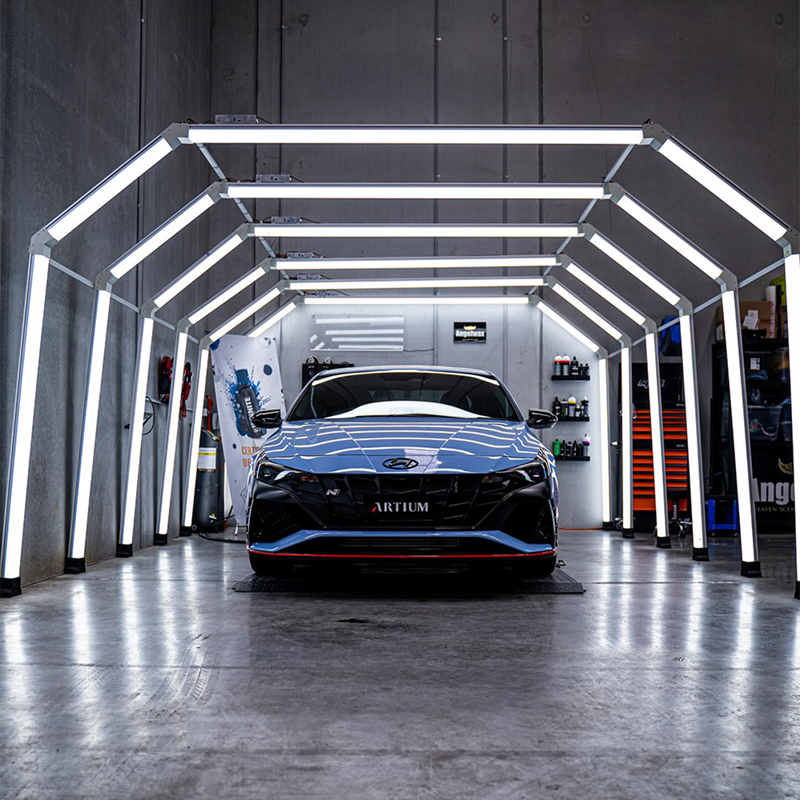
A modular detailing light tunnel utilizes hexagonal, honeycomb, or arching modular frames. These structures surround the vehicle with continuous light sources. The geometric patterns create stunning reflections on polished paint. The primary advantage is wraparound illumination. This design eliminates harsh shadows on lower door panels and rocker panels. It also creates a highly photogenic environment. The tunnel acts as a built-in marketing asset for your shop. Photos taken inside these setups perform exceptionally well on social media platforms.
However, these systems require a higher upfront investment. They also demand specific ceiling heights and floor-space clearance. If installed in a cramped bay, the structure can feel claustrophobic and restrict technician movement around the vehicle. You must measure the bay width to ensure doors can open fully without striking the aluminum frames.
Flat, ceiling-mounted LED grid systems offer a more traditional approach. Perimeter wall-wash lighting complements these overhead grids. This setup pushes light down and inward toward the center of the bay. These configurations are highly scalable for multi-bay shops. They are easier to integrate around existing HVAC ducts or fire suppression systems. The lower structural weight makes them suitable for buildings with strict ceiling load limits. Maintenance is generally straightforward.
The main disadvantage is the lack of lower-level illumination. You may require supplemental low-angle lighting to properly illuminate the bottom half of the vehicle. Without wall-mounted fixtures, technicians might still need handheld inspection lights for final quality checks on lower panels.
Hybrid setups combine an overhead LED light tunnel with articulated, wall-mounted inspection spotlights. This approach utilizes zoned switching to control different light sources independently. This configuration is best for high-volume shops. It allows the delivery bay to function for both final touch-ups and customer presentation. Technicians can isolate specific lighting zones based on the task. They can turn on harsh spotlights to check for coating high spots. Later, they can switch to the diffused overhead tunnel for the final customer handover.
| Lighting Configuration | Primary Advantage | Ideal Application | Structural Requirement |
|---|---|---|---|
| Modular Light Tunnel | Wraparound illumination, high marketing value | Flagship presentation bays, luxury handovers | High clearance, wide floor space |
| Linear LED Grids | Scalability, easy HVAC integration | Multi-bay shops, standard delivery areas | Standard ceiling load capacity |
| Hybrid Zoned Setup | Maximum versatility for QA and presentation | High-volume dual-purpose bays | Advanced electrical switching capability |
Standard commercial lighting typically offers an 80 CRI. This is insufficient for automotive detailing. You must mandate 95+ CRI requirements for your delivery bay. A 95+ CRI ensures true color matching. It makes swirl marks and holograms visible. Lower CRI lights wash out subtle defects, causing you to miss flaws that the customer might spot later under natural sunlight. Pay attention to the R9 value, which dictates how well the light renders deep reds. Standard LEDs often have a negative R9 value, making red paint look muddy.
| Paint Color | 80 CRI Appearance | 95+ CRI Appearance |
|---|---|---|
| Solid Black | Washed out, gray tint | Deep, rich, true black |
| Metallic Silver | Flat, dull flake | High contrast, popping metallic flake |
| Guards Red | Muddy, orange hue | Vibrant, accurate red |
| Pearl White | Yellowish cast | Crisp, clean white with visible pearl |
Evaluate the 5000K to 6000K Kelvin range. This spectrum mimics natural daylight. Warmer lights under 4000K cast a yellow hue that hides defects in clear coats. Cooler lights over 6500K create an unnatural, clinical appearance. This blue tint distorts the actual paint color, making rich reds look purple and deep blacks look gray.
Understand the difference between Lumens and Lux. Lumens measure raw output at the source. Lux measures the actual light hitting the vehicle surface. Establish baseline Lux requirements for your delivery bay. You typically need 750–1000 Lux at the floor level. This ensures the rocker panels receive adequate illumination.
| Task | Recommended Lux | Light Temperature | Primary Focus |
|---|---|---|---|
| Interior Cleaning | 300 - 500 Lux | 4000K - 5000K | General visibility, fabric inspection |
| Washing & Prep | 500 - 750 Lux | 5000K | Dirt removal, surface leveling |
| Paint Correction | 1000 - 1500 Lux | 5000K - 6000K | Defect spotting, swirl identification |
| Final Delivery | 750 - 1000 Lux | 5000K - 6000K | Gloss enhancement, uniform presentation |
Adjustable intensity is mandatory. Bright white paint requires different lux levels to spot defects compared to deep black paint. Metallic paints can wash out under maximum output. Dimmable controls allow you to tune the environment. You can lower the intensity to let metallic flakes pop, or raise it to inspect flat enamel finishes. Evaluate the diffusion technology. Premium setups use polycarbonate covers and frosted diffusers. These materials prevent raw LED diode reflection on ceramic-coated surfaces. Bare diodes create jagged, distracting reflections that ruin the visual presentation.
Social media marketing drives modern detailing businesses. Your lighting must utilize high-quality, flicker-free LED drivers. Standard drivers use low-frequency Pulse Width Modulation (PWM). This causes banding and strobing in smartphone videos. High-framerate reels require constant-current drivers. Flicker-free technology ensures your video content looks professional, smooth, and visually appealing.
Assess the necessity of IP54 or IP65 rated fixtures. Even in final delivery areas, environmental hazards exist. Exposure to ambient moisture is common. Polishing dust floats through the air. Chemical overspray from adjacent wash bays can drift into the presentation area. IP-rated housings protect the internal electronics. They prevent dust ingress and resist moisture, extending the lifespan of your investment.
Analyze the importance of aluminum housing in LED fixtures. Aluminum acts as a massive heat sink. Proper heat dissipation prevents diode degradation. When LEDs overheat, they experience color shifting and rapid lumen depreciation. Heavy-duty aluminum frames keep the operating temperature low. Compare the wattage draw of a full tunnel system versus traditional high-bay lighting. Factor in daily operational hours. While a massive car detailing light tunnel draws more total power than a few fluorescent tubes, the efficiency per lumen is vastly superior. Smart zoning further reduces operational costs by only illuminating the necessary sections.
Detail the minimum ceiling height and bay width required. You must safely install car workshop tunnel lights without obstructing vehicle doors. Lift mechanisms also require vertical clearance. A minimum ceiling height of 10 to 12 feet is generally recommended for overhead tunnel structures. This prevents the fixtures from sitting too close to the vehicle roof, which can cause intense hotspots.
Discuss mounting realities. Suspension cables offer flexibility for uneven ceilings. Direct-to-ceiling mounting provides a cleaner look but requires a perfectly flat surface. Consider load-bearing requirements. Heavy aluminum track systems require secure anchoring into structural joists, not just drywall. Unistrut channels often provide the most secure and adjustable mounting framework for commercial bays.
Follow these steps for a safe electrical installation:
A multi-fixture system can easily overload a standard 15-amp breaker. Always leave a 20% safety margin on the circuit. Dedicated circuits are usually necessary for large installations. Discuss control system integration. DALI, Zigbee, or standard 0-10V dimming switches allow seamless control. Smart controllers let you program specific scenes. You can have an inspection scene at 100% brightness and a handover scene dimmed to 60%.
Highlight code compliance. You must use UL-listed or CE-certified fixtures. Uncertified electronics pose severe fire risks. Decide between hardwiring and plug-and-play systems. Hardwiring looks cleaner but requires professional installation. Always hire licensed electricians for commercial installations to maintain your facility's insurance coverage.
Evaluate systems based on modularity. You need the ability to replace individual LED tubes or drivers. Dismantling the entire grid to fix one burnt-out section disrupts your business. Plug-and-play connectors between modular sections drastically reduce maintenance downtime. Assess standard warranty periods. Look for 3-year to 5-year warranties. Verify the availability of replacement parts from the manufacturer. A cheap system becomes useless if you cannot source a replacement connector two years down the line.
Frame the initial investment against the rated lifespan of the LEDs. Quality fixtures offer up to 50,000 hours of operational life. This translates to over a decade of standard shop use. The reduced maintenance costs offset the higher initial capital expenditure. You stop paying for replacement fluorescent bulbs and ballast repairs.
Consider the impact on employee morale and fatigue. Working under poor lighting causes eye strain and headaches. High-quality, flicker-free lighting reduces technician fatigue. This leads to better quality work and fewer mistakes during the final inspection phase. Discuss the lifespan of LED drivers versus the diodes themselves. Often, the driver fails before the LED. Choosing systems with easily replaceable drivers saves significant money over time.
A premium delivery area justifies higher-tier detailing packages. It provides a luxury dealership-level handover experience. Customers are willing to pay more when the environment reflects high standards. Furthermore, the organic social media reach generated by a stunning light tunnel acts as free advertising. The lighting pays for itself through increased booking rates and higher average ticket prices.
Warn against low-cost, unbranded e-commerce lighting kits. These cheap alternatives suffer from rapid lumen depreciation. They look bright on day one but lose 30% of their output within six months. They often feature sagging plastic frames instead of rigid aluminum. They lack proper IP ratings, making them vulnerable to shop dust. Most importantly, uncertified electrical components carry significant fire risks.
A: The ideal color temperature ranges between 5000K and 6000K. This daylight spectrum provides the most accurate color representation. It prevents the yellowing effect of warmer lights and the blue distortion of cooler lights, ensuring you spot defects accurately.
A: You should aim for 750 to 1000 Lux at the vehicle surface. To calculate lumens, multiply your square footage by the desired foot-candles (roughly 75-100). A standard two-car bay typically requires upwards of 60,000 to 80,000 total lumens for flawless presentation.
A: Yes, if your business relies on social media marketing and high-end customer handovers. While they carry a higher upfront cost and require more space, the wraparound illumination and photogenic aesthetic directly support premium service pricing.
A: Different paint colors require varying light intensities. Solid black paint needs high intensity to reveal micro-marring. Metallic white paint can wash out and cause blinding glare under maximum output. Dimmability allows you to tune the environment for perfect inspection.
A: Inspection lights are harsh, point-source beams used during paint correction to highlight scratches. Delivery lights provide diffused, uniform ambient illumination designed to showcase the final gloss and depth of the paint without creating distracting hotspots.
A: It is not recommended for ceilings under 10 feet. Low ceilings place the fixtures too close to the vehicle roof. This creates intense glare, limits technician mobility, and risks heat damage to the paint surface.
A: A CRI above 90 ensures the human eye sees the true color of the paint. It prevents color distortion and highlights subtle defects like holograms, preventing customer complaints about missed spots or mismatched touch-ups.


