


Views: 0 Author: Site Editor Publish Time: 2026-09-20 Origin: Site


Inadequate lighting in high-end auto spas carries a steep operational cost. Missed paint defects, inconsistent ceramic coating leveling, and compromised customer handovers directly damage your reputation. Scaling illumination across multi-bay shops introduces significant complexity. You must balance high-CRI requirements for precise paint correction against heavy electrical loads. Installation logistics and the aesthetic demands of a modern facility further complicate the process. Selecting the right car beauty station lighting drives both operational precision and customer trust. This technical evaluation framework will guide you through selecting, planning, and deploying a high-performance lighting architecture. You will learn how to optimize bay efficiency, manage electrical infrastructure, and create an environment that supports flawless detailing work.
Effective paint correction requires a strict lighting baseline. You need fixtures with a minimum Color Rendering Index (CRI) of 95. This high rating ensures colors appear exactly as they would under natural sunlight. Standard 80 CRI shop lights mask subtle paint imperfections, hiding sanding pigtails and fine buffer trails. Multi-spectrum lighting ranging from 4500K to 6500K is essential for comprehensive inspection. Different color temperatures expose different types of defects across various paint systems. Warmer light around 4500K cuts through metallic flakes to identify holograms and fine sanding marks on lighter paints. Cooler light at 6500K provides a clinical white beam that highlights swirl marks and micro-marring on solid dark finishes. Having adjustable color temperatures allows technicians to adapt instantly to the specific vehicle in their bay.
Many shop owners mistakenly believe brighter is always better. Excessive lumens without proper diffusion create blinding glare off polished clear coats. This harsh glare induces severe eye fatigue for detailers over long shifts, leading to missed defects and sloppy finishing. You need controlled intensity rather than raw, unfiltered power. Establish a baseline of 750 to 1000 lux at the vehicle surface. Proper polycarbonate diffusers scatter the light beam evenly. This ensures you see the actual clear coat surface rather than a blinding starburst reflection of the bare LED diode. High-quality frosted diffusers maintain necessary light intensity while eliminating the harsh hot spots that strain the optic nerve during a ten-hour correction job.
Lighting a three-dimensional object requires strategic geometry. Overhead fixtures alone only illuminate the hood, roof, and trunk. The vertical panels, including doors, fenders, and bumpers, fall into complete darkness. You must combine overhead ambient light with low-angle side lighting. This approach pushes light directly onto rocker panels and lower doors. Proper side placement prevents technicians from casting shadows over their own work areas while sitting on a detailing stool. Positioning wall-mounted lights at 45-degree angles from the floor ensures comprehensive coverage. This specific angle provides intense illumination for lower panel correction without blinding the operator.
Operational efficiency demands dimmable lighting fixtures. Dark-colored vehicles, like jet black or navy blue, absorb significant light. They require 100% intensity settings for effective defect removal. Conversely, white or silver vehicles reflect light aggressively. Hitting a white car with maximum output causes snow-blindness for the detailer. You must dim the fixtures to prevent wash-out and eye strain. Integrating smart relays allows for zone-based control within a single bay. You can adjust specific quadrants based on the panel currently being polished. Pulse Width Modulation (PWM) dimmers offer smooth transitions, allowing you to dial back the intensity to 50% for light cars without causing the LEDs to flicker.
Shop flooring interacts directly with your overhead lighting. A high-gloss polyaspartic or epoxy floor acts as a massive secondary light source. These reflective surfaces bounce overhead lumens back onto the vehicle's undercarriage and lower panels. This environmental synergy reduces the need for excessive low-angle fixtures. Light gray or white floors maximize this ambient bounce effect. They improve overall bay visibility while lowering total power consumption. Dark or matte floors absorb light, wasting energy and forcing your fixtures to work harder. Coordinating your wall colors, using matte white or light gray, with your floor finish yields a highly efficient workspace.
A continuous arch or semi-cylindrical LED structure defines this setup. A car detailing light tunnel delivers unmatched uniform illumination. It completely eliminates shadows across the entire vehicle surface, creating a massive light box effect. This architecture creates a premium environment perfect for final inspections. It requires a high spatial footprint and rigid installation parameters, often mounting directly to the floor or reinforced ceiling joists. The best use cases include dedicated final inspection areas and Paint Protection Film (PPF) application bays. Installers need this level of uniformity to spot silvering, stretch marks, or dust nibs under the film before it cures.
Hexagonal grids currently dominate as the industry standard for overhead bay lighting. They offer immense visual appeal, driving social media marketing and customer engagement. Grids provide a massive spread of ambient light across the shop floor. However, the light is highly diffused, lacking the directional intensity needed for heavy compounding. You cannot easily spot fine buffer trails under a hex grid alone. They are highly modular, making them easy to snap together and scale across three or more bays. Installation utilizes lightweight aluminum or polycarbonate framing. While visually striking, they must be supplemented for serious defect removal.
A hybrid approach is the most pragmatic solution for multi-bay shops. Use overhead grids for general washing, interior detailing, prep work, and ambient illumination. Pair these with dedicated, articulating high-CRI wall-mounted or mobile spotlights for heavy correction. This method optimizes your equipment budget. It delivers professional-grade results without over-equipping every single bay with expensive inspection lights. Technicians get the directional intensity they need exactly when they need it. Mobile spotlights can be positioned to highlight specific panels, while the overhead grid keeps the overall bay safely illuminated for surrounding foot traffic.
| Lighting Architecture | Illumination Uniformity | Installation Complexity | Primary Application |
|---|---|---|---|
| Detailing Light Tunnel | Excellent (Shadow-free) | High (Requires rigid mounting) | PPF Bays, Final Inspection, Ceramic Handovers |
| Hexagonal LED Grids | Good (Ambient spread) | Medium (Modular assembly) | Wash Bays, Interior Prep, General Detailing |
| Hybrid Systems | Variable (Highly controllable) | Medium (Requires multiple circuits) | Heavy Paint Correction, Multi-purpose Bays |
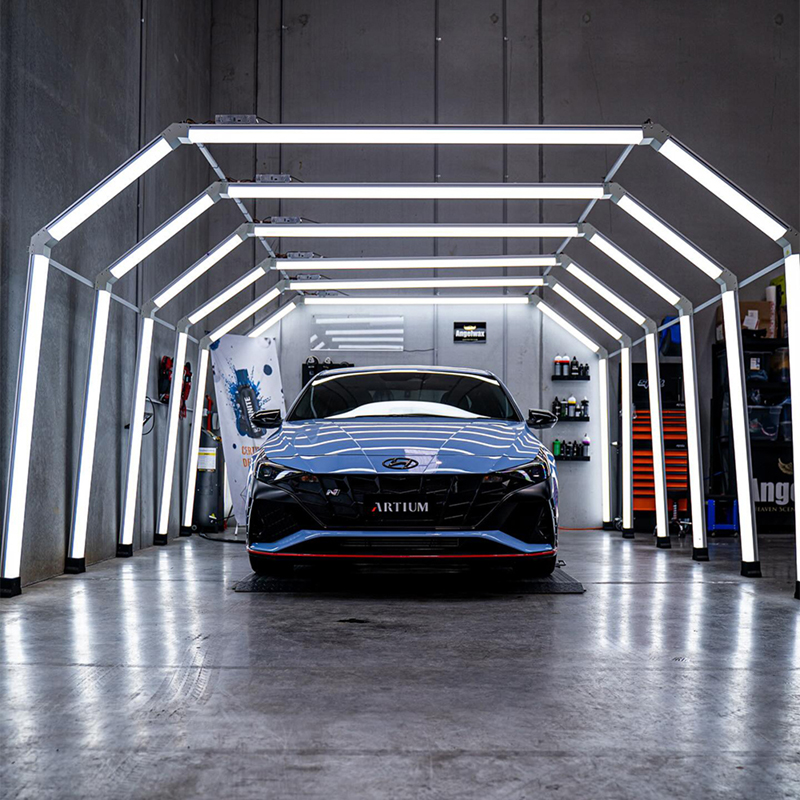
Calculating total wattage across multiple car workshop tunnel lights is a mandatory first step. You must audit the shop's main breaker panel before committing to a lighting plan. Add the wattage of all planned fixtures and divide by your voltage to find the required amperage. For example, twenty 60W fixtures draw 1200W. On a standard 120V circuit, that equals 10 amps. The National Electrical Code (NEC) limits continuous loads to 80% of the breaker capacity. A 20A breaker can only handle 16A continuously. Ensure your panel has adequate overhead capacity to prevent tripped breakers during peak operational hours.
Daisy-chaining LED fixtures end-to-end simplifies installation and saves wiring time. However, long runs cause voltage drop. The lights at the end of the chain will be noticeably dimmer than the ones at the start. Independent circuits per bay are required to prevent cascading failures. High-draw equipment like rotary polishers, hot water extractors, and air compressors share the same electrical ecosystem. Isolating lighting circuits ensures a tripped breaker from a heavy machine won't plunge the bay into darkness while a technician is working. Dedicated wiring provides long-term operational stability and safety.
The detailing environment is exceptionally harsh on electronics. Moisture, atomized chemicals, and heavy compounding dust are constant threats. You must establish minimum Ingress Protection (IP) ratings for your fixtures. Wash bays require IP65+ ratings to withstand direct water jets and high humidity. Standard dry-bay fixtures will short circuit in these conditions. Dry correction bays can utilize lower-rated fixtures safely. However, completely sealed units are still highly recommended for dry areas. Unsealed fixtures allow airborne polishing dust to coat internal reflectors, which drastically reduces lumen output over time.
Upgrading to high-efficiency LED drivers offers a strong long-term return on investment. Modern LED systems convert AC to DC power efficiently, running significantly cooler than legacy lighting. This directly reduces the ambient heat load in the shop, lowering your summer HVAC costs. Always check local municipal or utility rebates for commercial energy-efficient lighting upgrades. Many programs offset the initial purchase price of a LED light tunnel when replacing outdated fluorescent high-bays. Taking advantage of these commercial rebates accelerates your facility modernization while reducing monthly utility draws.
Comparing budget imported LED kits against commercial-grade fixtures reveals stark differences in longevity. Budget options often use low-grade diodes that suffer from rapid lumen depreciation. They may look bright on day one but lose 30% of their output within a year. Commercial fixtures maintain their color accuracy and output much longer due to superior thermal management. Heavy aluminum heat sinks pull heat away from the diodes, ensuring a 50,000-hour operational lifespan. Factoring in replacement frequency and maintenance labor makes commercial-grade fixtures more economical over a five-year operational window.
Analyze the repairability of different systems before purchasing. If a single tube fails, can you replace just that tube? Some proprietary systems require swapping an entire 4-foot section or node, escalating maintenance costs. Modular systems with universally available drivers and standard connections minimize downtime. Keep repair expenses manageable by choosing systems with accessible power supplies. LED drivers fail far more often than the diodes themselves. Remote-mounted drivers allow for quick swaps without dismantling the entire ceiling structure or renting a scissor lift.
Premium lighting exerts a massive psychological impact on customer perception. A brilliantly lit, clinical environment signals high-level professionalism. Customers feel confident leaving high-value vehicles in a facility that looks like an aerospace laboratory. The visual impact of a continuous light structure builds immediate trust. When clients see their vehicle under flawless illumination during a ceramic coating handover, the presentation validates their investment. This directly leads to better reviews, stronger word-of-mouth referrals, and higher customer retention rates across your client base.
Low ceilings trap heat and prevent adequate light spread, causing intense hot spots on the vehicle paint. High ceilings cause lumens to dissipate before reaching the surface. Suspension mounting using aircraft cable kits allows you to drop fixtures to the optimal height. The ideal height is usually 9 to 10 feet from the shop floor. Flush mounting works best in standard-height bays where suspension cables would interfere with vehicle hoods. Always measure clearance requirements for automotive lifts. Ensure your lighting architecture does not obstruct the upward travel of lifted SUVs or trucks.
Never compromise on UL or CE certifications when selecting fixtures. Non-certified, direct-import lighting poses severe fire risks due to substandard internal wiring. Installing unverified electrical equipment may void your commercial property insurance. It will also likely fail municipal fire and building inspections, halting your shop build-out. Always demand certification documents from your supplier before authorizing a multi-bay installation. Ensure your commercial electrician uses the correct wire gauge (AWG) for the calculated load. Compliance protects your business, your employees, and your clients' vehicles.
Scrutinize commercial lighting warranties carefully before signing purchase orders. Ensure coverage includes power supplies and LED drivers, not just the aluminum housings. Mitigate operational downtime by ordering surplus replacement parts during the initial build-out. Keeping spare tubes, connectors, and drivers on the shelf ensures a single failure doesn't shut down a profitable bay. Waiting three weeks for international shipping on proprietary parts halts production. A robust warranty combined with on-site spare parts guarantees continuous operation regardless of minor hardware failures.
A: The ideal range is between 4500K and 6500K. This spectrum mimics natural daylight, making it easier to spot surface defects. Warmer temperatures around 4500K highlight holograms and sanding marks, while cooler temperatures at 6500K expose micro-marring and swirl marks on dark paint.
A: Hexagonal grids provide excellent ambient light and strong visual aesthetics for marketing. However, they lack the directional intensity needed for professional paint correction. They must be supplemented with directional high-CRI spotlights to effectively identify and remove heavy defects.
A: You need a minimum ceiling height of 10 to 12 feet. This clearance ensures even light distribution across the vehicle. It also prevents the structure from interfering with open vehicle hoods or automotive lifts during daily operation.
A: Yes, but only if the fixtures have an IP65 or higher waterproof rating. Wash bays expose lighting to direct water jets and high humidity. Standard dry-bay fixtures will short circuit and pose a severe electrical hazard if installed in wet areas.
A: Add the total wattage of all fixtures on a single circuit and divide by the voltage to find the amperage. Ensure the total continuous load does not exceed 80% of the circuit breaker's rated capacity to comply with electrical safety standards.
A: Dark paint absorbs light, requiring higher intensity fixtures to reveal defects clearly. Light paint reflects light aggressively, which can cause glare and wash out the surface. Dimmable fixtures allow technicians to adjust the intensity based on the specific vehicle's color.


