


Views: 0 Author: Site Editor Publish Time: 2026-09-14 Origin: Site


Highly illuminated detailing bays look incredible on social media. They draw attention and create a sterile, high-end aesthetic. However, final automotive quality assurance requires strict technical performance, not just visual appeal. Missed defects during final inspection lead to severe operational headaches. Ceramic coating high spots, micro-marring, and buffer holograms compromise client trust. They force technicians into costly rework cycles. They ultimately diminish profit margins and disrupt shop scheduling.
A detailing light tunnel solves this precise problem. It shifts the focus from pure marketing value to verifiable utility. It serves as a rigorous final-stage inspection and quality control tool. Inspection-grade tunnel lighting was once exclusive to OEM motor vehicle manufacturing lines. Now, independent detailing and restoration workshops can access these advanced systems. You will learn how uniform light distribution, high Color Rendering Index (CRI), and specific color temperatures expose hidden defects. We will explore structural designs, technical specifications, and implementation realities to help you optimize your final quality checks.
Traditional overhead fluorescent fixtures fail miserably in automotive environments. They emit a narrow spectrum of light that flattens the appearance of paint. Legacy high-intensity discharge (HID) lamps also fall short. They generate massive amounts of heat and suffer from severe color shifting over time. Low-CRI LED lighting cannot accurately render paint conditions. These outdated systems simply make a room bright without providing clarity. You cannot correct what you cannot see.
Single-point directional lighting creates harsh shadows. It produces uneven lux levels across vehicle panels. The roof and hood might receive intense light, while the doors remain in darkness. Technicians struggle to see lower rocker panels clearly. Standard car workshop tunnel lights often cause sudden vision adjustment. When a technician looks from a dark lower panel to a bright overhead fixture, their pupils must rapidly adjust. Eye fatigue quickly sets in when working under these inconsistent lighting conditions.
This fatigue is not just uncomfortable. It leads to dangerous delays in reaction time. Technicians lose their visual acuity. They miss critical defects during the final wipe-down. A shadow cast by a poor lighting setup can easily hide a cluster of 3000-grit sanding marks. By the time the vehicle rolls out into natural sunlight, the defects become painfully obvious. You end up with a frustrated customer and a damaged reputation.
Failing to identify paint correction flaws impacts operations heavily. Coating leveling issues must be caught before vehicle delivery. When a technician misses a high spot during the initial flash time, the coating cures into a hardened ridge. Removing this ridge requires aggressive compounding or even wet sanding. You must tape off the surrounding trim, level the high spot, polish the area back to a high gloss, wipe it down with isopropyl alcohol, and reapply the coating.
This single missed defect can consume two hours of unbillable labor. It backs up your entire schedule. If the customer finds the high spot first, the situation worsens. You lose their trust immediately. They will scrutinize every inch of the vehicle from that point forward. A customer paying for a premium paint correction expects absolute perfection. Final quality checks require 100% visibility of the clear coat condition.
Technicians need to inspect the surface from multiple angles simultaneously. They should not have to rely constantly on handheld inspection lights. Handheld lights are useful for spot checks, but they slow down the overall inspection process. You need ambient lighting that acts as a massive inspection tool, allowing the technician to walk around the vehicle and spot flaws instantly.
Motor vehicle manufacturing paint tunnels set the global standard for inspection. Factory lines use massive, diffused light arches to check for dirt nibs, solvent pop, and uneven clear coat. These strict standards are now trickling down to the aftermarket sector. Independent shops adopt OEM-level illumination to guarantee a factory-level finish. You can now install the exact same lighting geometry used by major automakers.
Premium pricing models require flawless execution. You cannot charge top-tier rates if your shop lighting allows defects to slip through. Upgrading your lighting infrastructure bridges the gap between factory production and aftermarket detailing. It proves to your clients that your quality control processes rival those of major automotive manufacturers. When a customer walks into a bay lit by a professional tunnel, they immediately understand the value of your service.
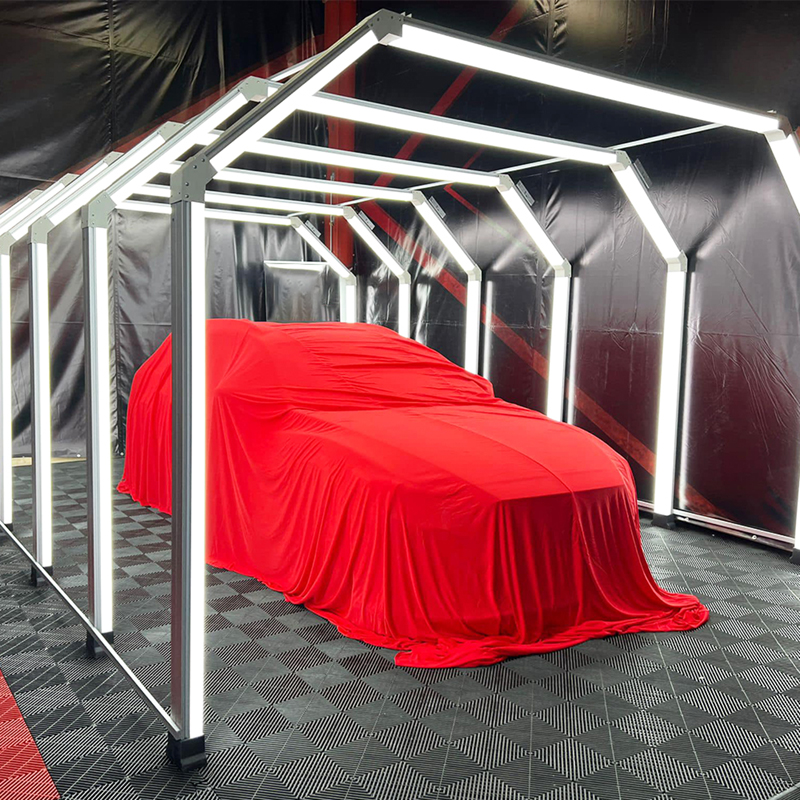
Light distribution physics matter deeply in a tunnel configuration. Archways and multi-point grids wrap the vehicle in continuous light. This structural design eliminates shadows on lower rocker panels. It illuminates complex aerodynamic curves evenly. You can see the reflection of the light band perfectly across the shoulder line of a vehicle. Any break or distortion in that reflection indicates a surface defect.
When you polish a door panel, you need to see the abrasive breaking down. You need to watch the compound turn clear. Directional lighting creates dark zones where you cannot monitor this process. A tunnel configuration ensures you have consistent visibility regardless of where you stand in the bay. You do not have to constantly reposition floor stands or drag heavy light tripods over air hoses.
Low-quality LED diodes create excessive glare. Bare chips emit intense, focused beams that bounce directly off the clear coat into the technician's eyes. Glare forces the pupil to constrict. This physiological reaction severely reduces the ability to spot micro-scratches. Proper light diffusion prevents this issue entirely. A well-designed tunnel uses covers that scatter the light evenly. This creates a soft, continuous glow. The light wraps around the vehicle rather than piercing it.
CRI measures how accurately a light source reveals true colors compared to natural sunlight. Automotive paint inspection requires a baseline CRI of 90+. Ideally, you want a CRI of 95 or higher for final quality checks. Standard shop lights often hover around 70 or 80 CRI. These low ratings make paint look flat, dull, and lifeless. You cannot accurately judge the condition of a metallic flake under 70 CRI lighting.
High-CRI lighting accurately reflects metallic flake and pearl finishes. It reveals the true color depth of the paint system. This allows for precise color matching during touch-ups or panel repaints. You can isolate defects easily when the light mimics the natural sun. Low-CRI lights hide subtle imperfections like light wash marring or fine swirl marks. Investing in high-CRI diodes ensures you see exactly what the customer will see outside.
A car detailing light tunnel enhances broader workshop operations. It is not just for polishing paint. Technicians conduct thorough inspections beyond the clear coat. Paintless Dent Repair (PDR) requires highly uniform reflections. The linear lights highlight subtle panel misalignments instantly. A technician can read the distortion in the light band to push a dent out perfectly. The continuous lines act as a massive PDR board.
Interior detailing benefits heavily from the ambient spill light. You can see dust in air vents and stains on carpets much easier. Mechanical diagnostics improve when the entire bay is brightly lit. Mechanics can spot fluid leaks or worn suspension components without dragging a drop light across the floor. You get significantly more utility out of the same square footage. The tunnel becomes the central diagnostic hub of the shop.
Surface defect detection requires specific baseline lux levels. Raw lumen output measures total brightness emitted from the fixture. Effective lux measures the actual illuminance hitting the target area. High lumens do not guarantee high lux if the beam angle is too wide or the ceiling is too high. You typically need 1,000 to 2,000 lux at the vehicle surface for effective inspection.
Measuring lux at the floor is useless for detailing. You must measure lux at waist and knee height, where the side panels sit. The inverse square law dictates that light intensity drops rapidly as distance increases. A fixture mounted twelve feet high will deliver far less lux to a car door than a fixture mounted on a side wall. Tunnel designs position the light sources closer to the lower panels to maintain high lux levels exactly where you need them.
You should map your bay with a lux meter before finalizing a design. Check the readings at the hood, the roof, and the lower doors. If the lux drops below 1,000 on the rocker panels, you will miss defects. You must adjust the mounting height or add supplemental side lighting to correct the deficit.
The ideal color temperature range mimics natural daylight. You should target 5000K to 6500K for automotive detailing. Light below 4000K appears too yellow and hides clear coat scratches. Light above 7000K appears blue and creates harsh, unnatural reflections. Maintaining a neutral white light is critical for accurate defect spotting. You want the light to be as objective as possible.
Dual-color or tunable LED systems offer distinct advantages. You can inspect different paint colors much more effectively. Warmer light around 4500K to 5000K helps identify defects on white or silver cars. Bright white paint tends to wash out under very cool light. Cooler light around 6000K to 6500K works better for black and dark-colored vehicles. It provides the stark contrast needed to see fine spiderweb swirls. Adjustability ensures you never struggle against the paint color.
Polycarbonate and acrylic diffusers play a massive role in tunnel performance. Proper diffusion softens the light source significantly. It spreads the intense energy of the LED chip across a wider surface area. This reveals buffer trails and holograms rather than washing them out in a blinding hotspot. You need to see the edges of the defect, not just a bright reflection.
Bare LED chips create harsh reflections on the clear coat. These reflections are so bright they mask the very defects you are trying to find. Specifying low-glare LEDs maximizes technician comfort. Prolonged inspection periods cause less eye strain with diffused light. You can stare at the reflection line for hours without getting a headache. High-quality diffusers transmit maximum light while eliminating the painful glare.
Structural geometries vary widely among tunnel systems. You must choose the design that fits your specific workflow. Let's compare the most common designs used in professional workshops today.
| Design Type | Primary Benefit | Best Use Case |
|---|---|---|
| Hexagonal Grid | Top-down uniform coverage | General bay lighting, flat panel polishing |
| Archway Tunnel | Side-panel and lower-door visibility | Final inspection, ceramic coating leveling |
| Linear Grid | Continuous reflection lines | Paintless Dent Repair (PDR), defect spotting |
Hexagonal grids provide excellent top-down coverage. They flood the hood, roof, and trunk with even light. However, they often lack the side illumination required for lower doors. Archway tunnels excel at illuminating those side panels. They wrap the light down to the floor. Linear grids create long, unbroken reflection lines ideal for reading bodywork.
Modular systems allow workshops to expand the tunnel length. You can scale the lighting infrastructure as your operational volume increases. You might start with a single arch for final inspection. Later, you can add more sections to create a full drive-through correction bay. This scalability prevents you from outgrowing your lighting setup. You simply bolt on additional segments and connect the wiring harnesses.
The automotive industry is transitioning from manual checks to automated quality control. A stable, high-quality light environment is a strict prerequisite for this technology. Camera-based visual inspection systems require absolutely consistent lux levels. If the lighting flickers or casts random shadows, the software will register false positives. The cameras need a clean, uniform reflection to analyze the clear coat accurately.
AI-driven systems map the surface of the vehicle. They look for microscopic contrast changes that indicate a defect. An LED light tunnel provides the foundational infrastructure for these advanced tools. Even if you rely on manual inspection today, installing a proper tunnel prepares your shop for future technological upgrades. You build a bay that can eventually support automated defect detection without requiring a complete lighting overhaul.
You must identify the infrastructure prerequisites before ordering any system. Measure your ceiling height accurately. Verify that your mounting hardware is compatible with your ceiling type. Assess the structural load-bearing limits of your ceiling joists. Large tunnel systems carry significant weight. You may need unistrut channels or aircraft cable suspension kits to mount them safely. Dropping a heavy fixture onto a customer's car is a catastrophic failure you must avoid.
Electrical requirements demand careful planning. These systems draw substantial amperage. You will likely need dedicated circuits to handle the load. Do not attempt to wire a massive tunnel into an existing lighting circuit. It will trip breakers constantly. Ensure full compliance with local commercial wiring codes. Hire a licensed electrician to evaluate your breaker panel and run the necessary conduit. You might need to upgrade your subpanel to accommodate the extra draw.
Running high-output lighting for 8 to 10 hours a day requires significant energy. Fortunately, LED systems consume far less power than legacy metal halide or halogen setups. Halogen systems waste massive amounts of energy as radiant heat. They turn your detailing bay into an oven during the summer months. This heat causes polishing compounds to dry out prematurely and makes ceramic coatings flash too quickly.
However, high-intensity LEDs still generate thermal loads at the diode level. The drivers and chips get hot. Aluminum heat sinks manage this heat effectively. The aluminum draws heat away from the diode, extending its lifespan. You must consider the potential impact on your shop's ambient temperature. Ensure your HVAC system can handle the slight increase in thermal load, especially if you install multiple tunnels in an enclosed space.
Commercial-grade LED diodes typically last over 50,000 hours. Budget alternatives degrade much faster. Diode degradation causes color shift and lumen depreciation over time. The light might start at 6000K but shift to a sickly green or blue after a year. The brightness will also drop, making inspections harder. You cannot perform accurate color matching under degraded lights.
You must monitor the light quality annually. Ensure the manufacturer offers modular replacement parts. Swapping a single faulty tube is much easier than replacing an entire grid section. Look for systems with plug-and-play connectors. This allows your technicians to replace a damaged light bar in minutes without calling an electrician. Regular maintenance involves wiping down the diffusers to remove polishing dust and chemical overspray. A dirty diffuser scatters light poorly and reduces your effective lux.
A: Automotive paint inspection requires a minimum Color Rendering Index (CRI) of 90. For the best results, aim for a CRI of 95 or higher. This ensures accurate color representation and highlights subtle defects like micro-marring and holograms that lower-CRI lights easily hide.
A: No. While a high-quality tunnel provides excellent ambient and directional lighting, it does not entirely replace handheld lights. Handheld swirl finders remain highly useful for pinpointing specific angles and checking tight crevices where overhead and side light cannot reach.
A: Focus on lux rather than raw lumens. You need between 1,000 and 2,000 lux hitting the vehicle surface. The exact lumen output required depends on your ceiling height, beam angle, and the efficiency of the polycarbonate diffusers used on the fixtures.
A: Hexagonal grids excel at top-down lighting but often struggle with side panels. If you need intense illumination on lower doors and rocker panels, an archway design or vertical wall-mounted linear lights will yield much better results for final inspections.
A: Color temperature dictates the contrast of defects against the paint. Warmer light around 4500K helps expose defects on lighter colors like white and silver. Cooler light near 6500K provides better contrast for finding fine scratches on black and dark-colored vehicles.
A: These structural systems draw significant amperage and usually require dedicated circuits. You must consult a licensed electrician to evaluate your breaker panel, ensure proper wire gauge, and guarantee strict compliance with local commercial building codes before installation.


