


Views: 0 Author: Site Editor Publish Time: 2026-09-23 Origin: Site


Commercial spaces are shifting toward visually immersive environments. Automotive detailing shops, salons, fitness centers, and retail stores demand interior designs that actively engage customers while reinforcing brand identity. Businesses need lighting solutions that support precise color matching to project their exact brand hues. Traditional custom architectural lighting often proves cost-prohibitive and inflexible. Conversely, standard LED strips lack the structural presence and professional finish required for high-end commercial applications. This creates a distinct gap between utilitarian illumination and dynamic brand expression.
Commercial-grade RGB hexagon lights bridge this gap effectively. They serve as a modular, scalable alternative that transforms ordinary ceilings and walls into powerful branding tools. By integrating color-accurate diodes with rigid geometric structures, these systems allow facilities to physically manifest their brand palettes. Facility managers can deploy these fixtures to create highly photogenic spaces that drive engagement. The following analysis explores how these geometric lighting systems integrate into commercial environments, the technical realities of color matching, and the infrastructure required to support them.
Defining what makes a lighting installation successful for branding requires looking beyond simple illumination. Success criteria hinge on visual consistency, high visibility, strict alignment with brand guidelines, and seamless integration with contemporary interior design. Hidden cove lighting or standard recessed troffers often fail to make a memorable impact. They provide necessary light but do not contribute to the spatial narrative. Geometric lighting structures inherently draw the eye. The sharp angles and interconnected patterns create a distinct visual anchor in any room. This structural prominence makes them highly effective vehicles for brand colors.
Visual impact directly influences brand recall. When a customer walks into a facility, the environmental lighting sets the immediate psychological tone. If a brand relies on a specific vibrant orange or a deep corporate blue, projecting that exact color through a massive overhead grid creates an immersive experience. Customers associate the physical space with the brand identity. The integration of customizable RGB hexagon lights elevates standard commercial units into modern, experiential destinations.
We see this strategic value play out across multiple specific use cases where brand-themed lighting directly drives return on investment. Facility managers often track foot traffic and social media tags before and after installing these grids. The geometric patterns naturally encourage visitors to take photos. This user-generated content acts as free marketing. When the lighting matches the brand's exact Pantone colors, every photo shared online reinforces brand recognition. You get a physical asset that doubles as a digital marketing tool.
Assessing the technical capacity of RGB diodes requires understanding how LED technology mixes light. Standard RGB diodes, typically utilizing SMD 5050 chips, contain three distinct emitters: red, green, and blue. By varying the voltage sent to each emitter, the fixture can access millions of color combinations. However, producing specific HEX or Pantone brand colors requires high-quality diodes and precise control systems. Lower-tier LEDs often struggle with color accuracy, producing hues that look washed out or slightly shifted from the intended brand palette. Commercial buyers must evaluate the specific diode quality and the resolution of the dimming curves to ensure the lights can hit exact brand targets.
A major distinction exists between standard RGB and RGBW technology. If your brand guidelines require pure white light alongside colored themes, standard RGB will fall short. Mixing red, green, and blue at full intensity produces a muddy or slightly purple-tinted white. This occurs because the color spectrum is not perfectly balanced. RGBW systems solve this by incorporating a dedicated white diode into the LED package. This allows the fixture to produce crisp, clean white light for standard operational hours, and then seamlessly transition into accurate brand colors for events or specific atmospheric needs. Choosing RGBW is essential for spaces that serve dual purposes.
Color rendering and consistency present another technical hurdle. Across large installations, you risk color shifting, where one section of the grid looks slightly different from another despite receiving the same data signal. This happens due to variations in the manufacturing process of the diodes. Commercial LED manufacturers mitigate this through strict binning standards. Binning groups LEDs with identical color temperatures and voltage requirements together. When sourcing fixtures for a brand-critical installation, verify that the manufacturer uses tight MacAdam ellipse binning. This ensures that the corporate blue on the left side of the room perfectly matches the corporate blue on the right side.
| Technology Type | Color Mixing Capability | White Light Quality | Best Commercial Application |
|---|---|---|---|
| Standard RGB | Good for basic colors, struggles with pastels | Poor (muddy, purple tint) | Nightclubs, gaming rooms, accent walls |
| RGBW (Red, Green, Blue, White) | Excellent, can mix pastels and exact brand hues | High (dedicated pure white diode) | Retail stores, salons, detailing garages |
| RGB+IC (Independent Control) | Dynamic chasing effects, multi-color segments | Variable depending on base diode | E-sports arenas, experiential marketing events |
Modularity serves diverse spatial requirements. Commercial spaces rarely feature identical dimensions. The ability to adapt a lighting system to unique architectural constraints is a massive advantage. These systems transition effortlessly from compact, easy-to-assemble kits used in small waiting areas to massive architectural features spanning entire warehouse ceilings. The interconnected tubes use standardized polycarbonate corner connectors, allowing installers to build custom grid shapes that navigate around HVAC ducts, fire sprinklers, and structural columns.
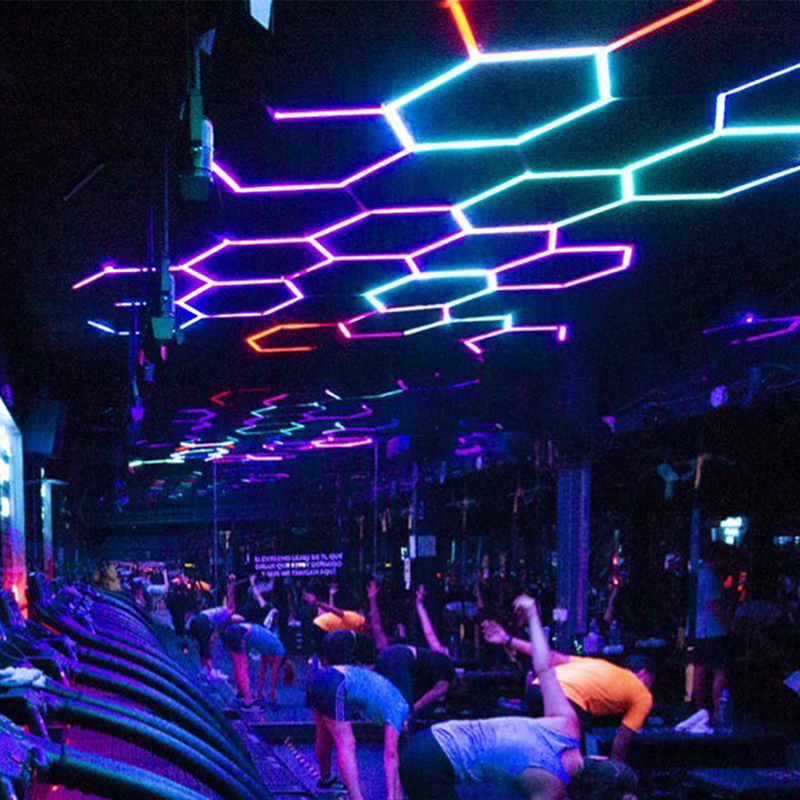
Deploying RGB hexagon ceiling lights creates ambient immersion. Utilizing overhead grids casts brand colors across wide floor plans without obstructing sightlines. This approach works exceptionally well in large, open-concept spaces like detailing garages, fitness centers, and expansive creative studios. The geometric pattern breaks up the monotony of flat commercial ceilings. Because the light distributes evenly across the entire grid, it minimizes harsh shadows while bathing the environment in the chosen brand palette.
Vertical applications offer a different strategic advantage. Installing RGB hexagon wall lights creates immediate focal points. Designers frequently use these configurations to build feature walls behind reception desks, establishing brand dominance the moment a client enters the facility. They also serve as highly effective social media photo backdrops. Customers naturally gravitate toward illuminated geometric patterns for photos, organically expanding the brand's digital reach. Wall installations require different mounting hardware, typically relying on direct stud anchoring or heavy-duty drywall toggles, but offer incredible visual impact at eye level.
Deployment speed and scalability significantly impact the overall project budget. Expanding a standard kit into a massive, multi-grid array requires minimal specialized training. The plug-and-play nature of the connectors reduces the time electricians spend on ladders. Compared to fabricating bespoke architectural lighting from scratch, modular geometric systems drastically reduce labor costs. You can scale the installation to fit a 500-square-foot boutique or a 5,000-square-foot showroom using the exact same core components.
When scaling a system for a large commercial footprint, follow these field-tested steps:
Operational reliability separates commercial installations from consumer-grade novelties. Comparing control interfaces is vital for daily commercial use and complex visual merchandising. The control system dictates how accurately you can reproduce brand colors and how easily staff can manage the environment.
Consumer-level apps operating on Bluetooth or standard Wi-Fi present severe limitations in commercial settings. They frequently suffer from range issues, connectivity drops, and interference from other wireless devices in the building. If a staff member's phone disconnects, the lighting might freeze or revert to a default setting. Commercial environments require the reliability of DMX (Digital Multiplex) controllers. DMX systems hardwire the lighting data directly into central building management systems or dedicated lighting consoles. This guarantees absolute stability. DMX allows for precise addressing, meaning you can control individual sections of the grid independently, assigning exact RGB values to match brand HEX codes without signal degradation.
Programming capabilities elevate the physical space during specific events. With robust control systems, color changing hexagon lights execute dynamic lighting effects tailored to brand activations. You can program the grid to display specific color chases for product launches, shift palettes for holiday themes, or react to interactive triggers. For example, gaming rooms can sync the lighting to in-game achievements, while boutique gyms can program the overhead grid to pulse red during high-intensity interval training timers. This level of automation transforms static lighting into an active participant in the customer experience.
| Control Interface | Connection Type | Reliability | Best Use Case |
|---|---|---|---|
| Smartphone App (Bluetooth) | Wireless (Short Range) | Low (Prone to interference) | Small single-room setups, temporary displays |
| Wi-Fi Bridge Controller | Wireless (Networked) | Medium (Depends on router strength) | Medium retail spaces, independent salons |
| DMX 512 Controller | Hardwired (XLR or RJ45) | Maximum (Industry standard) | Large gyms, arenas, franchise rollouts |
Balancing utilitarian needs with aesthetic goals presents a primary implementation risk. Decision-makers must understand that RGB diodes produce significantly fewer lumens than dedicated cool white LEDs. A grid composed entirely of colored diodes will not provide adequate illumination for high-precision tasks. Mitigation requires a layered lighting strategy. You must layer customizable geometric systems with dedicated high-CRI (Color Rendering Index) task lighting. In an automotive detailing shop, the geometric grid provides the brand atmosphere and ambient fill, while high-output directional spotlights handle the precision paint correction work.
Power supply and voltage drop present significant technical challenges when building massive modular grids. Low-voltage DC circuits experience voltage drop over long distances. If you power a massive grid from a single point, the tubes closest to the power supply will appear bright and color-accurate, while the tubes at the far end will dim and shift in color. Often, they turn yellow or red as the blue and green diodes fail to receive enough voltage. Mitigating this requires multiple power injection points. Installers must run parallel power lines to various sections of the grid, ensuring uniform voltage distribution and consistent brand colors across the entire structure.
Mounting and structural integrity demand careful evaluation. The hardware required depends entirely on the ceiling type. Suspended drop ceilings require specific T-bar clips and lightweight configurations to avoid exceeding weight limits. Drywall ceilings need heavy-duty toggle bolts. Open-joist commercial roofs often require aircraft cable suspension systems. Ensuring safety and compliance with local building codes is non-negotiable. The structural frame of the lighting grid must support its own weight without sagging over time.
Maintenance planning ensures the installation remains a brand asset rather than an eyesore. Diode degradation or driver failure will eventually occur. Planning for the replacement of individual faulty tubes without dismantling the entire geometric structure is vital. Select systems that allow for modular replacement. If one tube fails, maintenance staff should be able to unclip it from the corner connectors and snap a new one into place in minutes, minimizing downtime and maintaining the integrity of the brand display.
Evaluating the conceptual trade-offs involves balancing the higher initial investment of commercial-grade RGB systems against the long-term marketing value. Standard troffer lighting costs less upfront but provides zero brand differentiation. A highly photogenic, brand-aligned physical space acts as a continuous marketing asset. Customers take photos, share them on social media, and generate organic reach. The lighting pays for itself by elevating the perceived value of the services offered within the space. A premium aesthetic allows businesses to command premium pricing.
Longevity and warranty protection safeguard the capital expenditure. Commercial installations run for 10 to 14 hours a day. Consumer-grade plastics will yellow, and cheap diodes will burn out under this stress. Look for supplier warranties offering a minimum of 2 to 5 years. Verify that the warranty covers color shifting and driver failure, not just total fixture death. High-quality polycarbonate diffusers and aluminum housings ensure the fixtures survive the rigors of a commercial environment.
Standardization for franchises offers a unique logistical advantage. Rolling out identical modular lighting kits across multiple business locations maintains strict brand consistency. Because the systems are modular, corporate designers can create a standard lighting layout that franchisees can easily adapt to their specific floor plans. Whether the location is in New York or London, the exact brand colors and geometric patterns remain identical, reinforcing global brand identity through physical architecture.
When negotiating with commercial lighting suppliers, demand the following specifications:
A: Standard RGB systems struggle to produce pure white, often resulting in a muddy or purple-tinted hue. If you need clean, utilitarian white light alongside your brand colors, you must specify RGBW or RGB+IC systems. These incorporate a dedicated white diode, providing excellent task lighting during normal hours and accurate brand colors during events.
A: Small setups use multi-zone remote controls or smartphone apps via Wi-Fi. However, large-scale commercial grids require professional DMX systems. DMX controllers hardwire into the building's management system, allowing for flawless synchronization, precise HEX color matching, and complex dynamic lighting effects without signal drops.
A: Wall installations are generally easier to access than suspended ceiling grids, eliminating the need for scaffolding. However, they require specific mounting hardware. While ceiling grids can hang from aircraft cables, wall mounts need precise drywall anchors or direct stud mounting to keep the geometric pattern perfectly flush and secure.
A: They provide excellent ambient fill light and unmatched aesthetic appeal. However, RGB diodes output fewer lumens than dedicated white task lights. For high-precision tasks like automotive paint correction or hair coloring, you must layer the geometric lighting with high-lumen, high-CRI directional white lighting.
A: Yes, advanced smart controllers and DMX interfaces allow direct HEX code input, granting access to millions of color combinations. Keep in mind that slight visual variances can occur based on the specific diode quality and the ambient natural light in your commercial space.


