


Views: 0 Author: Site Editor Publish Time: 2026-09-28 Origin: Site


Maximizing sales per square foot requires constant layout adaptation. Physical remodeling disrupts foot traffic and drains visual merchandising budgets. Retailers face a persistent problem: keeping commercial spaces fresh and guiding customer navigation without shutting down aisles for construction. Traditional static lighting, like fluorescent troffers and fixed track fixtures, fails to support agile visual merchandising. When store designers rely on physical partitions to separate product categories, they inadvertently reduce sightlines, make spaces feel cramped, and create navigational dead ends. Modern retail demands non-physical spatial delineation.
Modular lighting architecture offers a practical alternative for dynamic spatial zoning. Using overhead and wall-mounted geometric arrays, store planners define specific areas using light intensity and color rather than drywall or shelving units. We will evaluate whether color changing hexagon lights can effectively replace physical barriers. We look at how these modular systems direct customer flow, highlight specific merchandise zones, and drive user-generated content to provide a scalable solution for agile retail environments.
A flexible retail zone must adapt to changing inventory and promotional cycles without requiring structural modifications. The primary success criterion for spatial flexibility is changing a specific area's function within a 24-hour window. If a new product launch requires a dedicated experiential area on Friday, the store layout must pivot seamlessly Thursday night. Any lighting solution deployed must meet strict baseline requirements for commercial retail. It must provide adequate illumination for product visibility, align perfectly with the overarching brand aesthetic, and maintain absolute visual comfort for shoppers and employees. Lighting that causes glare or distorts product colors fails the fundamental purpose of retail design, regardless of its aesthetic appeal.
Static lighting infrastructure creates severe operational bottlenecks for visual merchandisers. Legacy systems, particularly fixed track lighting and standard ambient LED panels, lock a store into a predetermined layout. When a visual merchandiser wants to draw attention to a temporary pop-up display or alter the store's navigational flow, fixed lights offer zero adaptability. Adjusting track heads requires ladders, physical labor, and often results in uneven light distribution. I have seen store managers try to use standard flat LED panels to create visual interest, but it always fails. Standard panels provide a flat, utilitarian wash of light. Without contrast, the human eye wanders aimlessly. Shoppers walk right past high-margin products because the lighting environment treats a clearance bin with the exact same visual weight as a premium new arrival.
Modern store design relies heavily on psychological principles, specifically using light intensity and color mapping to guide foot traffic. Humans are naturally phototropic; we move toward illuminated areas. By implementing smart, layered retail lighting design—which combines ambient, task, and accent lighting—retailers subconsciously direct shoppers through a space. Industry data shows that optimizing these visual cues boosts store sales by up to 40%. This increase ties directly to enhanced customer dwell time and deeper engagement with the merchandise. When a space uses dynamic lighting to create distinct visual destinations, shoppers spend more time exploring. This correlates directly to higher conversion rates and increased basket sizes.
Overhead geometric patterns create a distinct ceiling canopy effect. They naturally define the floor space directly beneath without requiring a single physical barrier. When shoppers walk under a clustered array of RGB hexagon ceiling lights, they subconsciously register entering a new department. This psychological delineation separates disparate product categories within an open-concept store. Color temperature plays a critical role here. Retailers program cool white or subtle blue tones to energize spaces dedicated to activewear, consumer electronics, or sporting goods. Shifting the array to warm amber tones instantly transforms the space below into a premium lounge area, ideal for high-end cosmetics, luxury leather goods, or personalized consultation desks.
Continuous and interconnected hexagon patterns act as highly effective visual pathways. Instead of relying on floor decals or hanging signage, store planners use the ceiling architecture to draw customers from the storefront deeper into the retail footprint. A linear configuration of hexagons guides shoppers past low-margin essentials directly toward high-margin seasonal displays. The human eye naturally follows geometric progression. These lighting pathways manage traffic flow organically. During high-traffic events like holiday sales, the lighting sequence can be animated or color-coded to direct queues, manage crowding, and ensure shoppers navigate the space exactly as the visual merchandising team intended.
Transitioning from ceiling suspension to wall mounting opens entirely new avenues for visual merchandising. Wall-mounted configurations serve as dynamic, high-contrast backdrops for mannequins, new arrivals, or focal product displays. By utilizing RGB hexagon wall lights, retailers create immediate depth and visual interest that flatly painted walls cannot achieve. This application is particularly powerful in storefront windows. A bright, geometric wall installation captures the attention of pedestrians from across the street. It creates a welcoming, modern atmosphere that reduces the reliance on expensive, bulky physical props. The lighting itself becomes the display architecture, allowing the actual merchandise to stand out against a glowing, customizable background.
Driving User-Generated Content (UGC) is a primary marketing objective for modern brands. Shoppers want to document and share their physical retail experiences. Geometric lighting plays a massive role in facilitating this behavior. The interlocking geometry of the hexagons creates immediate depth and background interest for photographs, instantly turning a standard corner into a dedicated selfie station. The physical design of these fixtures utilizes frosted polycarbonate diffusers to provide incredibly soft, omnidirectional light. This diffused lighting smooths out skin tones and eliminates harsh shadows, making it highly flattering. Installing these arrays in modern fitting rooms or dedicated experiential zones encourages shoppers to take photos, organically extending the brand's reach across social media platforms.
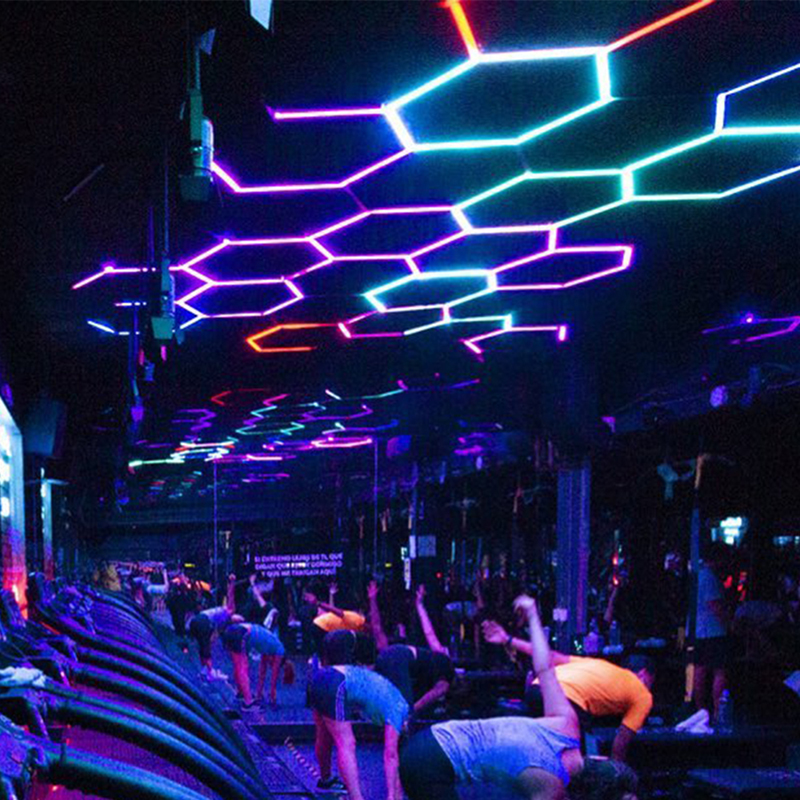
Commercial viability depends entirely on technical output. The primary white light emitted by these fixtures must possess a high Color Rendering Index (CRI of 90 or above). High CRI ensures merchandise colors are accurately represented. A navy blue suit must not look charcoal gray, and a vibrant red dress must not appear washed out. RGB capabilities are excellent for ambient zoning and background effects, but they should never be the primary light source illuminating the product itself. The hexagonal geometry provides a distinct advantage in light uniformity. Unlike traditional fluorescent troffers or highly directional spotlights that create harsh shadows and uneven bright spots, an interconnected honeycomb grid distributes light evenly across the merchandise, reducing glare and improving overall visibility.
| Lighting Metric | Standard Commercial LED Panels | Modular Hexagon Lighting Grids | Impact on Retail Environment |
|---|---|---|---|
| Color Rendering Index (CRI) | Typically 80-85 | 90+ (in premium models) | Higher CRI ensures accurate product color representation, reducing return rates based on color mismatch. |
| Light Distribution | Directional / Flat | Omnidirectional / Diffused | Hexagonal grids reduce harsh shadows on merchandise and mannequins, creating a premium visual experience. |
| Zoning Capability | Static (Requires physical rewiring) | Dynamic (Software controlled) | Allows instant reconfiguration of store layouts without construction or electrical downtime. |
| Visual Impact | Utilitarian / Unnoticed | Architectural / Engaging | Transforms the ceiling or wall into a design feature, increasing customer dwell time and brand recall. |
The control infrastructure dictates how effectively a store utilizes dynamic lighting. For small boutique shops or independent retailers, simple Bluetooth or Wi-Fi app controls are sufficient. Store managers manually adjust colors and brightness from a smartphone or tablet. Enterprise retail environments require robust, centralized solutions. Large-scale deployments of customizable RGB hexagon lights must integrate with DMX controllers or automated Building Management Systems (BMS). DMX integration allows the lighting grid to sync with in-store audio, video walls, and time-of-day scheduling. The lighting transitions automatically from a bright, energetic daylight setting in the morning to a warmer, more intimate setting in the evening without requiring manual intervention from floor staff.
The defining feature of this lighting architecture is physical scalability. The systems utilize standardized physical connectors—typically Y-connectors, V-connectors, and straight pins—that pass both structural support and low-voltage power between nodes. Store designers add or remove sections of the grid as seasonal inventory expands or contracts. If a retailer decides to double the size of their footwear department for the back-to-school season, the maintenance team simply snaps additional hexagon modules onto the existing grid. You do not need to hire electrical contractors to run new conduit. You do not need to pull permits for new junction boxes. This modular expansion drastically reduces the time and cost associated with store layout modifications.
Deploying high-output LED grids across a large commercial footprint introduces specific electrical challenges. The primary technical risk is voltage drop. This occurs when too many LED nodes are daisy-chained together on a single power supply. If a grid is too large, the lights furthest from the power source appear noticeably dimmer or fail to produce accurate colors. Proper installation requires meticulous load balancing. When we pull wire for these grids in commercial spaces, we always use plenum-rated 14 AWG or 16 AWG cable for the low-voltage runs. This minimizes resistance over long distances from the remote driver cabinet to the actual ceiling grid.
Installation methods vary significantly depending on the retail environment's existing architecture. In modern, industrial-style spaces with exposed ceilings, the entire hexagon grid is assembled on the floor and suspended using aircraft cable and adjustable grippers. This suspension method requires precise leveling but creates a striking, floating aesthetic. In traditional retail spaces utilizing acoustic T-bar drop ceilings, the installation process is different. Lightweight modular systems flush-mount directly to the drywall or attach to the T-bar grid using specialized clips. Installers must calculate the total weight distribution to ensure the existing grid supports the lighting array without sagging or violating commercial building codes.
| Mounting Surface | Hardware Required | Installation Complexity | Best Retail Application |
|---|---|---|---|
| Exposed Open Ceiling | Aircraft cable, adjustable grippers, unistrut | High (Requires precise leveling and aerial lifts) | Industrial streetwear boutiques, modern automotive showrooms |
| Acoustic T-Bar Drop Ceiling | Specialized T-bar clips, lightweight anchors | Medium (Requires weight distribution calculations) | Traditional big-box retail, consumer electronics stores |
| Drywall / Solid Surface | Flush-mount brackets, toggle bolts | Low to Medium (Requires hidden wire routing) | Storefront windows, fitting rooms, focal product walls |
High-output LEDs carry the inherent risk of causing visual discomfort. If the diodes are too intense or improperly shielded, they cause glare, leading to eye strain for shoppers and fatigue for employees working long shifts. Mitigation strategies are essential for a successful deployment. A system of RGB hexagon lights operates at higher intensity during bright afternoons to combat exterior glare, and dims automatically as evening approaches. When properly diffused and managed, these modular grids reduce eye strain by providing consistent, shadow-free illumination that improves staff focus and customer comfort.
Evaluating the financial viability of modular lighting requires looking beyond the initial purchase price. The upfront hardware investment for a commercial-grade geometric lighting system is higher than purchasing standard flat LED panels or basic track fixtures. This cost must be compared against the expenses associated with traditional spatial zoning. Building physical partition walls, installing high-end motorized track lighting, or constantly purchasing new physical display props requires significant labor, materials, and operational downtime. The modular lighting grid offers long-term agility. Once installed, the cost to reconfigure a retail zone drops to zero. The ability to redesign a store's layout overnight via software, without hiring contractors or closing aisles, provides a massive return on investment for brands relying on frequent visual merchandising updates.
Operational expenditures heavily favor modern LED architecture. High-output LEDs consume a fraction of the electricity required by legacy halogen or fluorescent systems, leading to immediate reductions in monthly utility bills. The lifespan of commercial-grade diodes typically exceeds 50,000 hours of continuous use. The modular nature of the system offers a unique maintenance benefit. If a single diode or connector fails, the maintenance team replaces that specific individual node in minutes. There is no need to scrap an entire large fixture or hire an electrician to rewire a ballast. This localized repair capability drastically reduces long-term maintenance costs and ensures the store always looks pristine.
The ultimate value proposition of dynamic lighting lies in its impact on sales metrics. By synthesizing psychological zoning, wayfinding, high CRI product illumination, and the creation of experiential UGC zones, the lighting directly addresses the core business problem. It increases customer engagement by making the physical space more interesting. It directs foot traffic specifically toward high-margin goods or new arrivals. It facilitates social media sharing, which serves as free organic marketing. When shoppers spend more time in a visually comfortable, easily navigable, and highly engaging environment, conversion rates naturally rise. The lighting transforms from a basic utility into an active driver of localized sales boosts.
A: Yes, provided they are high-output models designed specifically for commercial use. While they provide excellent ambient and uniform light, you should layer them with targeted accent lighting, such as adjustable spotlights, to properly highlight specific merchandise textures and details.
A: Commercial setups typically use DMX controllers or smart hubs integrated directly into the store's central building management system. This allows for automated scheduling, syncing with store audio, and seamless transitions without requiring manual input from retail staff on the floor.
A: Yes, lightweight modular systems can be suspended from or mounted directly to T-bar drop ceiling grids using specialized attachment clips. Installers must calculate the total weight distribution to ensure the grid can safely support the fixtures without sagging or violating building codes.
A: If the primary white diodes feature a high Color Rendering Index (CRI of 90+), product colors remain highly accurate. You should utilize the RGB color-changing functions for ambient spatial zoning and background effects rather than direct product illumination to avoid color distortion.
A: This depends entirely on the specific manufacturer's power supply and the voltage of the system. Commercial installations often require multiple power injection points for large, continuous grids to prevent voltage drop and ensure uniform brightness across the entire lighting array.
A: Yes, they are highly effective for storefront applications. They create high-contrast, dynamic visual displays that easily capture pedestrian attention from a distance. This significantly reduces the need for expensive, bulky physical window props while keeping the display area bright and engaging.


