


Views: 0 Author: Site Editor Publish Time: 2026-09-19 Origin: Site


Transitioning high-end automotive bays from standard overhead fluorescent or high-bay lighting to specialized, wrap-around illumination systems solves a massive operational headache. Traditional shop lighting creates harsh shadows, uneven color rendering, and persistent blind spots. These environmental flaws lead directly to workflow bottlenecks, missed paint defects, and increased rework in detailing and mechanical inspections. Relying on outdated fixtures forces technicians to constantly adjust portable lamps, slowing down every phase of vehicle service. Moving beyond aesthetics, shop owners must evaluate whether the structural and optical benefits of tunnel lighting systems provide a measurable return on investment. Upgrading to specialized lighting can drastically increase workflow velocity and elevate service quality. We will evaluate how continuous illumination arches eliminate shadows, improve defect resolution, and streamline daily operations, ensuring your lighting upgrade delivers tangible operational improvements.
A high-performance automotive bay requires specific lighting conditions to function efficiently. The baseline requirements include complete shadow elimination, strict color temperature consistency, and heavy glare reduction. Standard directional lighting fails to meet these criteria on the shop floor. High-bay fixtures push light straight down. This illuminates horizontal surfaces like hoods and roofs effectively. However, it leaves vertical surfaces like doors, fenders, and rocker panels in deep shadow. Technicians cannot correct paint defects or spot mechanical faults they cannot see.
The operational cost of poor visibility directly impacts bay profitability. Inadequate lighting increases the labor hours required per vehicle. Detailers spend excessive time cross-checking their work with handheld flashlights. Mechanics struggle to see deep into engine bays or wheel wells. This constant repositioning of secondary light sources disrupts focus and slows down the entire service process. Furthermore, compromised visibility leads to compromised quality control. Missed swirl marks or undetected fluid leaks result in customer dissatisfaction and costly rework.
Standard directional lighting also creates harsh glare points. When a single, intense light source reflects off a polished clear coat, it blinds the technician. This glare masks the surrounding paint surface, hiding micro-marring and sanding pigtails. In mechanical bays, overhead lights cast dark shadows under lift arms and vehicle overhangs. Technicians are forced to rely on cumbersome drop lights. These portable lights introduce trip hazards through trailing extension cords and frequently suffer damage in busy shop environments.
To understand the true cost of inadequate lighting, consider the daily workflow interruptions:
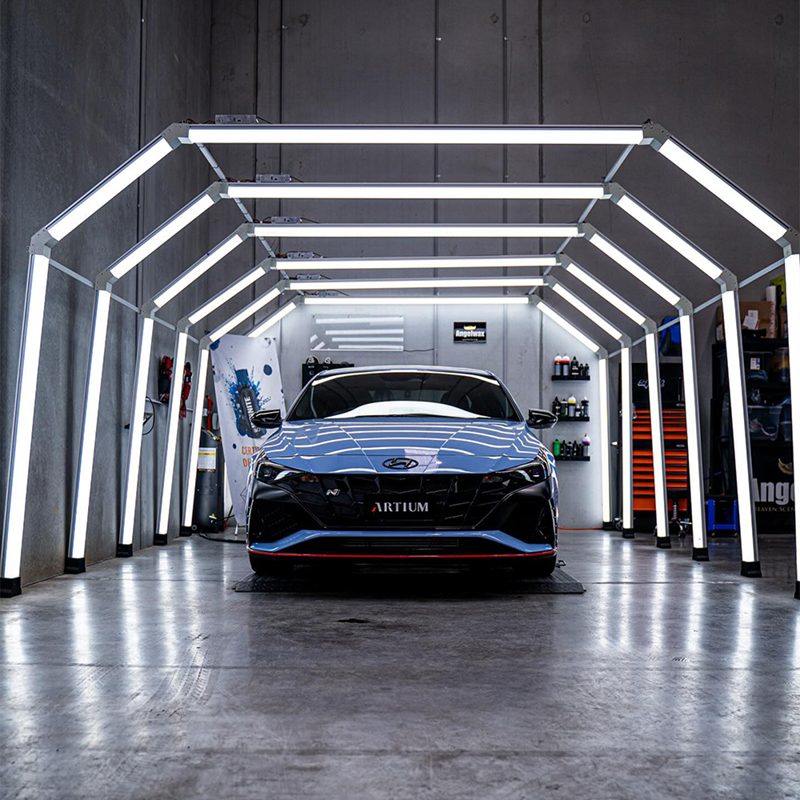
The fundamental advantage of a detailing light tunnel lies in its geometric light distribution. Instead of projecting light from a single overhead plane, these systems wrap illumination around the vehicle. Continuous light arches emit photons from multiple angles simultaneously. This intersecting light grid effectively cancels out shadows. When a technician leans over a fender, the light from the opposing wall and lower arches fills in the workspace. This wrap-around effect ensures that lower vehicle panels receive the exact same lux levels as the roof.
Continuous light arches dramatically enhance surface contrast. This contrast is mandatory for paint correction and ceramic coating application. The linear reflection of the LED strips on the clear coat acts as a visual guide. Any distortion in the reflection line instantly reveals dents, uneven clear coat leveling, or remaining swirl marks. Detailers can monitor their polishing progress in real-time without stopping to grab an inspection pen light. This continuous visual feedback loop accelerates the compounding and polishing phases.
The benefits extend far beyond cosmetic paintwork. Uniform, bright illumination transforms general mechanical inspections. A well-lit bay allows mechanics to easily identify fluid leaks, inspect suspension bushings, and trace wiring harnesses. The ambient light penetrates deep into the engine bay and undercarriage. This eliminates the reliance on cumbersome drop lights and headlamps. Technicians can keep both hands on their tools, improving safety and efficiency. High-quality, flicker-free lighting reduces eye strain and physical fatigue, keeping technicians alert and productive throughout long shifts.
Shop owners can choose between several structural configurations when planning an upgrade. Freestanding structural arches offer flexibility. You can bolt them directly to the floor without relying on the ceiling for support. This approach works well in leased buildings or facilities with exceptionally high, vaulted ceilings where dropping a grid is impractical. Conversely, ceiling-and-wall mounted grids maximize floor space. They integrate directly into the existing architecture, providing a clean, built-in aesthetic that keeps the floor completely clear of structural posts.
The shape of the lighting elements also dictates the workflow. Hexagonal modular systems create a distinct, modern look. The interlocking geometric patterns provide excellent diffuse lighting across the entire bay, making them great for general prep work. Continuous linear strip tunnels focus on creating unbroken reflection lines. These linear setups are preferred by dedicated paint correction specialists. The straight lines make it easier to spot subtle paint defects and ensure perfectly flat clear coat finishes.
You must assess which configuration aligns best with your specific service offerings. Consider the following operational matches:
Evaluating a car detailing light tunnel requires a strict focus on optical specifications. Lumen output dictates the overall brightness of the bay. However, you must calculate the optimal lux per square meter rather than just looking at total lumens. Lux measures the actual light intensity reaching the vehicle surface. A high-performance detailing bay typically requires between 1000 and 2000 lux at the working height. Insufficient lux leaves the lower panels too dark, while excessive lux can cause blinding glare on white or silver vehicles.
The Color Rendering Index (CRI) is a non-negotiable metric for any automotive workspace. CRI measures how accurately a light source reveals the true colors of an object compared to natural sunlight. A CRI of 90 or higher is required for professional shops. Low CRI lighting causes metamerism, where paint colors appear different under the shop lights than they do outside. This leads to mismatched touch-up paint, poorly blended panels, and missed high spots during coating applications. High CRI ensures that what you see in the bay is exactly what the customer will see in the sun.
Color temperature, measured in Kelvin (K), determines the warmth or coolness of the light. Selecting the correct temperature is vital for identifying different types of paint imperfections. Warm light (around 3000K to 4000K) can hide fine scratches. Cool light (above 7000K) introduces a blue tint that distorts color perception. The optimal range for automotive inspection sits between 5000K and 6500K. This daylight white spectrum provides the stark, neutral contrast necessary to reveal swirl marks, holograms, and sanding marks across all paint colors.
Modern lighting systems must accommodate future business growth. Adapting modular lighting systems for multi-bay expansions is a key advantage of LED technology. You can start by outfitting a single dedicated correction bay. As your volume increases, you can purchase additional modular sections to expand the tunnel across adjacent bays. This scalability allows you to manage capital expenditure while maintaining a consistent visual standard across the entire shop footprint.
Integration with existing shop infrastructure requires careful planning. You must ensure the lighting framework does not interfere with utility lines. The layout must accommodate HVAC vents to ensure proper airflow and temperature control. Blocking vents can lead to uncomfortable working conditions and extended curing times for coatings. Similarly, the lighting structure must route around compressed air lines, fluid delivery reels, and exhaust extraction hoses. A well-integrated system enhances the workspace without obstructing essential daily functions.
Automotive bays present harsh environmental challenges for electrical equipment. Understanding Ingress Protection (IP) ratings is essential for safety and longevity. The IP rating indicates the fixture's resistance to dust and moisture. Dry correction bays and mechanical areas can operate safely with standard IP20 or IP40 fixtures. However, wash bays and wet sanding areas demand strict waterproofing standards. Fixtures in these zones must carry at least an IP65 rating to withstand high humidity, chemical overspray, and direct water jets from pressure washers.
| Bay Type | Primary Activity | Minimum IP Rating | Recommended CRI | Ideal Color Temp (Kelvin) |
|---|---|---|---|---|
| Wash / Prep Bay | Decontamination, Wet Sanding | IP65 (Waterproof) | 85+ | 5000K - 6000K |
| Correction Bay | Polishing, Ceramic Coating | IP40 (Dust Resistant) | 90+ | 5500K - 6500K |
| Mechanical Bay | Repairs, Inspections | IP40 (Dust Resistant) | 80+ | 4000K - 5000K |
| Delivery / Showroom | Final Inspection, Client Handover | IP20 (Standard) | 95+ | 5000K |
Electrical compliance goes beyond just plugging in fixtures. You must calculate the total amperage draw of the entire tunnel system. While individual LEDs are highly efficient, a complete wrap-around tunnel utilizes thousands of diodes. This combined load often exceeds the capacity of standard lighting circuits. A standard 15-amp circuit can safely handle about 1440 watts. A large tunnel system might pull well over 2000 watts. Upgrading the shop's electrical panel and running dedicated 20-amp circuits is frequently necessary to prevent tripped breakers and ensure safe, continuous operation.
Evaluating the financial impact of premium lighting requires looking past the initial purchase order. The upfront capital expenditure for car workshop tunnel lights is noticeably higher than a standard high-bay LED upgrade. However, the true value lies in long-term throughput. By eliminating shadows and improving visibility, technicians work faster and with greater accuracy. A detailer might save 30 to 45 minutes per vehicle during the compounding and inspection phases. Over a week, these saved labor hours compound, allowing the shop to process more vehicles without increasing headcount.
Calculating the break-even point requires analyzing these saved labor hours alongside increased service quality. When technicians can clearly see their work, the rate of customer returns for missed defects drops to zero. Delivering flawless results consistently allows shop owners to justify premium service upcharges. Clients are willing to pay more when they see their vehicle prepped in a professional, brightly lit environment that guarantees perfection. The combination of faster turnaround times and higher ticket averages rapidly offsets the initial equipment investment.
Navigating the commercial lighting market requires diligent research. The industry is flooded with low-tier, unverified imports that boast exaggerated lumen claims and unrealistic lifespan metrics. Purchasing these inferior products often leads to premature driver failure, inconsistent color temperatures, and frustrating flickering issues. You must evaluate verified shop owner reviews to determine how specific fixtures perform in real-world automotive environments over several years.
Sourcing your equipment from manufacturers that specialize in automotive workspace lighting is mandatory. General commercial lighting vendors rarely understand the specific optical requirements of paint correction or the spatial constraints of a working bay. Specialized vendors understand the importance of CRI, glare reduction, and structural integration with automotive lifts. They provide accurate photometric data and design support tailored to the unique demands of the automotive service industry.
Even the highest quality LEDs experience degradation over time. This degradation impacts both total lumen output and color accuracy. As diodes age, they can shift in color temperature, potentially introducing a yellow or blue tint that compromises inspection quality. Understanding this reality is required for long-term maintenance planning. You must evaluate the ease of replacing individual LED nodes or drivers. Systems that allow for modular component replacement are vastly superior to proprietary fixtures that require complete unit replacement when a single driver fails.
Warranty evaluations require careful reading of the fine print. You must determine what commercial lighting warranties actually cover in an active automotive environment. Some warranties void if the fixtures are exposed to specific airborne chemicals or high humidity levels common in prep bays. Ensure the warranty covers driver failures, significant lumen depreciation, and color shifting. A robust warranty from a reputable manufacturer protects your investment and ensures your bay remains optimally lit for years.
Installing a comprehensive lighting system introduces specific structural risks. The most significant risk is interference with automotive lifts. Both 2-post and 4-post lifts require substantial vertical clearance. If the lighting arches are mounted too low, a raised vehicle will collide with the fixtures. You must carefully calculate the maximum overhead clearance required for tall vehicles, including lifted trucks and full-size SUVs. The lighting structure must wrap around the working area without encroaching on the physical footprint required by the lift mechanisms and the vehicles themselves.
Improper heat dissipation presents another major risk. While LEDs run cooler than traditional halogens, the drivers and power supplies generate significant heat. If the lighting grid is mounted flush against a low, unventilated ceiling, this heat becomes trapped. Excessive thermal buildup leads to premature driver failure and accelerated LED degradation. Ensuring adequate airflow around the power components is vital for maintaining the lifespan and performance of the system.
Mitigating these risks requires professional planning before any hardware is ordered. Conducting a comprehensive pre-installation electrical audit is the first mandatory step. An electrician must verify that your current panel can handle the continuous amperage draw of the new system. Simultaneously, you should request a photometric plan from the vendor. This 3D lighting simulation maps exactly how the light will fall across the bay, ensuring there are no dark spots between the arches and that the lux levels meet your requirements.
Hiring certified commercial electricians is strongly recommended over utilizing DIY plug-and-play kits. While some modular systems snap together easily, securing them safely to the ceiling structure and wiring them into the building's mains requires professional expertise. An electrician ensures all connections meet local safety codes, mitigating fire risks and preventing circuit overloads. Professional installation guarantees precise mounting heights. Establishing the correct height optimizes the focal point of the light, ensuring the brightest illumination hits directly at the vehicle's beltline where most complex correction work occurs.
Follow these specific installation phases to ensure a smooth deployment:
Car workshop tunnel lights are highly effective workflow accelerators. For shops specializing in paint correction, ceramic coatings, high-end detailing, and precision mechanical work, these systems eliminate the shadows and blind spots that cause daily bottlenecks. Provided your facility's infrastructure supports the installation, the transition to wrap-around illumination directly improves service quality, reduces labor times, and enhances technician ergonomics.
Base your purchasing decision on hard operational data rather than visual appeal alone. Evaluate your daily bay volume, primary service type, ceiling height, and available electrical capacity. A high-volume detailing shop requires different specifications than a general mechanical repair bay. Prioritize vendors with verified industry reviews, high CRI ratings, and proven modular designs that allow for long-term scalability and easy maintenance.
To move forward with upgrading your bay lighting, execute these next steps:
A: The ideal color temperature sits between 5000K and 6500K. This daylight white spectrum provides the stark contrast necessary to reveal swirl marks, scratches, and leveling issues in clear coats without introducing blue or yellow tints.
A: While an LED light tunnel utilizes highly efficient diodes, the sheer volume of fixtures means the total amperage draw is often higher than a few standard high-bay lights. You will likely need a dedicated circuit.
A: Yes, but only if the fixtures carry an appropriate Ingress Protection rating. Wash bay environments require at least an IP65 rating to protect the internal components against water jets and high humidity.
A: Minimum clearance depends on the vehicles serviced and lift usage. A ceiling height of at least 10 to 12 feet is recommended to allow for proper light diffusion and to accommodate trucks without structural interference.
A: Modular systems use plug-and-play connectors for straightforward assembly. However, mounting them securely to the ceiling and wiring them into the main electrical panel safely requires a certified commercial electrician.
A: By providing 360-degree, uniform illumination, they eliminate shadows. Technicians no longer need to constantly hold and move portable inspection lights, allowing for continuous, uninterrupted machine polishing.
A: Absolutely. The bright, uniform light eliminates shadows in the engine bay and undercarriage. This makes it easier to spot fluid leaks, inspect components, and work efficiently without constantly repositioning drop lights.


