


Views: 0 Author: Site Editor Publish Time: 2026-10-11 Origin: Site


For professional detailers and serious auto enthusiasts, nothing is more frustrating than finishing a multi-stage paint correction, pulling the car out into the sun, and immediately spotting missed swirl marks. Have you ever missed a subtle defect after hours of meticulous polishing? You are certainly not alone.
Historically, standard garage lights and basic overhead fixtures cast harsh shadows. They deceptively hide micro-defects until it is entirely too late. To combat this blind spot, the automotive surface care industry has adopted a highly effective structural solution. In this comprehensive guide, we will break down exactly how specific lighting frameworks solve the issue of hidden flaws, outperform standard equipment, and elevate your entire workspace.
Shadowless Visibility: A well-designed lighting framework surrounds the vehicle with uniform illumination, effectively eliminating the blind spots that typically conceal minor paint defects.
Optimal Color Accuracy: High Color Rendering Index LEDs closely mimic natural sunlight. This allows technicians to observe the true condition of the clear coat, revealing holograms and micro-marring with absolute precision.
Faster Turnarounds: Continuous, full-body illumination drastically reduces the time spent manually repositioning handheld inspection lamps.
Multi-Service Efficiency: Beyond basic polishing, structured lighting is absolutely critical for leveling ceramic coatings evenly and conducting precise Paint Protection Film inspections.
Business Growth: Upgrading to professional-grade illumination improves diagnostic accuracy while elevating the visual professionalism of the workspace.
Automotive detailing previously relied on basic overhead fluorescent tubes and scorching halogen work lamps. Halogens provided an intense beam necessary to spot deep scratches. However, they were highly inefficient, dangerous to touch, and only illuminated a localized area. As paint correction standards evolved, driven largely by ultra-hard ceramic coatings and advanced diminishing abrasives, the need for precision lighting became critical.
The industry gradually shifted toward specialized Auto Beauty Lighting. Detailers began utilizing LED technology to reduce heat and improve energy efficiency. Yet, the linear placement of standard LEDs still resulted in uneven coverage. Technicians found themselves crawling on creepers to inspect lower rocker panels that remained shrouded in darkness. This operational bottleneck paved the way for structural solutions.
Recent market analysis and search trends indicate a massive shift in automotive reconditioning. As multi-year ceramic coatings and Paint Protection Film installations become standard, consumer expectations have skyrocketed. Today's premium clients demand absolute perfection. Industry data reveals that detailers are actively abandoning traditional localized lighting in favor of full-body illumination systems. The modern detailing bay acts as a clinical presentation studio. A structural light tunnel directly aligns with this trend, providing the sterile, high-visibility environment required for modern high-gloss finishes.
A detailing tunnel is a modular system of high-intensity LED lights engineered to encapsulate the entire vehicle. Constructed using arched or grid-based aluminum frames, these systems distribute light evenly across the top and sides of the workspace. By creating a geometric cage of light, technicians can observe the paint from multiple angles simultaneously. This entirely frees up their hands for the polishing machine.
The physics of light dictate that a single directional source will cast a shadow when it strikes a curved object. Modern vehicles are complex combinations of convex curves and sharp body lines. When illuminated by a single overhead fixture, the hood may appear flawless while lower doors and intricate grilles fall into deep shadow.
In contrast, a wrap-around tunnel design solves this by flooding every angle with intersecting light beams. Light hits the vehicle from the top, sides, and front simultaneously. Consequently, this 360-degree illumination makes it physically impossible for micro-defects to hide in unlit zones.
As an automotive surface specialist will tell you, brightness alone does not equate to clarity. Blinding light washes out the very defects you want to find. Professional technicians rely on Color Rendering Index and Color Temperature. For meticulous paint correction, a Color Rendering Index of 90 or higher is strictly necessary. It prevents color distortion and accurately reveals clear coat damage. Furthermore, a color temperature of 6500K provides a crisp daylight spectrum. This specific range highlights scratches without causing excessive glare during a ten-hour shift.
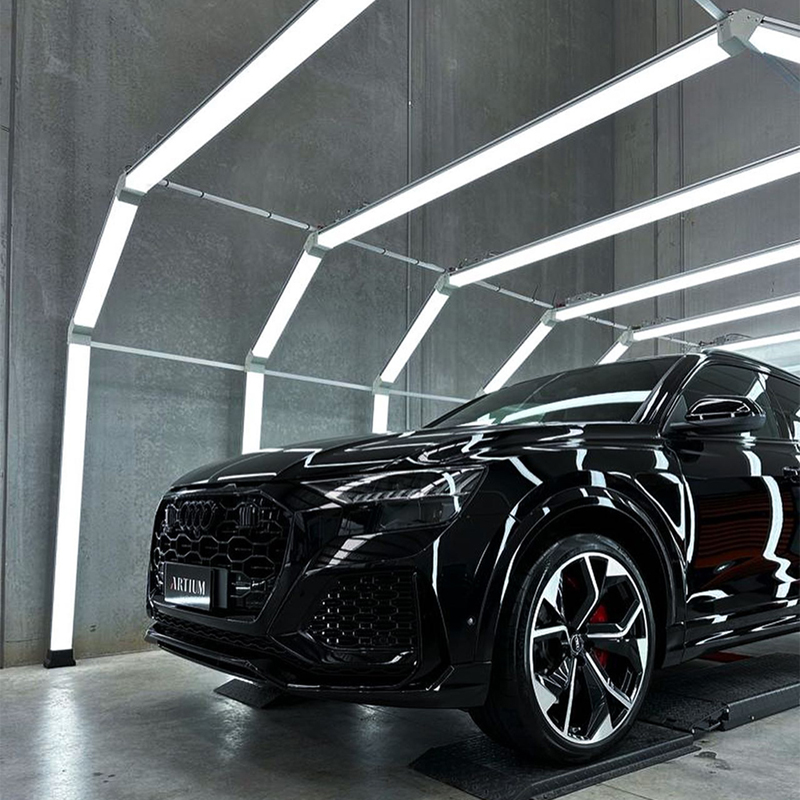
Swirl marks are microscopic scratches etched into the clear coat. They are most often caused by improper automated car washes. Under flat lighting, these fine scratches seamlessly blend into the paint. The uniform grid pattern of a tunnel system creates distinct reflection lines on the surface. When the clear coat is damaged, these reflected lines appear jagged or distorted. The human eye easily detects this geometric distortion, making swirl marks instantly visible.
Holograms are micro-abrasions left behind by rotary polishers. They require a highly focused light source to reflect off their microscopic ridges. A full-scale setup illuminates the entire side profile of the vehicle simultaneously. This broad coverage allows the detailer to see the complete path of the buffer trail, ensuring no section is overlooked.
Random Isolated Deep Scratches require intense, penetrating light. The high lumen output generated by a continuous LED framework penetrates the upper layer of the clear coat. This objective visibility empowers technicians to make informed decisions about compounding aggressiveness, preventing the unnecessary removal of healthy clear coat.
Applying ceramic coatings is an incredibly time-sensitive process. When you are leveling a high-solids ceramic coating at 75 degrees ambient temperature, the liquid polymer begins to flash rapidly. If excess product remains, it hardens into a stubborn high spot. The surrounding, uniform light of a Tunnel Luci LED Detailing setup brilliantly highlights the rainbow flashing process. Technicians can spot and level excess product from every viewing angle before it permanently bonds.
Paint Protection Film demands a sterile environment. Before the adhesive sets, installers must inspect the film for trapped dust nibs or tiny air bubbles. A premium lighting setup acts as a massive inspection grid. As the technician moves, the continuous light reflects off the glossy surface, immediately highlighting any raised imperfections and ensuring a flawless installation.
When outfitting a workspace, business owners must evaluate lighting efficiency. Their operational impacts on workflow vary significantly.
Lighting Type | Primary Use Case | Shadow Elimination | Workflow Efficiency |
|---|---|---|---|
Handheld Inspection Lamps | Localized spot-checking | Poor | Low, occupies one hand |
Overhead LEDs | General room illumination | Poor, harsh downward shadows | Medium |
Detailing Light Tunnel | Full-vehicle correction & coating | Excellent, 360-degree coverage | High, completely hands-free |
The structural tunnel system combines full-room brightness with the defect-finding intensity of specialized Car Detailing Lights. By wrapping light around the sides, it provides a completely hands-free inspection environment. This hybrid approach covers the entire vehicle simultaneously, representing the most efficient choice for high-volume detailing operations.
Transitioning to a comprehensive illumination system is a strategic capital investment. A poorly configured system leads to insufficient light distribution. Prospective buyers must analyze critical technical parameters before purchasing to ensure they get commercial-grade equipment.
The physical dimensions of your detailing bay dictate structural requirements. Modularity is the most crucial feature to prioritize. Modular systems utilize interlocking grid patterns. This adaptability ensures the light source remains at the optimal distance from the vehicle. If lights are mounted too far away, the lux decreases and reduces defect visibility.
Visibility is directly correlated to light quality. Excessive brightness creates severe glare and causes eye fatigue. Instead of maximum brightness, evaluate luminous efficacy. Professional systems should offer 110 to 120 lumens per watt. This provides a balanced output that floods the area without blinding the operator. High-efficiency LEDs keep operational utility costs manageable during long working hours.
A detailing bay is an active industrial environment involving high humidity and airborne polishing dust. The physical construction must withstand daily commercial use. Prioritize frames constructed from aviation-grade aluminum. Aluminum acts as a highly efficient passive heat sink. The diffusers should be manufactured from impact-resistant polycarbonate rather than cheap acrylic that yellows over time. Modern systems feature plug-and-play wiring with secure joints, allowing a small team to assemble the structure rapidly.
Spotting paint defects quickly is the foundation of high-end detailing. A detailing light tunnel removes guesswork and drastically speeds up your daily workflow. It ensures a flawless finish every single time a vehicle leaves your bay. This upgrade pays for itself by saving valuable labor time and attracting higher-paying clients who recognize true professionalism.
Ready to transform your detailing bay into a world-class inspection studio? Upgrading your infrastructure is the fastest way to improve diagnostic accuracy and build client trust. Explore professional-grade, modular lighting solutions tailored to your workspace dimensions at Contation LED, and scale your auto beauty business to the next level today.
Yes, installing these systems in residential settings is entirely feasible. Standard two-car home garages typically measure around 20 by 20 feet. Because premium lighting frameworks utilize interlocking grids, you can customize the footprint to fit securely within these parameters. Many detailers suspend the lighting grid flush against the ceiling to maximize vertical space.
While a comprehensive tunnel system eliminates shadows across most of a vehicle, maintaining a handheld light is standard practice. The tunnel excels at providing uniform light across large panels. However, modern vehicles feature intricate geometries like deep-set front grilles. A handheld light directs concentrated light into these recessed areas for final quality control.
Modern systems are engineered specifically for straightforward assembly. The majority utilize a plug-and-play electrical design. The aluminum housing segments connect via standardized joints, eliminating the need for manual wire splicing. The assembled grid must be securely anchored to ceiling joists using proper suspension cables.
For automotive paint correction, a color temperature of 6500K is widely considered the industry standard. This daylight-white spectrum provides the starkest contrast for highlighting clear coat scratches, swirl marks, and holograms. Warmer temperatures can mask subtle defects, while excessively cool blue light causes severe eye strain over long working hours.
A professional detailing bay requires significantly more illumination than a standard mechanical garage. You should aim for a minimum of 75 to 100 lumens per square foot at the working surface level. A well-configured light tunnel naturally achieves this high lux density by concentrating the lumen output directly around the vehicle rather than dispersing it across the entire room.


