


Views: 0 Author: Site Editor Publish Time: 2026-08-18 Origin: Site


Social media feeds often showcase vibrant geometric lighting setups. Many view these displays as purely aesthetic trends. However, this aesthetic has rapidly evolved into a mandatory standard. It is now a strict functional requirement for commercial auto shops. Managers implement hexagrid working lighting to transform their workspaces completely. Modern inspection bays demand continuous, shadow-free illumination. This vital upgrade directly increases defect detection rates. It also drastically improves technician accuracy during intricate repairs. You must establish a clear baseline assumption before purchasing. Not all grid systems deliver commercial-grade performance. Many cheap consumer kits simply cannot withstand rigorous daily shop environments. This guide separates professional-grade fixtures from low-end alternatives. You will learn how to evaluate crucial specifications and structural integrity. We will also explore effective procurement strategies. By the end, you will understand exactly how to select fixtures to optimize your daily operations.
Traditional linear shop lights create severe operational problems. They produce harsh directional shadows across vehicle surfaces. These aggressive shadows mask minor dents and tiny paint inconsistencies. They also hide uneven panel gaps during critical final inspections. Technicians often struggle to see lower rocker panels clearly. Standard high-bay lighting creates intense bright spots surrounded by deep dark zones. We must fundamentally rethink the geometry of shop illumination to solve this.
A hexagonal light structure provides a brilliant multi-source cross-illumination effect. Light hits the vehicle from dozens of different angles simultaneously. This geometric layout physically wraps the vehicle in light. It effectively eliminates the dangerous blind spots caused by single-point sources. When a technician inspects a side door, they no longer block their own light source.
A successful retrofit relies on specific measurable criteria. The new system must reduce technician eye strain significantly. Constantly squinting under harsh glare causes severe fatigue. A proper installation should improve quality assurance pass rates immediately. You want to catch defects before handing keys back to clients. Finally, the fixtures must withstand harsh shop-floor environmental conditions. They need to resist dust, oil, and accidental impacts daily.
You cannot compromise on color accuracy in a professional bay. Commercial inspection requires a Minimum 90 CRI (Color Rendering Index) rating. This crucial metric measures how accurately a light source reveals true colors. Technicians need high CRI specifically for inspecting fresh clear coats. They rely heavily on it for precise paint color matching. It also helps them identify subtle surface contaminants before polishing. Lower CRI lights make metallic flakes look completely dull. They often cause poorly matched paint panels to appear identical indoors.
High lumen output is essential for large inspection bays. Typical commercial systems deliver roughly 110 to 120 lumens per watt. However, raw power often creates intense, blinding glare. You must balance this brightness carefully for user comfort. Diffused polycarbonate covers are absolutely necessary. They soften the intense LED diode output effectively. This diffusion prevents blinding technicians when they look upward toward the ceiling.
Shop floors are inherently messy environments. Evaluating Ingress Protection (IP) ratings is a critical step. IP54 represents the absolute minimum rating for basic dust resistance. Airborne polishing compounds will eventually destroy unprotected electronic circuits.
| Shop Zone / Location | Minimum IP Rating Required | Primary Environmental Threat |
|---|---|---|
| Dry Paint Correction Bay | IP54 | Airborne dust and polishing compound residue |
| General Mechanics Bay | IP54 | Oil splashes and metallic brake dust |
| Wet Sanding / Prep Station | IP65 | Direct water drips and high humidity |
| Wash Bay (Adjacent) | IP65 or IP67 | Direct pressure washer spray and chemicals |
LEDs generate significant heat during continuous operation. Built-in aluminum heat sinks are highly necessary for longevity. They actively draw heat away from the sensitive internal diodes. Cheap plastic housings trap this heat inside the tube. Overheating directly causes premature LED diode degradation. It also leads to severe color shifting over time. Professional shops run continuous 10 to 14 hour shifts daily. Efficient thermal management ensures the lights maintain consistent brightness over many years.
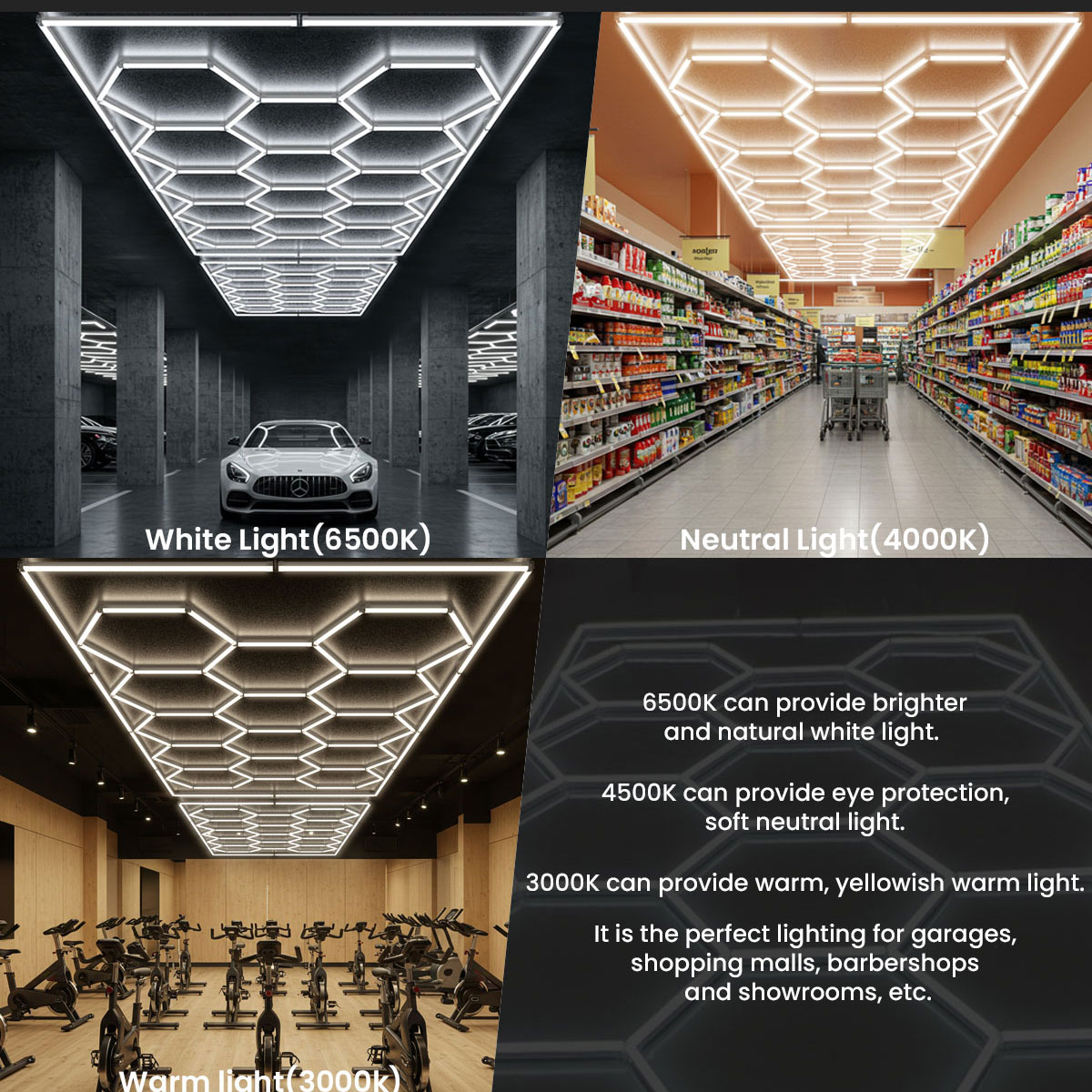
We must compare light uniformity across the entire workspace. hexagonal LED lights offer far superior multidirectional coverage. Standard linear car detailing lights push photons in only one direction. Fluorescent panel troffers create overlapping pools of uncomfortable glare. The honeycomb pattern entirely eliminates these harsh transitions. It distributes light evenly across every square inch of the vehicle hood. You get perfect visibility whether inspecting a roof or a bumper.
Operational advantages become apparent when analyzing maintenance protocols. Commercial hexagrids feature a highly modular design. Suppose a careless technician accidentally strikes one section of the grid. If one specific tube fails, you only replace a small 1.5ft segment. You do not need to discard a massive integrated high-bay fixture. This smart modularity minimizes shop downtime significantly. It keeps your inspection bays running smoothly without interrupting service schedules.
Let us discuss the long-term financial realities. Hexagrids do require a higher initial capital expenditure. However, you must look closely at operational expenditure savings. They consume significantly less electricity than older metal halide setups. You also spend less money constantly replacing burnt-out fluorescent bulbs. Reduced maintenance costs offset the initial purchase price rapidly. You gain better working conditions and lower monthly utility bills simultaneously.
| Feature Matrix | Commercial Hexagrids | Linear LED Strips | Fluorescent Troffers |
|---|---|---|---|
| Shadow Reduction | Excellent (Multi-directional) | Moderate (Directional) | Poor (High glare/dark spots) |
| Modularity | High (Replace individual tubes) | Low (Replace entire fixture) | Moderate (Replace bulbs) |
| Energy Efficiency | Very High | High | Low |
| Visual Aesthetics | Modern, Professional | Standard, Basic | Outdated, Industrial |
Planning a retrofitting project requires strict attention to physical realities. Installing a massive overhead grid involves specific mechanical and electrical risks. Facility managers must address these technical challenges before approving any purchase order.
The internet is currently flooded with B2B marketplaces selling cheap clones. You must identify distinct red flags during the procurement phase. A major warning sign is the lack of recognized safety certifications. Never buy fixtures lacking proper UL, CE, or ETL marks. Uncertified electrical lighting poses significant fire risks to your facility. Another major red flag is a warranty lasting under one year. Commercial vendors confidently stand behind their products for three to five years minimum.
Professional installations require scientific planning and validation. Instruct your buyers to request a standard DIALux calculation. You should also accept similar 3D lighting calculation reports. Reputable vendors provide these reports before you finalize any purchasing. These visual layouts guarantee floor-level lux requirements are met perfectly. They show exact light distribution patterns in false-color rendering. They eliminate expensive guesswork from the early design phase.
You need a concrete, step-by-step action plan moving forward. We recommend following these specific procurement practices:
Avoid buying cheap, all-in-one pre-packaged kits found on generic retail sites. Commercial-grade honeycomb LED lights demand proper commercial sourcing channels.
Investing in commercial-grade infrastructure directly impacts your service quality. Upgraded illumination ensures technicians easily spot microscopic defects before clients do. It also vastly improves overall shop floor safety by eliminating dark trip hazards. Remember to prioritize high CRI, solid aluminum construction, and proper IP ratings. Do not settle for uncertified consumer kits.
We encourage facility managers to take immediate action today. Request a localized lighting audit from your maintenance team. Measure your bays and document your current electrical circuit capacity. Then, request a technical spec sheet and DIALux rendering from shortlisted suppliers. Upgrading your visual environment is the fastest way to elevate your operational excellence.
A: Yes, many commercial-grade systems offer dimming capabilities. However, you must specify this requirement before purchasing. Dimmable setups require compatible LED drivers, typically utilizing a 0-10V dimming protocol. Standard on/off drivers cannot be dimmed retroactively. Always ensure your shop wiring supports low-voltage dimming lines.
A: For optimal lux delivery and minimal glare, we recommend suspending the grid 9 to 12 feet above the floor. If your ceilings are higher, utilize adjustable aircraft cables to drop the fixtures to this ideal working height.
A: Absolutely. Professional systems rely on a highly modular architecture. They use standardized plug-and-play Y and V polycarbonate connectors. This allows installers to link various tube lengths together. You can easily build custom geometric shapes to fit around columns, lifts, or irregular bay walls.
A: Industrial environments frequently experience voltage fluctuations from heavy machinery. Cheap consumer lights burn out quickly under these conditions. Professional fixtures utilize commercial-grade drivers featuring built-in surge protection. These robust drivers regulate incoming voltage, protecting the sensitive LED diodes from unexpected electrical spikes.


