


Views: 0 Author: Site Editor Publish Time: 2026-08-23 Origin: Site


Detailers frequently lose billable hours to a hidden operational bottleneck: constantly adjusting portable work lights or repositioning the vehicle to chase shadows and spot paint defects. Inconsistent shop lighting creates blind spots, particularly on lower side panels, bumpers, and complex curves. This necessitates continuous physical repositioning, which breaks workflow, increases physical fatigue, and introduces the risk of missed high/low spots or compounding errors during precision detailing. We must transition from analyzing the labor cost of poor lighting to evaluating the structural solution. Investing in a dedicated LED light tunnel eliminates the need for repositioning by providing uniform, 360-degree illumination. Shop owners need to determine if the return on investment justifies the installation. Upgrading the physical environment changes how technicians approach paint correction.
Workflow Efficiency: A properly configured LED light tunnel drastically reduces the need to move vehicles or portable stands by enveloping the workspace in uniform, multi-directional light.
Defect Detection: Continuous arch or grid lighting minimizes harsh shadows, allowing detailers to identify swirl marks, holograms, and coating high spots from a static standing position.
Operational Savings: Beyond labor efficiency, upgrading to LED technology yields significant long-term cost savings through reduced energy consumption and lower maintenance requirements compared to traditional high-output shop lights.
Facility Requirements: Implementation requires significant overhead space, dedicated electrical circuits, and specific ceiling heights to accommodate standard vehicle dimensions.
Cost vs. ROI: While upfront costs are high, high-volume shops typically recover the investment through reduced labor hours per vehicle, improved quality control, and lower utility overhead.
Defining the baseline metric for success requires looking at physical movement on the shop floor. Success means reducing the physical steps taken and minutes spent adjusting lighting per detailing stage. These stages include heavy washing, aggressive compounding, fine polishing, and ceramic coating application. Every time a technician stops the dual-action polisher to move a tripod stand, efficiency drops. The physical toll on a detailer's back and knees from constantly bending down to check rocker panels with a handheld light adds up over a ten-hour shift, leading to fatigue and sloppy finishing work.
You must calculate the cumulative time lost to moving these lights across a standard work week. Consider a technician working on a large black SUV. They polish the driver-side door, then realize the lower rocker panel sits in a shadow. They stop the machine, wipe off the polish residue, walk over to the halogen stand, adjust the height, change the angle, and walk back. This sequence takes roughly two minutes. Multiply that by ten panels, and you lose twenty minutes per vehicle just chasing the light. Detailers waste countless hours adjusting overhead bays and physically turning the vehicle. You have to catch the light at the correct angle to see the true condition of the clear coat, especially when dealing with sticky paints or heavy oxidation.
Inadequate lower-panel visibility leads directly to missed defects. Missed defects cause customer callbacks and severe reputation damage. When a customer finds a patch of holograms on their lower door panel in direct sunlight, the shop loses credibility instantly. Standard overhead fluorescent or single-point LED bays fail to illuminate vertical surfaces. Light travels in straight lines, creating harsh shadows below the vehicle beltline. Rocker panels, lower bumpers, and complex diffuser fins remain hidden in darkness under traditional shop lighting.
Handheld inspection lights work well as supplementary tools. They fail as primary light sources because they require one hand to operate. This slows down the machine polishing process significantly. A technician cannot safely operate a heavy rotary polisher while holding a flashlight. Mounting lights on rolling carts offers a slight improvement, but heavy extension cables still create trip hazards across wet shop floors. The physical mechanics of detailing demand a hands-free, universally illuminated workspace to maintain momentum and accuracy.
A detailing light tunnel acts as a complete environmental upgrade rather than a simple fixture replacement. Multi-directional lighting relies on overlapping light beams from arches or grids. These overlapping beams cancel out shadows completely. Continuous lighting allows detailers to walk around the vehicle without moving their light source. This optimizes visual performance step-by-step. The vehicle remains stationary while the technician moves fluidly from panel to panel, maintaining their rhythm and focus on the paint correction process.
Color temperature and Color Rendering Index play massive roles in paint correction. True paint correction requires a high CRI of 90 or above. This ensures the light accurately reflects the true color of the paint, revealing subtle undertones in metallic finishes and exposing sanding pigtails that lower-quality lights hide. The appropriate color temperature sits strictly between 5000K and 6500K. This range mimics natural daylight, providing the stark contrast needed to spot micro-marring and dual-action haze. Anything warmer hides defects, while anything cooler causes severe eye strain and washes out the panel.
Uniform color temperature across the entire tunnel prevents optical illusions. Detailers avoid high spots during ceramic coating leveling when the light remains consistent. A high spot looks like a dark smudge under poor lighting. Under uniform LED illumination, the high spot reflects light differently, making the rainbow flashing effect instantly visible. The environment dictates the quality of the work. Controlling the light means controlling the final outcome of the detailing process.
When you eliminate the need to constantly check and re-check panels with a swirl finder light, the entire correction phase accelerates. Technicians maintain their physical rhythm. They apply compound, work the section in overlapping passes, wipe down the panel, and immediately see the results. The ambient light provides all the necessary feedback. This continuous feedback loop prevents over-polishing, preserves clear coat thickness, and ensures a flawless finish before the final wipe-down.
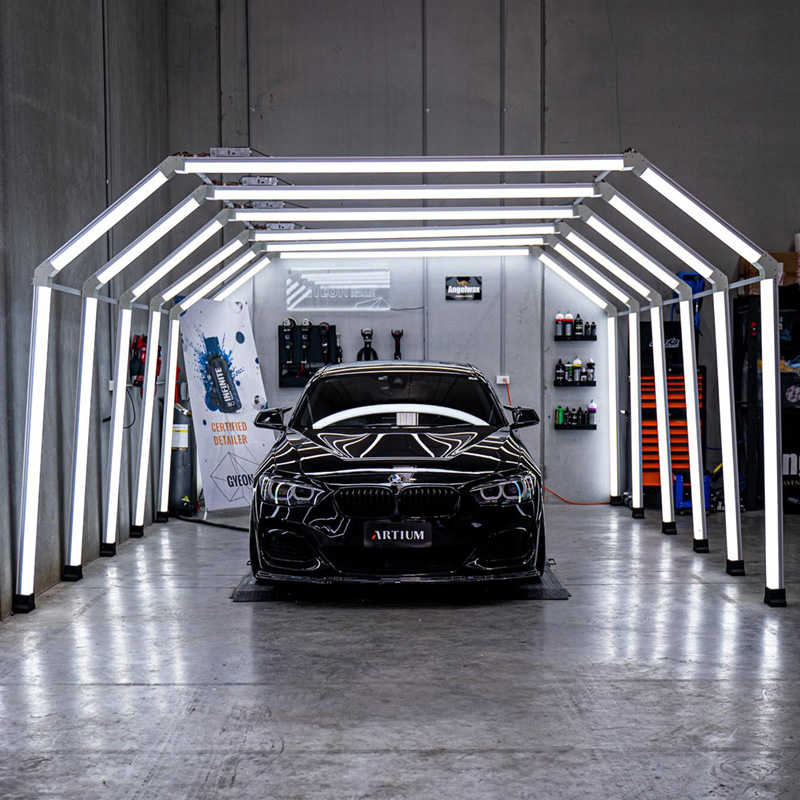
We must assess different tunnel configurations based on specific shop needs. You cannot simply buy the brightest lights and expect perfect results. The physical layout of the diodes determines how the light interacts with the vehicle panels. A shop specializing in lifted trucks requires a vastly different setup than a studio working exclusively on low-slung exotic sports cars.
Lighting Configuration Comparison
Configuration Type | Primary Advantage | Best Application | Potential Drawback |
|---|---|---|---|
Freestanding Arch | Superior side-panel visibility | Heavy paint correction | Requires wider floor space |
Ceiling Hexagonal Grid | Excellent top-down illumination | Ceramic coating application | Weaker lower door visibility |
Hybrid Wall/Ceiling | Complete 360-degree coverage | High-volume detail studios | Complex installation process |
Adjustable lumen output is a strict necessity for professional environments. Heavy compounding requires high lumen output to spot deep scratches and oxidation. Conversely, spotting ceramic coating high spots demands lower, diffused output. Too much light washes out the subtle rainbow effect of a flashing coating. Dimming capabilities allow the technician to tailor the environment to the specific chemical process happening on the paint. You need the ability to drop the brightness by fifty percent when applying graphene or ceramic sealants.
Thermal management ensures operational stability. LED technology emits low forward heat, preventing ceramic coatings from flashing prematurely. Traditional halogen work lights often cause this exact issue, forcing the detailer to rush the leveling process and risk leaving high spots. Robust fixture housing withstands constant operation and shop vibrations. Air compressors and heavy machinery create constant micro-vibrations that rattle cheap fixtures apart. Detailing bays expose lights to moisture, chemical mist, and polishing dust.
You need IP65-rated car workshop tunnel lights to withstand these harsh environments without short-circuiting. The IP rating system stands for Ingress Protection. The '6' means the fixture is completely dust-tight, keeping out heavy compounding dust. The '5' means it can withstand water jets from any direction. When technicians pressure wash a vehicle inside the bay, atomized water particles float up to the ceiling. If the light housings lack proper rubber gaskets, moisture penetrates the casing and corrodes the internal wiring. Investing in sealed units prevents catastrophic electrical failures.
Balancing operational benefits against financial and spatial realities requires careful calculation. You must calculate the return on investment accurately. Compare the cost of the tunnel and installation against the hourly shop rate multiplied by the hours saved per week. You cannot look at the upfront invoice in a vacuum; you must measure it against recovered billable time.
Follow these steps to calculate your specific return on investment:
Track the exact time spent repositioning lights on five different vehicles.
Calculate the average time lost per vehicle.
Multiply that average by your weekly vehicle volume.
Multiply the total weekly hours saved by your shop's hourly labor rate.
Divide the total cost of the lighting system by your weekly savings to find your break-even point in weeks.
If a tunnel saves two hours of repositioning time per vehicle, the financial recovery happens rapidly in a high-volume shop. The math heavily favors the upgrade when labor costs run high. A technician who spends less time moving lights spends more time actually polishing paint, increasing the overall throughput of the facility.
Factor in long-term cost savings from reduced energy consumption. Running multiple high-draw metal halide or halogen fixtures drains electricity rapidly. LEDs offer a massive reduction in wattage for the exact same lumen output. They also boast a long lifespan, eliminating frequent bulb replacements. This reduces ongoing maintenance costs and prevents downtime caused by blown bulbs in the middle of a correction job. You stop paying for replacement halogen tubes and start keeping that capital in the business.
Space requirements dictate the physical feasibility of the installation. A car detailing light tunnel requires specific width and height clearances. You must accommodate large SUVs and lifted trucks without creating a claustrophobic workspace. Technicians need at least three to four feet of clearance on all sides of the vehicle to move a rolling stool and a polisher cord without snagging on the light frames. Dedicating a fixed bay solely to correction and coating means sacrificing a multi-purpose bay. You trade flexibility for extreme specialization. This trade-off works perfectly for dedicated correction studios but hurts general repair shops that need every bay available for mechanical work.
Technical hurdles often cause tunnel installations to fail or underperform. Overloading existing shop circuits presents a massive fire risk. A full LED array draws significant amperage. Consult a licensed electrician to install dedicated breakers. Local code compliance for high-draw LED arrays is mandatory. Never attempt to run a massive lighting system off a single standard wall outlet. Proper electrical infrastructure prevents breaker trips during crucial machine polishing stages.
To mitigate electrical risks, implement the following protocols:
Install dedicated 20-amp circuits specifically for the lighting array.
Use commercial-grade wiring rated for continuous heavy loads.
Mount surge protectors at the breaker panel to shield the LED drivers from power spikes.
Keep all wiring connections inside waterproof junction boxes.
Ensure the total amperage draw does not exceed eighty percent of the breaker's rated capacity.
Premium systems still require an iterative process of post-installation calibration. You must test, adjust, and move specific light sections. This optimizes visual performance for the shop's most common vehicle profiles. A shop working primarily on low-slung sports cars needs a different light angle than a shop specializing in lifted diesel trucks. Calibration takes time but guarantees the system works as intended. You will likely spend the first week tweaking the angles of the lower arch lights to perfectly hit the rocker panels.
Working inside a high-intensity light tunnel for eight hours causes severe eye fatigue. Glare management is a serious occupational health concern. Utilize frosted diffusers, strategic fixture angling, and dimmable zones to protect detailer vision. Bare diodes cause retinal burn over time, leading to headaches and decreased productivity. Assembling cheap, imported DIY kits leads to sagging frames and failing diodes within months. The plastic connectors snap under the weight of the aluminum rails, and the LED drivers burn out due to poor heat sinks. Invest in professional-grade, turnkey systems with solid warranties to mitigate installation challenges and ensure structural integrity.
Measure your primary detailing bay dimensions to determine maximum arch width and ceiling clearance.
Audit your current electrical panel capacity with a licensed electrician to confirm you have space for dedicated circuits.
Request specification sheets detailing CRI, IP ratings, and energy consumption metrics from reputable lighting manufacturers.
Schedule a structural assessment to ensure your ceiling joists can support the weight of a suspended grid system.
A: No. While a tunnel eliminates repositioning for general paint correction, handheld lights remain essential. Detailers still need them for hyper-specific angle checks, interior work, and inspecting complex wheel barrels.
A: The ideal color temperature ranges from 5000K to 6500K. This specific range simulates natural daylight perfectly. It provides the optimal contrast needed for spotting swirl marks, holograms, and remaining polishing residue on clear coats.
A: Yes, provided they have the correct ingress protection. You must install fixtures with IP65 or IP67 waterproof ratings. These ratings ensure the lights survive direct water exposure, heavy chemical mist, and extreme moisture conditions.
A: Most standard installations require a minimum ceiling height of 10 to 12 feet. This clearance accommodates lifted trucks or large SUVs safely. It ensures light fixtures do not interfere with the vehicle roof during polishing.
A: No. Unlike traditional halogen lamps, LEDs feature excellent thermal management. They emit minimal forward heat into the workspace. This prevents ceramic coatings from flashing too quickly during the application and leveling process.
A: Yes, prolonged exposure to high-intensity lighting causes eye fatigue. Detailers working long shifts must manage this occupational hazard. Utilizing frosted diffusers, strategic fixture angling, and dimmable zones effectively mitigates glare during extensive polishing sessions.
A: Calculate the total wattage of all fixtures and divide by your voltage to find the amperage draw. Always consult a licensed electrician. They will install dedicated circuits to prevent breaker trips and ensure safety compliance.


