


Views: 0 Author: Site Editor Publish Time: 2026-08-17 Origin: Site


Social media feeds constantly show auto shops bathed in sleek, futuristic lighting grids. However, a tension exists between striking shop aesthetics and the hardcore functional requirements of professional detailing. Skepticism remains high among veteran detailers regarding whether these popular setups actually aid in paint correction.
Proper paint inspection demands lighting capable of exposing microscopic clear coat defects like swirl marks, holograms, and dual-action (DA) haze. If you choose the wrong lighting geometry, it can wash out these crucial flaws. Improper lighting also creates confusing surface reflections, leading to missed scratches and poor polishing results.
Today, we evaluate whether these geometric systems function as legitimate car detailing lights. We will examine the physics of light diffusion and highlight critical hardware specifications. Finally, we will show you how to integrate them into your workspace without compromising strict quality control.
Paint correction relies heavily on optical physics. Professional detailers must understand how different light sources interact across a clear coat. A detailing bay requires two distinct types of lighting to function optimally. You need ambient floodlighting to create a baseline visible workspace. You also need point-source lighting to create sharp surface contrast.
Ambient lighting washes over the vehicle evenly. It allows technicians to see the entire car clearly during washing, claying, and interior tasks. Point-source lighting, however, acts like a laser. It pierces the darkness to illuminate the sharp edges of micro-scratches. Without point-source lighting, fine swirl marks remain hidden.
The Color Rendering Index (CRI) dictates your ability to see true paint color. You must mandate a CRI above 90 for any overhead fixture. Low CRI ratings distort colors, making metallic reds look dull or muddy. High CRI reveals the exact tint of the base coat. It helps you spot localized burn-throughs immediately. It also highlights uneven compounding haze left behind by aggressive polishing pads.
Visual ergonomics play a massive role in a technician's daily health. Detailers often stare at highly reflective clear coats for eight hours a day. Harsh, improperly diffused overhead lighting causes intense optical fatigue. Glare reflects off the hood directly into the user's eyes. Over time, this causes headaches and reduces work quality. Proper diffusion ensures the light spreads evenly, protecting the technician's vision while keeping the workspace adequately bright.
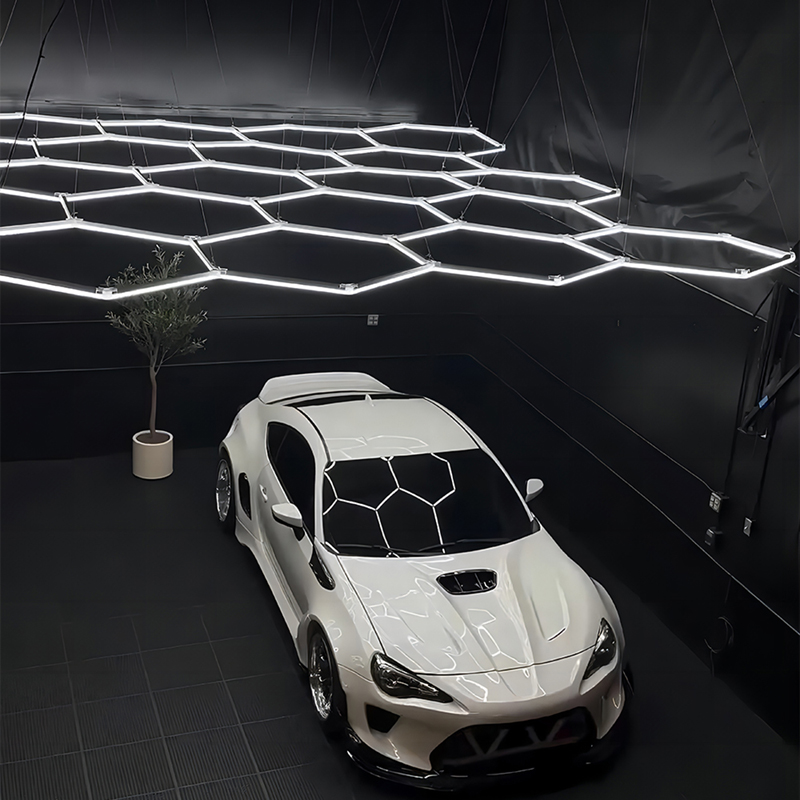
Applying geometric light patterns to a glossy surface yields unique advantages and distinct limitations. The grid reflection acts as a massive visual map across the vehicle. This continuous geometric reflection provides an incredible advantage for leveling ceramic coatings.
When applying a coating, high spots alter the straight lines of the reflection. You can spot these imperfections instantly before the coating cures. Paintless Dent Repair (PDR) technicians also use these lines to identify broad leveling issues across body panels.
However, this geometry has a major limitation. The broad, diffused nature of these grids can fill in and hide fine swirl marks. Because the light hits the scratch from multiple angles, it eliminates the contrast needed to see the defect. If used as your only light source, a geometric grid will betray you during the final polishing stages. You will think the paint is flawless, only to pull the car into direct sunlight and discover remaining holograms.
Despite this limitation for final inspection, the shadow elimination provided by these setups is unmatched. A continuous overhead grid prevents cast shadows from ruining your compounding phase. Traditional single-bulb fixtures cast a dark shadow over your dual-action polisher as you lean over the hood. Multi-directional angles wrap light around your body. This keeps the working area brightly lit regardless of where you stand.
Ultimately, a grid of honeycomb LED lights serves as the ultimate base-layer illumination. It handles 90% of the visual workload in a detailing bay. For the final finish validation, you must pair it alongside low-angle or handheld directional inspection beams.
Not all geometric lighting kits meet professional standards. The market is flooded by entry-level consumer kits prone to early failure. You must evaluate critical hardware specifications before installing these fixtures over expensive vehicles.
Drivetrain and transformer reliability dictate the lifespan of your investment. Cheap integrated ballasts represent the most common point of failure. They overheat easily and cause noticeable flickering. This strobe effect causes extreme eye strain. Look for quality signs like isolated, UL-listed LED drivers. High-end constant-current drivers ensure stable power delivery, eliminating flicker entirely.
Diffuser material is another critical component. You must choose milky or frosted polycarbonate (PC) covers. These covers act as a vital filter between the harsh LED diodes and the reflective paint. Clear covers create intense hotspot glare on the clear coat. Frosted covers are non-negotiable for professional detailing bays.
You also need to assess the IP rating requirements of your specific workspace. Standard detailing bays where only dry polishing occurs can use lower ratings. However, wet wash bays face constant moisture. If your lights will encounter pressure washer overspray, specify IP54 or IP65 requirements. Unsealed units will suffer moisture ingress, leading to short circuits and potential fire hazards.
Finally, consider the lumen density. You need enough brightness to see clearly without causing reflection blindness. Standardizing around 25,000+ lumens works perfectly for a standard two-car detailing bay. Exceeding this threshold bounces too much light off the floor and walls, washing out the natural contrast needed for paint correction.
Honeycomb LED Spec Evaluation Matrix
| Specification Feature | Standard Polishing Bay | Wet Wash Bay | Primary Benefit |
|---|---|---|---|
| IP Rating | IP20 to IP44 | IP54 to IP65 minimum | Prevents moisture ingress and dangerous electrical shorts. |
| CRI (Color Rendering) | >90 CRI | >85 CRI | Reveals true paint color and hidden clear coat burn-throughs. |
| PC Cover Type | Frosted / Milky | Frosted / Milky | Eliminates harsh diode glare and minimizes optical eye fatigue. |
| LED Driver Type | Isolated Constant-Current | Isolated Constant-Current | Prevents strobe effects on moving dual-action polishers. |
By strictly adhering to these metrics, your investment in hexagonal LED lights will survive the rigorous daily demands of a commercial automotive shop.
Even the highest quality light fails if positioned incorrectly. Strategic positioning ensures light reaches the lowest panels of the vehicle. Many shop owners make the mistake of clustering the grid strictly in the top-center of the ceiling.
The grid should extend slightly beyond the footprint of the vehicle. If the lights only cover the roofline, the vertical side panels remain in shadow. Extending the perimeter two to three feet past the car's doors allows light to wash down the sides. This illuminates the rocker panels and lower doors during compounding.
Ceiling height directly correlates to clear coat reflection clarity. Optimal diffusion occurs when mounting these systems on standard 10-foot to 12-foot ceilings. If your ceiling is lower than 9 feet, the lights sit too close to the paint. This intensifies glare and makes the grid reflection too sharp. If your ceiling exceeds 14 feet, the light scatters too much before reaching the vehicle. In high-ceiling warehouses, you must suspend the grid via aircraft cables to reach the optimal height zone.
Follow these numbered best practices for optimal layout configuration:
Zoning and dimmability offer immense flexibility. Multi-switch configurations are a necessity for serious correction work. Sometimes, ambient light overwhelms your handheld inspection beams. By shutting off specific center sections, you can darken the immediate workspace. This allows your directional swirl-finder lights to pop the micro-marring perfectly, without competing against the overhead grid.
A well-designed detailing bay serves as a powerful marketing tool. High-end lighting architecture dramatically impacts customer perception. When a client drives a luxury sports car into a poorly lit, dingy garage, trust plummets. They question the shop's attention to detail.
Conversely, an illuminated geometric ceiling signals premium quality. It creates an atmosphere of clinical precision. Customers instantly associate bright, clean workspaces with superior craftsmanship. This aesthetic trust provides serious leverage for your business model. You can confidently command premium pricing for ceramic coatings and multi-stage corrections.
Beyond the physical shop experience, a hexagonal light setup transforms your social media presence. The unique reflections on glossy hoods make before-and-after photos highly engaging. Short-form videos of cars pulling into an illuminated bay generate massive organic reach. The lighting itself becomes a silent brand ambassador, working 24/7 to attract high-paying clientele who value a premium automotive experience.
A hexagonal setup is a highly effective, dual-purpose asset for auto detailing operations. It drives both operational visibility and commercial branding simultaneously. However, shop owners must understand its specific role as premium ambient lighting rather than a complete substitute for point-source inspection beams.
When selecting equipment, bypass low-tier aesthetic kits built for residential garages. Prioritize commercial-grade models evaluated strictly on CRI ratings, driver reliability, and modular scalability.
Take the following next steps to upgrade your shop:
A: No. While excellent for general leveling and coating application, you still need a dedicated point-source light (like a high-CRI headlamp or handheld swirl finder) for final swirl inspection. Broad lighting diffuses fine scratches, making the paint look flawless until exposed to direct sunlight.
A: Only cheap, low-frequency units do. Commercial-grade setups use constant-current drivers that eliminate flicker and strobing. Always verify the manufacturer uses high-quality isolated drivers before purchasing a system for intensive machine polishing environments.
A: Only if they carry an IP54 or higher rating. Standard unsealed units will suffer moisture ingress and short-circuit. If you regularly use pressure washers or foam cannons, standard IP20 lights present a serious safety hazard and will fail quickly.
A: Professional kits utilize modular plug-and-play Y/V connectors. These connectors allow single tubes to be swapped without dismantling the entire ceiling structure. Always buy from a supplier that provides accessible replacement parts rather than sealed, unrepairable systems.


